


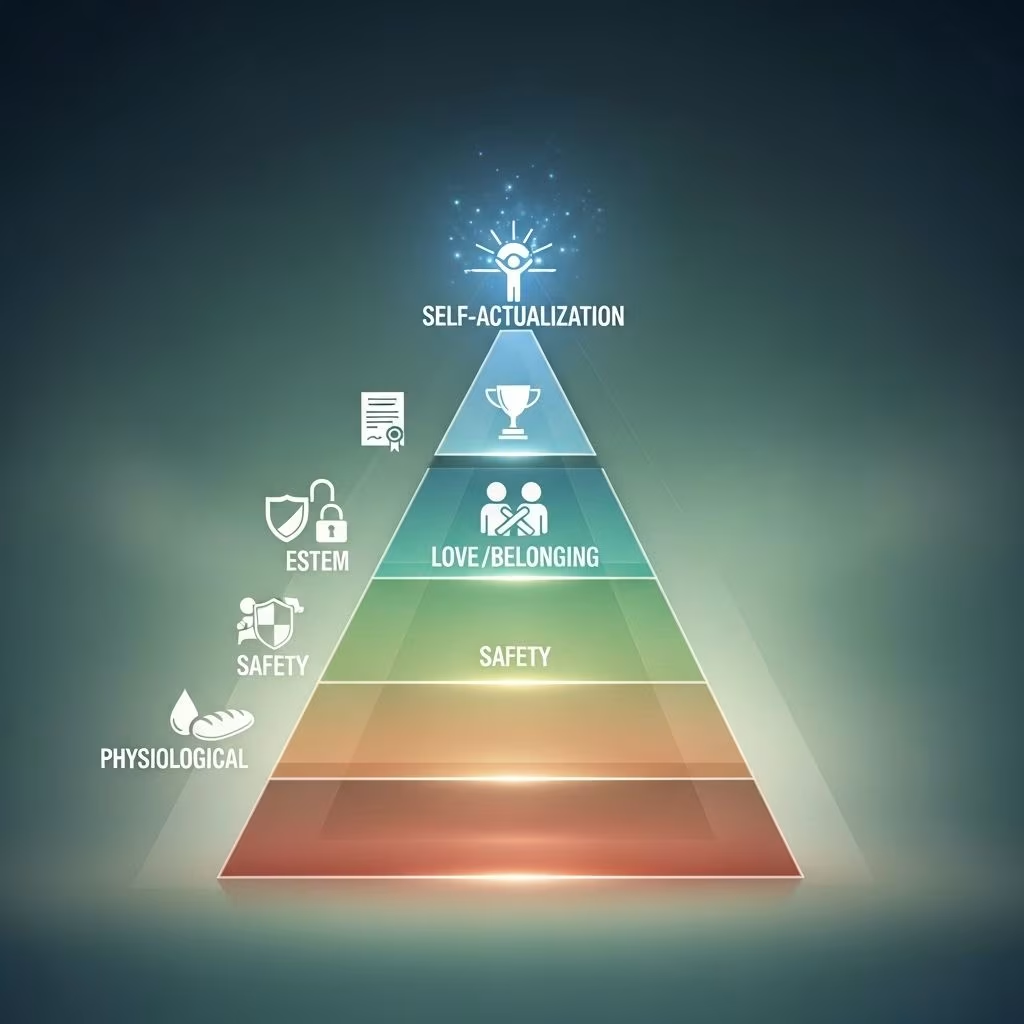
Maslow’s Hierarchy of Needs is one of the most widely recognized frameworks in psychology for understanding human motivation, personal growth, and the factors that drive our daily behaviors. Developed by Abraham Maslow in the mid-20th century, this theory organizes fundamental human needs into a systematic model, often depicted as a pyramid, with each level representing a different set of requirements for well-being and fulfillment.
What Is Maslow’s Hierarchy of Needs?
Abraham Maslow’s Hierarchy of Needs is a five-tiered model proposing that people are motivated to fulfill basic needs before moving on to more complex, psychological ones. The original model consists of the following stages, from most basic to most advanced:
- Physiological Needs
- Safety Needs
- Love and Belongingness Needs
- Esteem Needs
- Self-Actualization
Maslow later proposed additional higher-order needs, such as cognitive, aesthetic, and transcendence needs, though the five classic tiers remain most influential in psychology.
Background and History
Maslow introduced his hierarchy in a 1943 paper titled “A Theory of Human Motivation” and later expanded on it in his 1954 book, Motivation and Personality. Inspired by studying exemplary people and their behaviors—such as Albert Einstein and Eleanor Roosevelt—Maslow sought to understand what drives individuals toward fulfillment and self-growth. He postulated that human needs are organized in a hierarchically ordered system, and that needs at one level must be at least partially satisfied before higher-level needs become motivational drivers.
| Level | Description | Examples |
|---|---|---|
| Physiological | Basic requirements for survival | Food, water, air, shelter, sleep |
| Safety | Protection from harm, stability | Personal security, financial security, health, safe environments |
| Love/Belonging | Social connections, acceptance | Friendships, family, intimacy, group membership |
| Esteem | Respect, self-worth, recognition | Status, achievement, confidence, respect by others |
| Self-Actualization | Realizing personal potential | Personal growth, creativity, fulfilling potential |
Physiological Needs
Physiological needs form the foundation of the pyramid and are the most essential for survival. These include:
- Air and breathing
- Food and water
- Clothing and shelter
- Sleep and rest
- Homeostasis (internal balance)
Until these fundamental needs are adequately met, the human body cannot optimally function, and higher-level motivations will remain out of reach.
Safety Needs
Once physiological needs are reasonably satisfied, the second level concerns safety and security. Safety needs can be physical and emotional and provide the structure and predictability required for continued well-being.
- Personal and physical safety
- Health and well-being
- Financial security (employment, savings)
- Freedom from fear and chaos
- Protection from accidents, injury, or illness
Safety is ensured through reliable family structures, societal systems, law and order, and access to healthcare.
Love and Belongingness Needs
The third tier is the need for love, affection, and social connection. Humans are inherently social beings, and this need encompasses:
- Friendships and peer relationships
- Family bonds and intimacy
- Sensation of community and group acceptance
- Affection, trust, and acceptance from others
When individuals experience social isolation or rejection, it can significantly impact emotional health and well-being. Meeting these needs is crucial for developing self-confidence and a positive self-image.
Esteem Needs
The fourth stage involves esteem needs, which Maslow divided into two distinct categories:
- Esteem for oneself – Self-respect, achievement, independence, mastery
- Esteem from others – Status, recognition, prestige, appreciation
Achieving healthy self-esteem provides a sense of confidence and accomplishment, while unmet esteem needs may lead to feelings of inferiority, weakness, or helplessness.
Self-Actualization
Self-actualization represents the highest level in Maslow’s classic hierarchy. At this stage, individuals are motivated by the desire to reach their fullest potential and achieve personal growth. Characteristics and activities involved in self-actualization include:
- Personal growth and self-fulfillment
- Creativity and innovation
- Pursuit of passions and talents
- Autonomy and authenticity
- Search for meaning and purpose
Notably, self-actualized individuals regularly seek new experiences and realize their values and capabilities. The journey is ongoing, as personal growth does not have a finite endpoint.
Expanded Hierarchy: Cognitive, Aesthetic, and Transcendence Needs
While the five-level model is most widely recognized, Maslow later proposed additional layers:
- Cognitive Needs: Desire for knowledge, understanding, and intellectual exploration.
- Aesthetic Needs: Appreciation for beauty, balance, and form.
- Transcendence Needs: Seeking fulfillment beyond the self, often through altruism, spirituality, or meaningful causes.
These stages reinforce the complex, multi-dimensional nature of human motivation and fulfillment.
Applications of Maslow’s Hierarchy of Needs
Although originally intended as a theory for individual motivation, Maslow’s hierarchy has many practical applications in modern life:
- Education: Educators can better support students’ learning by first addressing their basic and emotional needs.
- Workplace Motivation: Employers often use the hierarchy to design engaging and supportive work environments.
- Mental Health: Therapists consider basic needs when addressing client well-being and development.
- Personal Growth: Individuals use the model for self-assessment and goal-setting.
Criticisms and Limitations
Maslow’s theory has had profound influence but is not without criticism:
- Cultural Bias: The hierarchy may reflect Western, individualistic values and not account for collectivist or communal cultures where social belonging may precede physiological or safety needs.
- Lack of Empirical Rigor: Critics note that the hierarchy is based on clinical observation and biographical studies, rather than systematic scientific evidence.
- Rigid Sequence?: Modern research suggests that individuals may pursue multiple needs simultaneously, and that the order is more flexible than Maslow originally described.
- Exceptions: Some individuals prioritize transcendence, love, or esteem above basic needs depending on circumstances and personal values.
Key Takeaways
- Maslow’s Hierarchy of Needs categorizes human motivations from basic survival to self-actualization.
- Needs at lower levels generally must be at least partially met before higher needs become motivational drivers.
- The hierarchy has influenced fields as varied as psychology, business, education, and health care.
- Despite its utility, critics point out limitations regarding empirical support and cultural applicability.
Frequently Asked Questions (FAQs)
What are the five levels of Maslow’s Hierarchy of Needs?
The five levels are physiological needs, safety needs, love and belongingness needs, esteem needs, and self-actualization.
Do all people follow the hierarchy in the same order?
Not always. Recent research and cultural differences show that people may pursue needs in different orders or even simultaneously, depending on life circumstances and cultural background.
How can Maslow’s hierarchy be applied in education?
Teachers and institutions can use the hierarchy to ensure students’ basic needs are addressed, providing a solid foundation for learning and personal growth.
Is it possible to reach self-actualization?
Self-actualization is a lifelong process. Many individuals experience moments of self-actualization, but continual personal growth and striving are part of the journey.
What are the main criticisms of Maslow’s theory?
Main criticisms include its cultural bias, lack of empirical research, and the assumption that needs must be met in a strict sequence which doesn’t fit every individual’s experience.
Further Reading
- Motivation and Personality by Abraham H. Maslow
- Contemporary Psychology Textbooks
- Articles on motivation and personal development
References
- https://www.simplypsychology.org/maslow.html
- https://people-shift.com/articles/maslows-hierarchy-of-needs/
- https://www.youtube.com/watch?v=O-4ithG_07Q&vl=en
- https://www.ebsco.com/research-starters/psychology/maslows-hierarchy-needs
- https://www.masterclass.com/articles/a-guide-to-the-5-levels-of-maslows-hierarchy-of-needs


