


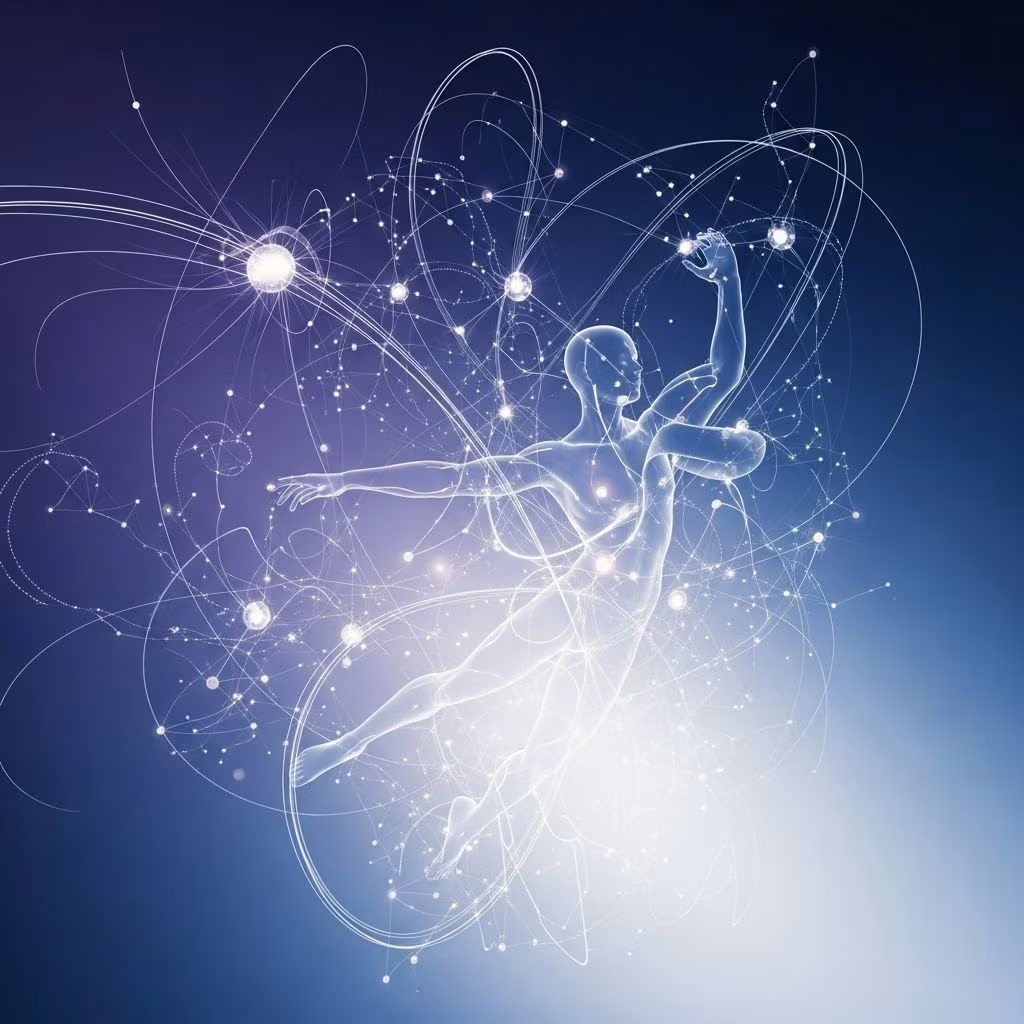
The human ability to move with precision, maintain posture, and perform even the most complex physical actions depends on a subtle yet essential sense known as kinesthesis. Also called the kinesthetic sense, kinesthesis is our awareness of the position and movement of our body parts. This sense enables feats as diverse as walking in the dark, playing musical instruments, or catching a ball without consciously thinking about the motions involved.
What Is Kinesthesis?
Kinesthesis refers to the sensation of movement and body position, allowing us to detect the movements of our limbs, trunk, and overall body without the need for visual cues. Through kinesthesis, we can:
- Sense the position of our arms and legs at any given moment
- Coordinate our movements smoothly
- Engage in complex physical activities like sports, dance, or typing
- Adjust posture or motion to maintain balance
Kinesthesis is sometimes described as “muscle sense” or “muscle memory,” though the actual sensation arises not from muscles storing memories, but from sensory receptors transmitting information to the brain regarding body movement and positioning .
How Kinesthesis Works
The experience of kinesthesis comes from a sophisticated network of receptors embedded in our muscles, tendons, and joints. These specialized sensory organs—proprioceptors—report the length, tension, and position of our muscles and limbs, sending this internal sensory data to the nervous system. Here’s a more detailed breakdown of this physiological process:
- Muscle spindles: These detect changes in muscle fiber length and provide rapid feedback to the brain about the degree and speed of muscle stretch or contraction.
- Golgi tendon organs: Located in the tendons, these sense changes in muscle tension, helping regulate force and prevent injury.
- Joint receptors: Although long assumed to be pivotal, recent research has shown that their role is relatively minor compared to muscle and skin receptors .
- Skin stretch receptors: These contribute feedback on movement and position, particularly when muscles are active or limbs are moving.
- Cerebellum and parietal cortex: Areas of the brain involved in integrating sensory feedback, forming internal predictions of movement, and calibrating ongoing activity according to external and internal cues .
This sensory information is communicated without us needing to focus on it consciously. As a result, kinesthesis operates largely at an unconscious level, guiding movements seamlessly and automatically .
Kinesthesis vs. Proprioception: Key Differences
Kinesthesis and proprioception are closely related terms, often used interchangeably. However, they each have distinct features:
| Aspect | Kinesthesis | Proprioception |
|---|---|---|
| Definition | Sense of movement and awareness of body parts in motion | Sense of position and spatial awareness of the body and effort required for movement |
| Focus | Dynamic (movement, motion awareness) | Static (joint position, posture, force of muscle contraction) |
| Sensory Origins | Muscle spindles, skin receptors, motor command signals | Muscle spindles, joint receptors, Golgi tendon organs |
| Example | Feeling your arm swing as you walk | Knowing where your arm is even when you are not moving it |
Kinesthesis is considered more behavioral, concerned with how your body moves through space, while proprioception is more cognitive, related to the internal sense of your body’s configuration and orientation .
Physiological Mechanisms Behind Kinesthesis
The intricate workings of kinesthesis depend on several key components within the body:
- Muscle Spindles: Sensitive to both changes in length and the velocity at which muscles stretch, they powerfully inform us about limb motion and position. Primary endings in these spindles contribute to sensing both static position and movement, while secondary endings focus more on static position.
- Golgi Tendon Organs: Sense tension rather than length, offering feedback that helps modulate force and maintain safe limits during movement.
- Sensory Pathways: Signals from these receptors travel via peripheral nerves to the spinal cord, then to the brain, where higher processing and integration occur—particularly in the cerebellum and parietal lobes .
- Centrally Generated Motor Commands: Recent findings show that the brain’s own predictions about intended movement also help shape our sense of position—offering an additional layer of awareness during motion .
- Skin Receptors: These provide further input about movement, particularly when stretching occurs during voluntary effort.
This well-coordinated system ensures that we know not only where our limbs are, but how fast and in what direction we are moving them.
Practical Significance of Kinesthesis
Kinesthesis is vital to daily life. It underlies our:
- Motor coordination: Kinesthesis allows us to move smoothly and with control, whether brushing teeth or riding a bike.
- Learning new skills: Repetitive practice of physical actions (like piano or sports maneuvers) develops kinesthetic memory, enabling actions to become automatic over time .
- Balance and posture: By continuously informing the nervous system about the position and motion of body parts, kinesthesis is essential for standing upright or walking with stability.
- Performance in sports and the arts: Athletes, dancers, and musicians rely on refined kinesthetic senses to perfect routines, complex movements, and sequences.
- Reaction to environmental changes: Kinesthesis allows quick, automatic responses, such as regaining balance on an uneven sidewalk or catching a falling object reflexively.
Loss or impairment of kinesthesis—due to nerve injuries, neurological disorders, or accidents—can lead to severe movement and coordination difficulties, making even simple actions (walking, reaching, or holding objects) challenging.
Examples of Kinesthesis in Action
Kinesthetic awareness is on display everywhere:
- Walking in the dark: Despite not seeing your legs, you can walk straight and avoid stumbling, thanks to feedback from kinesthetic receptors.
- Typing on a keyboard: Experienced typists move their fingers quickly and smoothly, rarely looking at the keys.
- Playing an instrument: Musicians play complex sequences with their hands or feet without watching their limbs.
- Dancing: Dancers memorize and repeat sequential body movements, often in time with music, which requires precise kinesthetic feedback.
- Sports performance: Athletes learn to execute movements (like throwing, swinging, or leaping) through repetition and muscle memory, which are kinesthetically encoded.
Kinesthetic Learning and Its Role in Education
Some individuals excel when learning involves movement—these are known as kinesthetic learners. This learning style favors hands-on activities, role-playing, building models, and physically engaging with subject material .
Characteristics of kinesthetic learners:
- Remember things better when physically active during learning
- Enjoy hands-on problem-solving or building
- Prefer demonstrations, field trips, or interactive experiments
- Often have trouble sitting still for extended periods
Teachers can incorporate kinesthetic activities—such as acting out scenes, using educational games, or integrating movement-based breaks—to support these learners.
Kinesthesis, Vestibular Sense, and Proprioception: How They Interact
Kinesthesis works closely with the vestibular system (located in the inner ear, responsible for balance and spatial orientation) and the broader proprioceptive system. Together, these senses enable us to:
- Navigate the environment safely
- Maintain posture and equilibrium
- React accurately to internal and external forces
For example, stepping off a curb activates the vestibular system (balance), helps you sense limb positioning (proprioception), and guides foot placement (kinesthesis).
Disorders and Impaired Kinesthesis
Various conditions can affect kinesthetic sense, including:
- Peripheral neuropathy: Damage to nerves supplying muscles and joints may dull kinesthetic feedback.
- Neurological diseases: Conditions like Parkinson’s disease, stroke, or multiple sclerosis can disrupt internal communication, affecting kinesthetic sensation.
- Muscle or joint injury: Trauma may dampen or distort the sensory input from the affected regions.
Symptoms can include unsteady gait, clumsiness, difficulty coordinating motions, or needing vision to guide movement previously performed without looking.
Frequently Asked Questions (FAQs) About Kinesthesis
Q: Is kinesthesis the same as muscle memory?
A: No, while “muscle memory” describes the automatic recall of movement patterns through practice, the sensation itself is created by kinesthetic feedback loops between muscles, nerves, and the brain .
Q: Can you lose your sense of kinesthesis?
A: Yes, neurological conditions, nerve injury, and some diseases can impair kinesthesis, leading to difficulties in coordination and balance.
Q: How is kinesthesis tested clinically?
A: Clinicians may ask patients to move limbs with eyes closed or match limb positions between sides of the body to detect impairment in kinesthetic feedback.
Q: How does kinesthesis differ from proprioception?
A: Kinesthesis is more concerned with movement perception, whereas proprioception is about the body’s position and orientation in space .
Q: Why is kinesthesis important in sports?
A: It allows athletes to perfect complex movement sequences with speed and precision, contributing to elite performance without relying solely on vision.
Summary Table: Key Features of Kinesthesis
| Function | Main Biological Basis | Everyday Relevance |
|---|---|---|
| Sensing movement of limbs and body parts | Muscle spindles, Golgi tendon organs, skin receptors | Walking, sports, typing |
| Maintaining coordination and posture | Integration in brain (cerebellum, parietal cortex) | Standing upright, balancing |
| Learning new motor skills | Repetitive practice, sensory feedback, neural adaptation | Dancing, playing instruments |
Conclusion
The kinesthetic sense plays a foundational role in nearly every voluntary movement we make, operating largely beneath our awareness but enabling the fluid execution of tasks that define our physical existence. Understanding kinesthesis therefore not only enriches our appreciation of human sensory complexity but also reveals the marvels of coordinated action in both routine and extraordinary activities.
References
- https://en.wikipedia.org/wiki/Kinaesthetics
- https://fiveable.me/key-terms/introduction-brain-behavior/kinesthesia
- https://pmc.ncbi.nlm.nih.gov/articles/PMC2754351/
- https://pressbooks.umn.edu/sensationandperception/chapter/kinesthesia-and-prorioception/
- https://study.com/academy/lesson/vestibular-and-kinesthetic-senses.html
- https://www.britannica.com/science/kinesthesis
- https://www.simplek12.com/blog/kinesthetic-learning-style
- https://pubmed.ncbi.nlm.nih.gov/29978899/
- https://www.turkishkinesiology.com/index.php/ahe/article/download/3/3/13


