


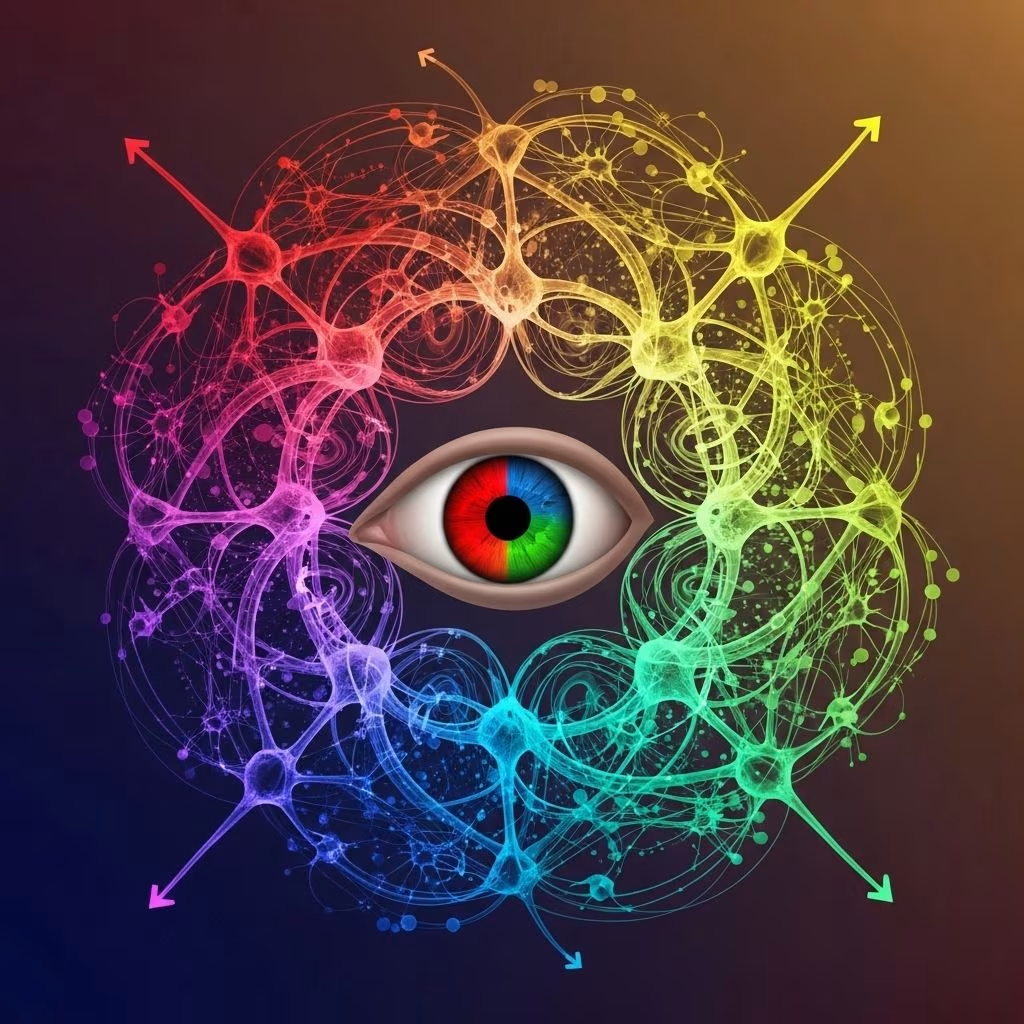
Understanding the Opponent Process Theory of Color Vision
The opponent process theory of color vision is a foundational explanation in psychology and neuroscience that describes how human beings perceive and differentiate colors using opposing neural mechanisms. First proposed by German physiologist Ewald Hering in the late nineteenth century, this theory has shaped our understanding of visual perception and finds broad applications in both science and industry.
What is the Opponent Process Theory?
The opponent process theory suggests that color perception is controlled by three opposing systems within our visual system. Each system is organized into opposing pairs, allowing us to perceive a wide range of colors while never experiencing certain color combinations simultaneously. According to Hering, these opponent color pairs are:
- Red versus green
- Blue versus yellow
- Black versus white (luminance channel)
This means you cannot see colors like reddish-green or yellowish-blue because the visual system suppresses one color in the pair when the other dominates. For example, when red is active, green is inhibited, and vice versa. This antagonistic relationship is the core mechanism of the theory.
Historical Background: Hering’s Challenge to Helmholtz
Before Hering introduced his theory, Hermann von Helmholtz’s trichromatic theory dominated scientific understanding of color vision. Helmholtz’s model proposed that three types of cone photoreceptors—sensitive to red, green, and blue light—combine to produce every perceivable color. Hering disputed this view, arguing that color vision was not just about mixing wavelengths but rather about pairs of opposing colors. While the trichromatic theory explained cone activity, Hering’s opponent process theory explained how the brain interprets those signals to create the full spectrum of perceived color.
How Does the Opponent Process Theory Work?
The theory posits that our eyes and brain process color using three opponent channels:
- Red–Green Channel: Detects variations between red and green but never both maximally at once.
- Blue–Yellow Channel: Detects variations between blue and yellow with similar exclusivity.
- Black–White Channel: Responsible for lightness (luminance) differences, corresponding to how we see black and white changes.
Color information begins with the cones in the retina, specialized photoreceptor cells that respond to different wavelengths. There are three types of cones:
- Short-wavelength cones (S-cones): Most sensitive to blue light
- Medium-wavelength cones (M-cones): Most sensitive to green light
- Long-wavelength cones (L-cones): Most sensitive to red light
Signals from these cones are then transmitted to retinal ganglion cells, which encode the information as differences between the opponent pairs. This antagonistic processing helps explain why we cannot perceive colors like “greenish-red.” The concept also aligns with how colors are cancelled out or enhanced during perception.
Supporting Evidence: The Afterimage Experiment
A classic demonstration of the theory is the afterimage effect:
If you stare intently at a colored shape—for example, a bright red square—for about 20–30 seconds and then quickly shift your gaze to a white sheet, you’ll see a fleeting image in the opponent color (in this case, green). This occurs due to cone fatigue. The cones sensitive to red become temporarily desensitized, and the opponent green channel, which is no longer suppressed, becomes visually prominent.
Steps for testing the effect:
- Place a small white square at the center of a colored square (red, green, yellow, or blue) on a white sheet of paper.
- Stare at the white square for 20–30 seconds without shifting your gaze.
- Quickly look away to a blank white sheet and blink.
- Observe the color of the afterimage, which will appear in the opponent hue (e.g., staring at a red square yields a green afterimage).
This experiment underscores Hering’s proposal that color vision is processed through opposing mechanisms. The phenomenon is temporary, and the original cones recover within several seconds.
Comparison Table: Opponent Process Theory vs. Trichromatic Theory
| Feature | Opponent Process Theory | Trichromatic Theory |
|---|---|---|
| Originator | Ewald Hering (late 19th century) | Hermann von Helmholtz (mid 19th century) |
| Mechanism | Opposing pairs of channels (red-green, blue-yellow, black-white) | Three cone photoreceptors (red, green, blue) |
| Explains Afterimages | Yes | No |
| Explains Color Blindness | Yes (e.g., why certain color pairs can’t be seen simultaneously) | Partially (explains at cone level) |
| Level of Analysis | Neural mechanisms & perception | Retinal receptor response |
| Limitations | Not a direct map to cone physiology | Cannot explain all perceptual phenomena |
Physiological and Psychological Relevance
The opponent process theory bridges gaps between physiology and psychology. Physiologically, it aligns with the way retinal and neural circuits are organized. Psychologically, it explains perceptual phenomena such as afterimages and why we recognize contrast between certain colors more readily. However, modern research notes that the neural basis is more complex than Hering originally described. While behavioral evidence supports the concept, biology reveals a combination of both theories in actual human vision. Cones respond individually to light of different wavelengths (trichromatic theory), but signals are then organized and interpreted by opponent neurons (opponent process theory).
Applications and Real-World Examples
The implications of the opponent process theory extend beyond academia:
- Design and Art: Designers use color pairs from opposite channels (e.g., orange-blue, red-green) to create vibrant, harmonious color palettes that are visually accessible.
- Color Blindness: The theory explains why red-green and blue-yellow are the two major forms of color blindness. If one channel is non-functional, the individual cannot distinguish between those paired colors.
- Visual Technology: Modern screen and print technologies use knowledge of opposing colors to calibrate displays and produce vivid images.
Opponent Process Theory in Emotional Response
Interestingly, the concept extends to emotions as well. Richard Solomon expanded the theory in the twentieth century to describe how strong emotions, when experienced repeatedly, produce an opposite or balancing emotion over time. For instance, the rush of fear from skydiving may be followed by intense relief or pleasure. This dual-process model helps explain why intense positive or negative states are often followed by opposite emotional aftereffects.
Common Misconceptions and Limitations
- Not all color phenomena are explained solely by opponent processing. The integration of both trichromatic and opponent models is necessary for a full understanding of human color vision.
- Modern science has clarified neural mechanisms. Originally, Hering’s theory was psychological, but subsequent research has partially mapped opponent processing to specific neurons and circuits in the retina and brain.
Frequently Asked Questions (FAQs)
What is the opponent process theory of color vision?
This theory states that color perception is controlled by three pairs of opposing channels: red-green, blue-yellow, and black-white. Each pair acts antagonistically, so one color inhibits the perception of the other in the same channel.
Who developed the opponent process theory?
The theory was proposed by German physiologist Ewald Hering in the late 1800s as a challenge to the prevailing trichromatic model by Helmholtz.
How is the opponent process theory different from the trichromatic theory?
While the trichromatic theory focuses on three cone types (red, green, blue) that combine signals to create the perception of color, the opponent process theory describes how the brain organizes these signals into opposing color channels, explaining phenomena like afterimages and certain forms of color blindness.
What are afterimages and how do they relate to this theory?
An afterimage is a visual impression that persists after the original stimulus has been removed. According to the opponent process theory, afterimages appear in the opponent color (e.g., green after staring at red) due to temporary fatigue of the cones responding to the original color.
Does the theory explain all color vision phenomena?
No single theory explains all aspects of color vision. Scientists now recognize that both trichromatic processes (at the photoreceptor level) and opponent processes (at the neural level) work together to produce our full spectrum of color perception.
References
- Healthline: Opponent Process Theory of Color Vision
- Wikipedia: Opponent Process
- Cantor’s Paradise: Opponent Process Theories of Color Vision
- Social Science Explainer (YouTube): Opponent Process Theory Video
- Pressbooks (UMN): Tri-chromatic vs. Color Opponent Processing
References
- https://www.healthline.com/health/opponent-process-theory
- https://en.wikipedia.org/wiki/Opponent_process
- https://www.youtube.com/watch?v=DO0kTNxEFrs
- https://www.youtube.com/watch?v=zAXVgl7SDJk
- https://www.cantorsparadise.com/opponent-process-theories-of-color-vision-6dfe6c6a1ca0
- https://pressbooks.umn.edu/sensationandperception/chapter/tri-chromatic-vs-color-opponent-processing/


