


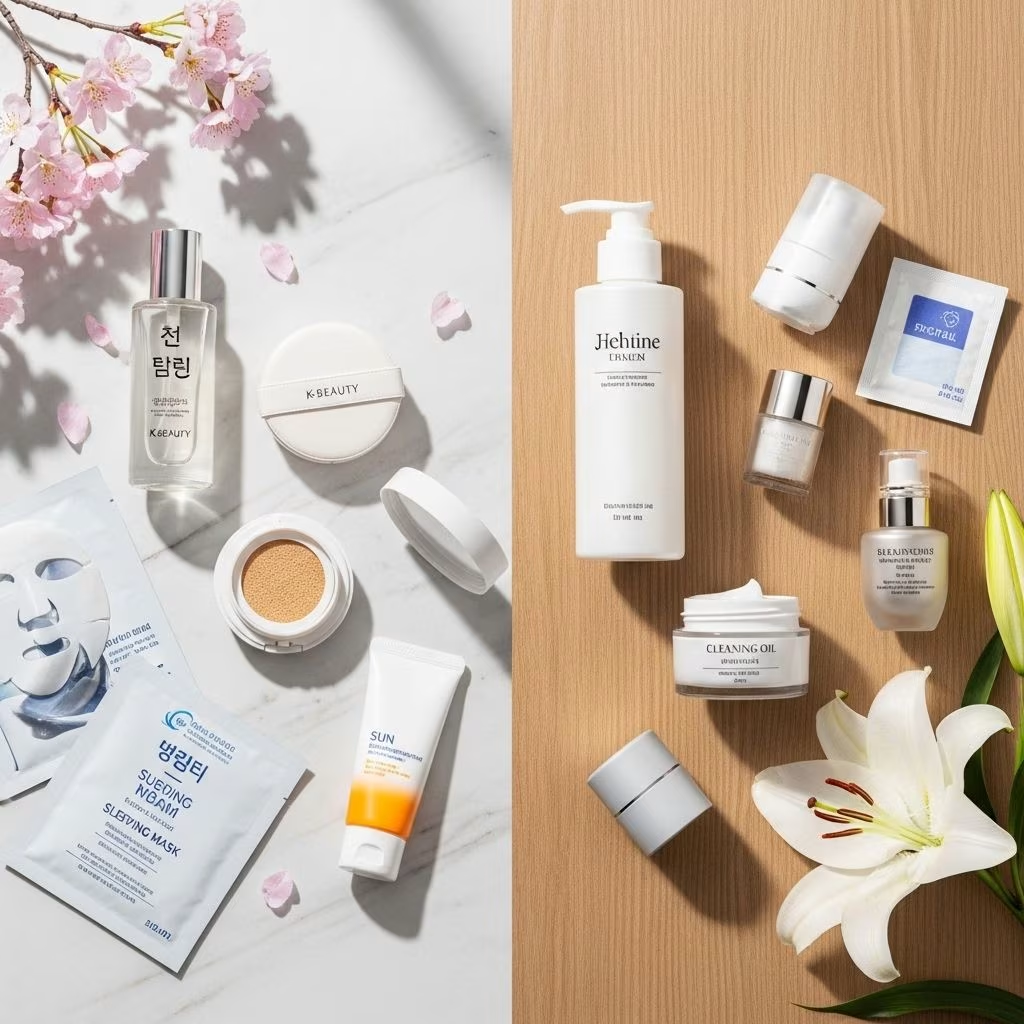
When it comes to beauty, few regions command as much respect or stir as much curiosity as South Korea and Japan. Over the past decade, K-Beauty and J-Beauty have redefined skincare worldwide. But what truly sets them apart, and which philosophy is right for you? This ultimate guide breaks down the essential differences, similarities, and tips so you can make the best decision for your skincare journey.
Introduction: Why K-Beauty and J-Beauty?
The world is captivated by the youthful glow and smooth complexion of individuals from Korea and Japan. Global interest in their time-honored beauty traditions has skyrocketed as both regions regularly innovate and launch trending skincare products. While both emphasize prevention, hydration, and sun protection, their approaches are distinct—offering different experiences, results, and philosophies for skincare enthusiasts.
Philosophy: The Heart of K-Beauty and J-Beauty
K-Beauty Philosophy: ‘More is More’
Korean beauty is defined by meticulous routines, continuous innovations, and a playful yet scientific exploration of new ingredients and formats. The multi-step ritual is designed to maximize radiance—particularly the signature ‘glass skin’ look, characterized by dewy, poreless, and translucent skin. K-Beauty:
- Embraces innovation and trends, quickly adapting to new skincare technologies.
- Promotes customization with a wide range of products for different skin types and concerns.
- Is rooted in the belief that consistent layering delivers optimal results.
- Encourages playfulness and experimentation in routines.
J-Beauty Philosophy: ‘Less is More’
Japanese beauty favors a minimalist approach, upholding a tradition of quality, simplicity, and long-term skin health. Inspired by the notion of Bihada (beautiful skin), the goal is sustained radiance achieved with a few, carefully chosen steps. J-Beauty:
- Prioritizes functionality and simplicity over trends.
- Focuses on quality over quantity, using fewer products but with highly effective, time-tested ingredients.
- Emphasizes gentle care and supports the skin’s natural barrier.
- Seeks long-term results—the skin care marathon rather than a sprint.
Routine Comparison: Steps and Structure
| Aspect | K-Beauty | J-Beauty |
|---|---|---|
| Routine Length | Typically 7-10 steps or more | Usually 3-5 steps |
| Main Principle | Layering for comprehensive care | Minimalism; letting each product shine |
| Daily Focus | Multiple concerns, hydration, and glow | Barrier support, gentle hydration, sun protection |
| Product Texture | Lightweight gels, serums, sheet masks | Soft cleansers, watery lotions, lightweight essences |
K-Beauty Routine: A Step-by-Step Look
- Oil Cleanser: Removes makeup and sunscreen.
- Foam/Water-Based Cleanser: Double-cleansing to leave skin fresh.
- Exfoliator: Gentle acids or scrubs, used 1-2 times per week.
- Toner: Balances pH and hydrates.
- Essence: Lightweight hydration boost—a signature K-Beauty step.
- Serum/Ampoule: Targets concerns (e.g., dark spots, acne, dehydration).
- Sheet Mask: Gives intense hydration (often 2-4 times/week).
- Eye Cream: Addresses puffiness, dark circles.
- Moisturizer: Seals in all previous layers.
- Sunscreen (AM routine): Vital for daily protection.
While not all steps are daily for everyone, the routine is customizable and often includes numerous products for layering maximum benefits.
J-Beauty Routine: The Elegant 4-Step Approach
- Double Cleanse: Start with oil-based, followed by a gentle water-based cleanser.
- Lotion/Essence: Hydrating, lightweight texture to prep skin.
- Treatment/Serum: Targeted formulas, if needed.
- Sun Protection: Sunscreen is never skipped in the morning.
Moisturizers are used as needed, but the focus remains on core steps executed with discipline and care, minimizing irritation and streamlining for efficiency.
Key Ingredients & Formulation Principles
K-Beauty Ingredients and Innovations
- Snail mucin: Helps repair and soothe skin.
- Fermented extracts: Supports skin barrier and glow (saccharomyces, galactomyces).
- Centella asiatica: Soothes irritation.
- Niacinamide: Brightens and evens skin tone.
- Hydrogel, jelly, and sheet mask formats for essence delivery.
- Innovative sunscreen textures (watery, no white cast).
K-Beauty excels in cutting-edge formulas, creative packaging, and a willingness to experiment with new active ingredients inspired by both nature and science.
J-Beauty Ingredients: Simplicity Meets Efficacy
- Rice bran and rice ferment (sake): Known for brightening and moisturizing.
- Camellia oil: Deeply nourishing, antioxidant-rich.
- Green tea extract: Potent antioxidants against pollution and inflammation.
- Minimalist, short ingredient lists: Lower risk of irritation, suitable for sensitive skin.
J-Beauty places great value on time-tested ingredients, many of which are botanically derived and have been used for centuries in Japanese culture. The philosophy is to avoid unnecessary additives and prioritize skin’s natural health for the long-term.
Cultural Influences and Skin Ideals
| Influence | K-Beauty | J-Beauty |
|---|---|---|
| Cultural Ideal | ‘Glass skin’—dewy, shiny, glowing | ‘Moist, smooth skin’—natural, healthy, long-term radiance |
| Heritage | Mix of traditional and pop culture influences (K-pop, celebrity trends) | Rooted in tradition—Zen, minimalism, seasonal approach |
Japanese skincare reflects a reverence for simplicity, nature, and routine. This is mirrored in their architecture, cuisine, and daily life. Korean skincare is more trend-driven and dynamic, heavily influenced by pop culture and media, striving to help consumers achieve the luminous skin seen on idols and celebrities.
Popular Products and Brands
Must-Try K-Beauty Products & Brands
- Laneige Water Sleeping Mask: Iconic for overnight hydration and glow.
- Missha Time Revolution First Treatment Essence: Fermented essence for moisture and clarity.
- Cosrx Advanced Snail 96 Mucin Power Essence: For barrier repair and soothing.
- Dr. Jart+ Cicapair Tiger Grass Cream: Calms redness, strengthens skin.
- Innisfree Green Tea Seed Serum: Light, antioxidant-rich hydration.
Must-Try J-Beauty Products & Brands
- SK-II Facial Treatment Essence: Legendary for smooth, luminous skin (Pitera as hero ingredient).
- Hada Labo Gokujyun Hydrating Lotion: Hydrates with multiple weights of hyaluronic acid.
- DHC Deep Cleansing Oil: Classic oil cleanser based on olive oil.
- Shiseido Ultimune Power Infusing Concentrate: Fortifies skin, boosts resilience.
- Senka Perfect Whip Cleanser: Iconic Japanese foam cleanser.
Which is Right for You?
There is no universal answer—both philosophies offer unique advantages. Your choice may depend on:
- Time & Lifestyle: Prefer a simple, quick routine? Try J-Beauty. Enjoy detailed, pampering rituals? K-Beauty may fit you.
- Skin Concerns: Layering in K-Beauty may address multiple issues at once. Sensitive skin may prefer J-Beauty’s minimalism.
- Budget: J-Beauty’s focus on premium, fewer steps can lead to higher per-product cost, while K-Beauty’s array may allow experimentation at lower prices per item.
- Desired Results: Rapid visible improvements and fun product variety = K-Beauty. Sustainable, long-term improvement with less risk of irritation = J-Beauty.
Remember: There are no hard rules! Many people mix and match steps from both traditions to create a custom routine that fits their skin’s changing needs throughout the year.
Frequently Asked Questions (FAQs)
Q: Can I combine K-Beauty and J-Beauty in one skincare routine?
A: Yes, blending elements from both can yield excellent results. Just be mindful to avoid product overload, and always introduce new items gradually, especially if you have sensitive skin.
Q: Is K-Beauty always about 10 steps?
A: Not necessarily. While 7–10 steps is iconic, routines are easily customized. Many people adapt K-Beauty to just 4–6 steps based on time and preference.
Q: Which approach is better for aging skin?
A: Both address aging concerns well, but J-Beauty’s focus on barrier health and gentle hydration is particularly suited for mature, sensitive skin. K-Beauty serums and treatments also target anti-aging with diverse actives.
Q: Are the products safe for all skin types?
A: Both K-Beauty and J-Beauty offer products for every skin type. J-Beauty often excels for sensitive skin due to its minimalist, gentle formulas.
Q: Why is sunscreen so important in both routines?
A: Sun damage is the leading cause of premature aging, pigmentation, and skin cancer. Both Korean and Japanese skincare stress daily sunscreen as the final step in any AM routine for all-around skin health.
Summary Table: K-Beauty vs J-Beauty
| Feature | K-Beauty | J-Beauty |
|---|---|---|
| Routine Steps | Multi-step (7-10 steps, customizable) | Minimal (3-5 steps) |
| Product Focus | Innovation, layering, trend-driven | Simplicity, quality, tradition-driven |
| Key Ingredients | Snail mucin, fermented blends, cica | Rice extract, camellia oil, green tea |
| Suitable For | Those who enjoy experimentation, rapid trends | Those who want minimalism and gentle, long-term results |
| Cultural Roots | K-pop, innovation, celebrity inspiration | Wabi-sabi, nature, simplicity, Zen |
| Sunscreen Role | Essential, with innovative new formulas | Central, premium textures and UV protection |
| Popular Brands | Laneige, Innisfree, Cosrx, Dr. Jart+ | SK-II, Shiseido, Hada Labo, DHC |
In summary: K-Beauty dazzles with novelty and customizable routines, while J-Beauty impresses through quiet refinement and a commitment to long-term, sustainable skin health. Whichever you choose—or if you combine both—embrace the consistent use of sunscreen and gentle hydration as your foundation for beautiful skin.
References
- https://www.dermstore.com/blog/j-beauty-vs-k-beauty/
- https://buymejapan.com/blogs/japanese-skincare-and-beauty/korean-vs-japanese-skincare-unveiling-top-differences
- https://www.cassandrabankson.com/blogs/latest/j-beauty-and-k-beauty-can-they-be-compared
- https://www.eyurs.com/blogs/beauty/japanese-vs-korean-skincare-what-s-the-difference
- https://shikobeauty.com/blogs/culture/whats-the-difference-between-k-beauty-and-j-beauty-skincare
- https://www.youtube.com/watch?v=WWluJo959ms
- https://japanesetaste.com/blogs/japanese-taste-blog/japanese-vs-korean-skincare-what-s-the-difference
- https://wellconnected.murad.com/podcast/j-beauty-vs-k-beauty-do-you-know-the-differences-you-really-should/


