


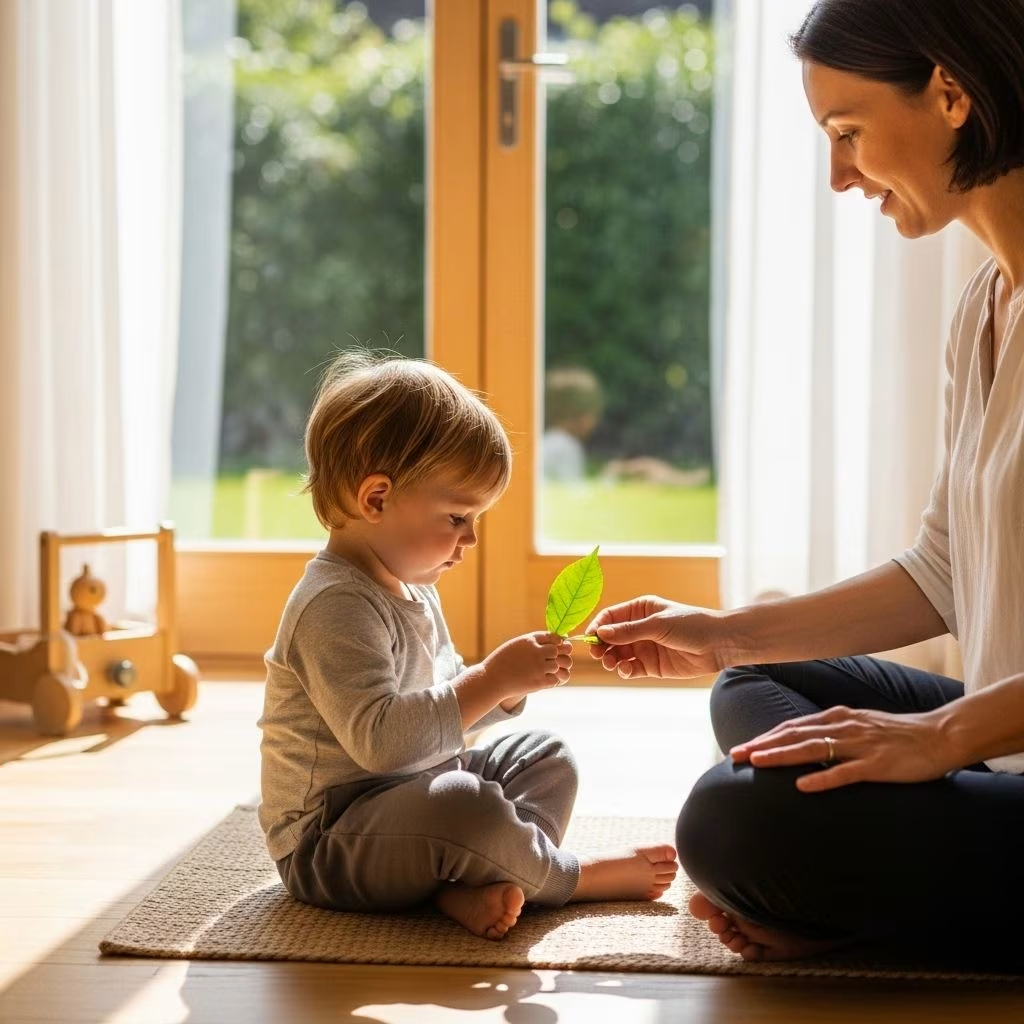
Mindfulness—the practice of bringing focused, nonjudgmental awareness to the present moment—has gained widespread traction as a beneficial tool for emotional regulation, stress management, and social-emotional learning. As education systems and families increasingly consider introducing mindfulness to ever-younger children, significant ethical questions arise. This article provides a thorough examination of the ethical landscape surrounding the teaching of mindfulness to toddlers, aiming to empower parents, educators, and policymakers with knowledge, practical guidance, and clear boundaries for best practice.
Introduction to Mindfulness in Early Childhood
In recent years, mindfulness has become a cornerstone of many school-based programs and parenting strategies. This interest extends to early childhood—particularly the toddler years (ages 1-3)—motivated by research showing potential improvements in self-regulation, empathy, and social-emotional competency. However, empirical evidence for mindfulness with children under age four remains limited, making ethical considerations especially prominent for this formative age group.
Potential Benefits and Implementation Challenges
Studies in preschool-aged children (typically 3-5 years old) have reported outcomes such as improved emotional regulation and prosocial behavior following short-term mindfulness interventions. Example activities include mindful breathing, listening to bells, gentle movement, and mindful eating. While these findings are promising, several implementation challenges and potential risks emerge when considering toddlers:
- Limited cognitive and emotional maturity—Toddlers have developing attention spans and may not be able to engage with mindfulness concepts as intended for older children.
- Lack of robust, age-specific research—Most empirical data involve preschoolers, not toddlers, leaving a gap in evidence regarding efficacy and safety for the youngest children.
- Varied educator understanding and training—Teachers and caregivers may struggle with adapting mindfulness techniques to toddler developmental levels.
Core Ethical Principles in Teaching Mindfulness
Across the literature and professional guidelines, several ethical principles are repeatedly emphasized:
- First, do no harm—Preventing physical, psychological, social, and cultural harm to children must be the highest priority.
- Clarity of intention and transparency—Teachers must be clear about their motivations and the abilities of their methods; avoiding hidden agendas or introducing religious/philosophical content without consent is essential.
- Respect for autonomy—Supporting a child’s (and family’s) ownership of the learning process, including voluntary participation and freedom to opt out.
- Competence and responsibility—Teachers should practice within the limits of their expertise and follow codes of ethical conduct.
- Equity and access—Ensuring that mindfulness is offered inclusively, respecting diversity and cultural backgrounds.
The Developmental Context: Understanding Toddlers
At ages 1-3, children are rapidly developing language, motor skills, and emotional awareness—but they are also highly variable in attention, impulse control, and self-expression. These realities present unique challenges:
- Concrete thinking—Toddlers are literal thinkers, and abstract concepts like \”present moment awareness\” are outside their grasp.
- Short attention spans—Mindfulness activities must be short, playful, and sensory-focused to engage meaningfully.
- Reliance on adult modeling—Children at this age learn best through observation and imitation, so the teacher’s own mindful presence is the most impactful lesson.
Ethically, mindfulness for toddlers must be developmentally attuned and delivered in ways that honor their “here and now” perspective, rather than attempting to impose discipline or introspection beyond their years.
Informed Consent and Parental Involvement
Because toddlers cannot provide true informed consent, obtaining clear and ongoing parental (or guardian) consent is non-negotiable. Best practices include:
- Explaining the nature, purpose, and activities of mindfulness sessions to parents in simple, transparent language.
- Clarifying that children’s participation is always voluntary, with the right to withdraw at any time.
- Inviting parents to observe or participate, which reinforces alignment between home and educational settings and builds trust.
Disregarding parental concerns or neglecting consent undermines trust, can lead to inadvertent harm, and is ethically indefensible.
Teacher Competence and Training
Due to the sensitive and formative nature of early childhood, teachers introducing mindfulness to toddlers should meet specific competence and preparation standards:
- Personal mindfulness practice—Educators with their own mindfulness practice model calmness and present-moment awareness, facilitating a more authentic experience for children.
- Formal training in child development and mindfulness pedagogy—Understanding both the practice and the unique needs of toddlers is essential.
- Ongoing supervision and professional development—To ensure ethical practice, mitigate biases, and allow for reflective learning.
Risks increase dramatically when under-trained facilitators introduce practices they don’t fully understand or cannot adapt to the toddler context.
Adaptation and Cultural Sensitivity
Mindfulness has its roots in diverse religious and secular traditions, and families may have concerns about unwanted philosophical, spiritual, or cultural influences. To navigate these issues ethically:
- Clearly separate mindfulness activities from religious content unless families are explicitly informed and consenting.
- Design activities (such as mindful listening, movement, or sensory play) to be accessible and meaningful to families from all backgrounds.
- Affirm cultural variations in approaches to attention, self-regulation, and emotional expression.
Minimizing Harm, Maximizing Benefit
Mindfulness should never cause additional distress or disadvantage to toddlers. Key precautions include:
- Activity design: Use short, engaging, playful activities appropriate to age (e.g., gentle breathing, paying attention to sounds, mindful movement, playful sensory experiences).
- Monitoring for adverse reactions: Be alert for signs of distress, boredom, confusion, or withdrawal during activities and be ready to stop any session promptly.
- Individual differences: Respect each child’s temperament and readiness. There is no “one size fits all” approach; forced participation is never appropriate.
- Safe environment: Maintain adequate adult-to-child ratios and always ensure physical and psychological safety during sessions.
Privacy and Confidentiality
Although toddlers are unlikely to share personal information intentionally, mindfulness sessions may open up emotional expression or reveal vulnerabilities. Ethical precautions include:
- Never sharing observations about a child’s behavior during mindfulness sessions with unauthorized individuals.
- Documenting any concerning disclosures (e.g., about stress or trauma) using established protocols, without breaching confidentiality unless required by law or safeguarding standards.
Practical Guidelines and Recommendations
| Ethical Guideline | Key Implications for Toddlers |
|---|---|
| Do No Harm | Activities must be safe, enjoyable, and developmentally appropriate. |
| Informed Parental Consent | Parents are fully briefed and involved in decision-making and follow-up. |
| Teacher Competence | Only practitioners with relevant training and personal mindfulness practice should lead sessions. |
| Voluntary Participation | Children’s engagement is never forced; opting out is always allowed. |
| Cultural Sensitivity | Mindfulness content is secular, accessible, and respectful of family backgrounds. |
| Confidentiality | Children’s emotional disclosures are handled with care and according to best safeguarding practices. |
Summary of Practical Steps:
- Choose brief, playful, sensory-based activities (e.g., singing bowls, soft breathing, mindful movement, tactile play).
- Model mindfulness rather than instructing it formally.
- Seek and maintain informed parental involvement.
- Monitor for signals of distress and adapt or discontinue practices as necessary.
- Undertake ongoing ethics training and reflective supervision.
Frequently Asked Questions (FAQs)
Q: Is teaching mindfulness to toddlers safe?
A: When adapted to the child’s developmental level and led by competent adults, brief, playful mindfulness activities can be safe and beneficial. However, ongoing vigilance for distress and robust parental involvement are essential safeguards.
Q: What are the biggest risks of teaching mindfulness to very young children?
A: Main risks include emotional confusion, disengagement from forced participation, and misunderstandings due to developmental limitations. Inadequate teacher training or lack of parental consent also pose ethical dangers.
Q: Can mindfulness practice conflict with a family’s culture or religion?
A: Yes, some mindfulness techniques or explanations may be viewed as religious or philosophically inappropriate by some families. All mindfulness offerings for toddlers should be delivered in a secular, culturally respectful way and with open family communication.
Q: What types of mindfulness activities are most appropriate for toddlers?
A: Sensory-based, physically active, short, and playful activities—such as following sounds, mindful movement, or focused breathing with visual cues—are most suitable.
Q: Does a teacher need special certification to teach mindfulness to toddlers?
A: While formal certification is not universally required, specialized training in both mindfulness practices and child development, as well as ongoing supervision, is strongly recommended for ethical and safety reasons.
Conclusion
Introducing mindfulness to toddlers offers potential benefits but must always be grounded in carefully considered ethical practice. The intersection of early development, family values, and educator competence creates a landscape where thoughtful planning, transparency, and ongoing reflection are non-negotiable. By following best practices—grounded in ‘do no harm’, informed parental consent, child-centered pedagogies, and cultural humility—we can maximize the benefits of mindfulness for the youngest learners, while minimizing the risks and honoring the trust placed in teachers and caregivers. As research and practice continue to evolve, so too must our ethical vigilance and care.
References
- https://susankaisergreenland.com/blog/2018/5/8/seven-ethical-guidelines-for-teaching-mindfulness-to-children-and-families-by-chris-willard
- https://unifiedmindfulness.com/ethical-guidelines-2/
- https://www.tandfonline.com/doi/full/10.1080/1350293X.2025.2453867
- https://pmc.ncbi.nlm.nih.gov/articles/PMC11000349/
- https://www.opa.org/index.php?option=com_content&view=article&id=202%3Apracticing-mindfulness-without-a-mindfulness-practice&catid=26%3Anewsletters&Itemid=130
- https://www.buddhistinquiry.org/article/teaching-mindfulness-to-children/


