


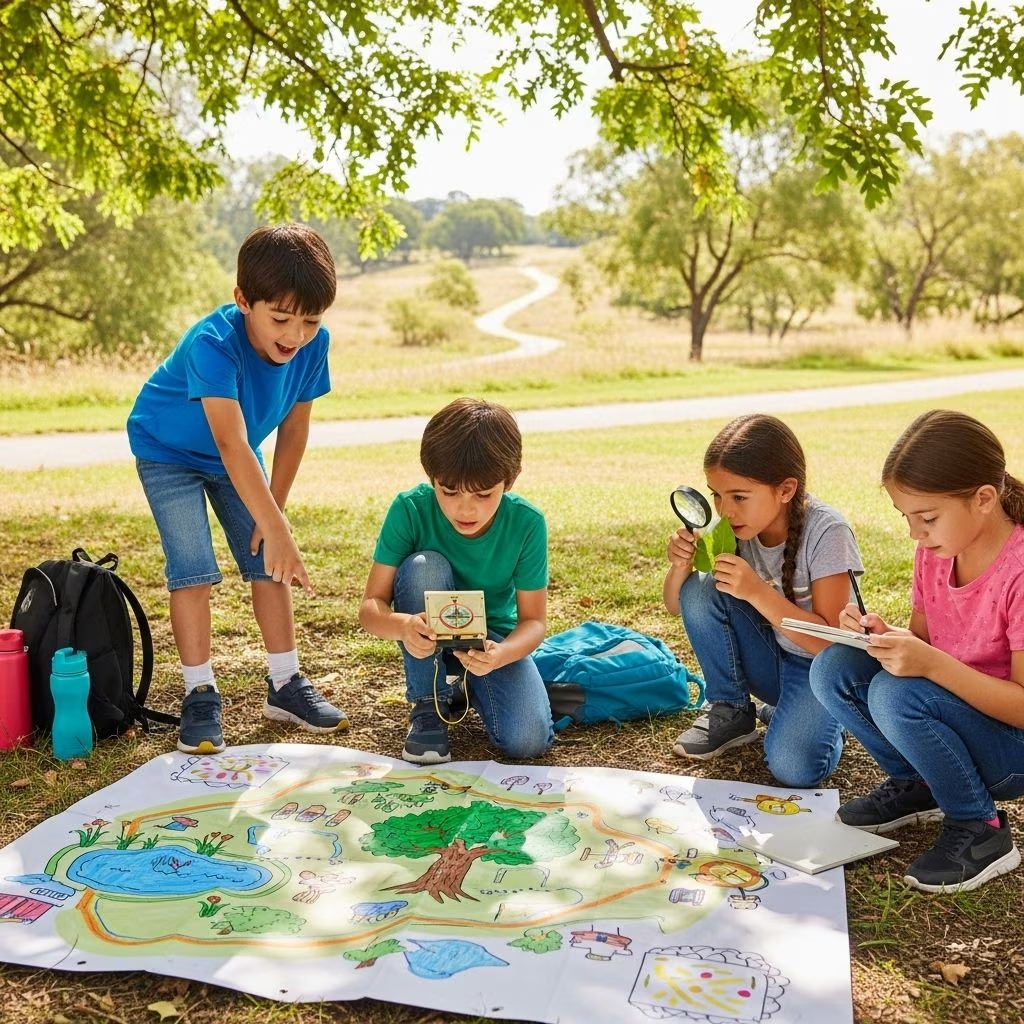
Getting kids outdoors is one of the best ways to ignite their curiosity about the world and help them develop essential geography and mapping skills. By turning natural and built environments into open-air classrooms, children relate physical features, spatial orientation, and real-world navigation to their everyday experiences. This comprehensive guide delves into a wide variety of activities, games, and practical projects that make outdoor geography not only educational but unforgettable.
Why Outdoor Geography Matters
Geography is the science of places, environments, and the relationships between people and their worlds. While classroom resources provide foundational knowledge, outdoor geography immerses kids in real-world discovery, encouraging them to connect abstract concepts to direct experience. By participating in activities such as outdoor mapping, treasure hunts, and field observations, children develop a deeper understanding and appreciation of their local and global environments.
Core Benefits of Mapping Activities Outdoors
Taking geography outside offers unique academic, social, and developmental benefits:
- Fosters Curiosity: Kids ask questions about what they observe, leading to inquiry-based learning.
- Improves Physical Activity: Integrates movement with learning, benefitting health and focus.
- Builds Spatial Awareness: Navigating real terrain deepens understanding of distance, direction, and landscapes.
- Strengthens Social Skills: Activities often require teamwork, communication, and role-sharing.
- Connects Curriculum to Everyday Life: Learning outdoors bridges knowledge from lessons to daily living.
- Encourages Environmental Stewardship: First-hand exploration nurtures respect and care for nature.
Essential Skills Kids Learn Outdoors
Through outdoor geography and mapping activities, children acquire a range of skills:
- Map Reading: Understanding symbols, scale, and legends.
- Cardinal Directions: Using north, south, east, west in real contexts.
- Observation: Noticing natural features, weather, and changes in surroundings.
- Problem Solving: Deciphering clues, planning routes, and completing challenges.
- Navigation: Applying compass use and reading coordinates.
- Recording & Reporting: Documenting findings, drawing maps, and sharing conclusions.
- Critical Thinking: Analyzing patterns, comparing environments, and hypothesizing about causes and effects.
Getting Started: Guidelines for Safe and Effective Learning
Before diving into activities, consider the following guidelines to maximize learning and fun:
- Choose Age-Appropriate Tasks: Match activities to children’s developmental level to keep them challenged but not frustrated.
- Prioritize Safety: Supervise, choose safe environments, and communicate boundaries clearly.
- Equip with Essentials: Maps, compasses, pencils, notebooks, water bottles, and appropriate clothing.
- Start Simple: Introduce basic concepts (directions, symbols) before more complex tasks.
- Relate to Familiar Surroundings: Begin with school grounds or a neighborhood park before venturing further.
- Encourage Reflection: Discuss what children observed, learned, and found challenging.
Creative Geography Activities for Outdoors
Here are some imaginative, hands-on activities that turn the outdoors into a dynamic geography classroom:
1. Geography Scavenger Hunt
Prepare a list of geographical features or objects (e.g., hill, pond, unusual rock, certain tree species). As kids explore a park or neighborhood, they check off each item they find. Add a map or drawing challenge at the end to locate where each feature was found.
2. Local Treasure Hunt
- Hide markers or small treasures across an outdoor space.
- Give children a hand-drawn map with clues or simple symbols to follow.
- This boosts their ability to interpret maps and navigate using geographic cues.
3. Build a Landform
- Provide materials (sand, rocks, sticks, clay) and challenge kids to build model landforms: mountains, valleys, rivers, islands, etc.
- Have them label the features on their mini-landscapes and explain real-world counterparts.
4. Nature Walk Mapping
- Go on a nature walk and have kids sketch a map of their route, marking interesting features like trees, streams, or changes in elevation.
- Discuss how to use symbols and create a simple legend to accompany the map.
5. Map Race With Chalk
- Draw a giant map (world, country, or region) on the pavement using sidewalk chalk.
- Call out names of places, and kids race to stand on the correct location—add facts for bonus points!
6. Outdoor Compass Games
- Teach kids to use compasses and follow step-by-step clues: “10 steps north, turn east and walk five steps.”
- Group activities can add elements of teamwork and timed challenges.
7. Map of My Neighborhood
- Ask kids to draw their home neighborhood, noting streets, buildings, parks, and landmarks.
- Encourage them to describe routes and give directions, fostering both mapping and communication skills.
8. Geography Relay Race
- Set up a relay course outdoors with geography questions at checkpoints.
- Kids must answer a mapping or location-based question correctly before moving to the next station.
9. DIY Compass Creation
- Help children make their own compass using a needle, magnet, and a bowl of water.
- Use the DIY compass to practice basic navigation skills outdoors—understand how the Earth’s magnetic field guides navigation.
10. Weather Observation Station
- Set up simple weather tools and encourage kids to record wind direction, temperature, rainfall, and cloud types.
- Link weather observations to maps and geographical zones.
Engaging Map Skills Activities Outdoors
Outdoor activities are perfect for introducing core map skills in playful ways. Here are tried-and-tested favorites:
- Cardinal Direction Dance: Incorporate movement by having kids respond to spoken commands—”Jump north!” or “Turn south!” This embeds directional awareness in muscle memory.
- Map Puzzles: Print or create large paper, foam, or felt maps and have teams assemble them. Add labels for continents, oceans, or local features for extra learning.
- Mapping the School: Guide kids as they sketch the layout of their school, including classrooms, play areas, exits, and special features. This builds practical mapping and observational skills.
- Latitude & Longitude Battleship: Use a grid (drawn on concrete, paper, or even a lawn) and let kids guess coordinates to “find the treasure.” This activity introduces basics of global location.
- DIY Globe Craft: Challenge kids to create a 3D globe using papier-mâché, labeling continents, oceans, and the equator. This hands-on project anchors global concepts in tactile experience.
Teamwork, Problem Solving, and Play
Many geography and mapping games naturally foster communication, problem-solving, and group collaboration. Consider:
- Team Map Challenges: Group kids and assign them to create different region maps, then present to the group.
- Compass Navigation Races: Teams compete to follow clues or instructions involving compass points, strengthening both mapping and social skills.
- Interactive Playground Markings: Use thermoplastic playground maps—such as a large UK map or compass rose—to spark games and lessons focused on national geography, landmarks, and direction following.
Using Tech Outdoors: Digital Mapping and Augmented Learning
Blend technology with outdoor exploration for innovative learning:
- Mobile Map Apps: Guide kids in using mobile apps to plot routes, collect location data, or identify features using GPS.
- Augmented Reality (AR) Scavenger Hunts: Some AR apps allow children to “find” digital clues in real spaces, making geography lessons feel like immersive adventures.
- Online Satellite Mapping: Follow up outdoor activity with online tools (such as Google Maps or Seterra), allowing children to compare their hand-drawn maps to satellite images for reflection and accuracy.
Building Explorers: Projects for Home and Community
The following projects bridge the gap between outdoor play and structured learning, making geography a year-round adventure:
| Activity | Description | Learning Objectives |
|---|---|---|
| Neighborhood Map Quest | Kids create a map of their neighborhood with landmarks, streets, and parks; follow or give directions based on their map. | Spatial awareness, practical navigation, community connections |
| Fact File Challenge | Children research and present facts about local or world landmarks, using outdoor map markings as reference points. | Research skills, communication, global awareness |
| City Planning Simulation | Using large grids outdoors, kids design their own towns: placement of roads, buildings, and parks; justify their choices. | Critical thinking, planning, environmental awareness |
| Outdoor Landform Models | Harness local materials (mud, sand, leaves) to build rivers, valleys, and hills, labeling each part. | Physical geography, creative expression |
Frequently Asked Questions (FAQs)
Q: How do I start teaching geography outdoors if our environment is mostly urban?
A: Urban areas are full of geographic features to explore—roads, parks, bridges, buildings, and rivers. Focus activities on mapping the neighborhood, observing traffic patterns, or identifying directional changes in the city grid. Use playground markings or city landmarks as reference points.
Q: What are the best ways to teach young children about directions?
A: Start with cardinal direction games (north, south, east, west) using sidewalk chalk arrows or movement-based activities like the Cardinal Direction Dance. Transition to using simple compasses and giving turn-by-turn instructions during outdoor walks.
Q: How can outdoor mapping help children with problem-solving?
A: Challenges like treasure hunts, relay races, and navigation routes require decoding clues, planning logical steps, and working as a team. These activities teach critical thinking, adaptability, and decision-making.
Q: What low-cost materials do I need to run these activities?
A: Most activities require simple items—chalk, graph paper, pencils, compasses, magnets, and everyday natural materials (rocks, twigs, leaves, sand). You can enhance projects with affordable globes, inflatable world balls, or printed map puzzles.
Q: How can I connect what we learn outdoors to school curriculum standards?
A: Many activities—such as constructing maps, measuring distances, identifying weather patterns, or creating landforms—directly support geography, science, and math standards. Discuss and document what is observed, measured, or constructed to reinforce classroom connections.
Conclusion: Making Geography an Ongoing Outdoor Adventure
Outdoor geography and mapping activities not only spark excitement but also lay the foundation for life-long skills. By equipping children to decode their environment, navigate new places, and appreciate Earth’s diversity, we foster independence and curiosity. Transforming parks, playgrounds, and neighborhoods into interactive labs, educators and parents can instill in children a sense of wonder and responsibility for their world—a gift that endures far beyond the classroom.
References
- https://fun-play.co.uk/outdoor-playground-geography-activities/
- https://tpd.edu.au/map-skills-activities-for-kids/
- https://educationpossible.com/outdoor-geography-activities/
- https://thrivewithoutdoorlearning.com/fun-with-maps-mapping-activities-for-kids/
- https://www.whatdowedoallday.com/map-activities-for-kids/
- https://www.mapofthemonth.com/site/


