


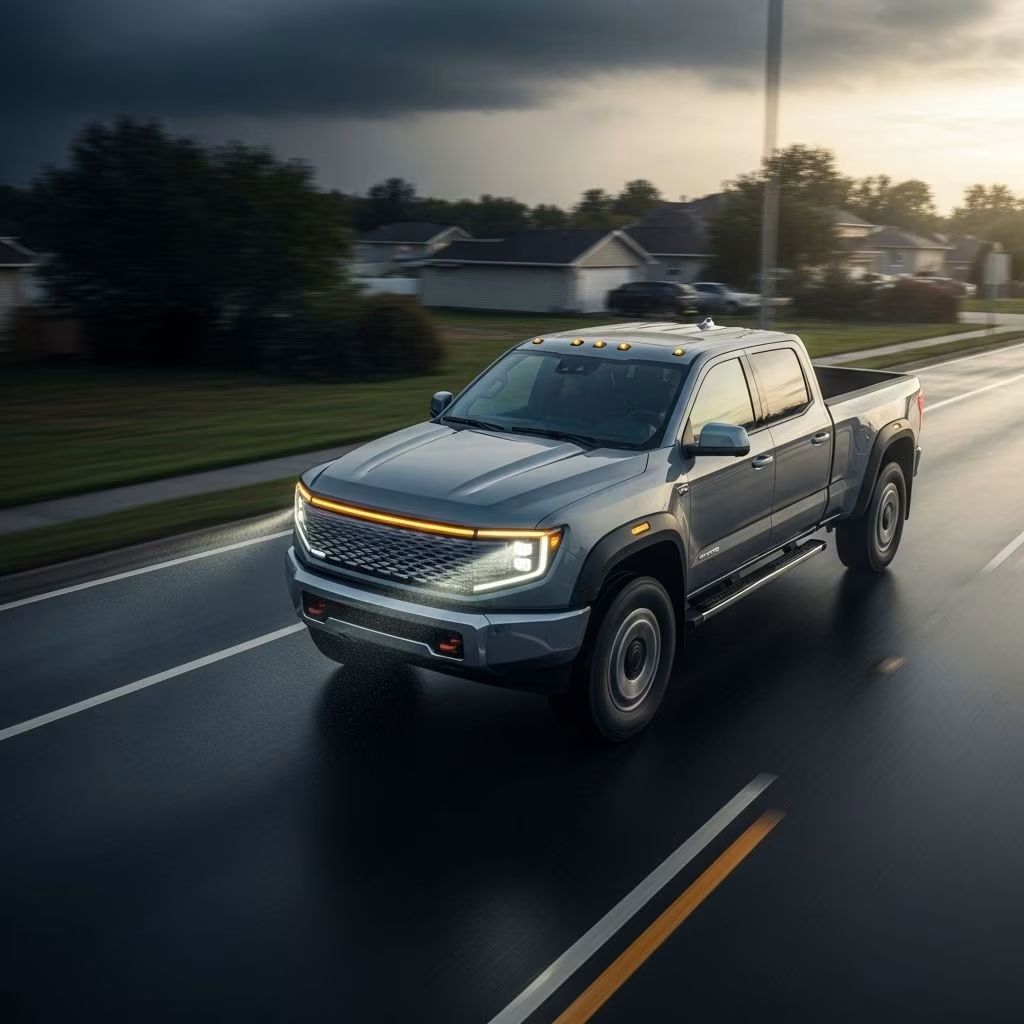
Why Heavy Electric Pickups Are Triggering Road Safety Alarms
Electric vehicles (EVs), particularly heavy electric pickups and large SUVs, are revolutionizing the auto industry—but they’re also introducing a new set of road safety concerns that regulators and infrastructure experts are only beginning to fully address. As these vehicles grow in size and weight due to the requirements of high-capacity batteries, established safety measures, both for vehicles and roadways, are increasingly under threat. This article explores the mounting evidence and regulatory warnings regarding the safety implications of heavier EVs, focusing on perspectives from the National Transportation Safety Board (NTSB), recent crash data, changing infrastructure needs, and the broader context of automotive evolution.
The Context: Electrification and Changing Vehicle Profiles
The global push for lower emissions and higher efficiency is swiftly propelling the adoption of EVs. While the shift promises significant environmental benefits, recent years have seen a decisive move from compact electric models to large pickups and SUVs. Modern EV pickups commonly weigh far more than their gasoline counterparts, with much of the excess mass stemming from massive lithium-ion battery packs needed to deliver competitive range and performance.
For instance:
- The GMC Hummer EV weighs over 9,000 pounds—its battery pack alone tips the scales at about 2,900 pounds, similar to a whole Honda Civic.
- The Ford F-150 Lightning adds 2,000 to 3,000 pounds over the comparable internal combustion model.
- Even smaller electric crossovers and SUVs, like the Mustang Mach-E and Toyota RAV4 EV, are roughly 33% heavier than their gas-powered equivalents.
Weight as a Critical Safety Issue: Who Is Speaking Out?
Vehicle weight is emerging as a crucial factor in road safety. This concern has been publicly articulated by Jennifer Homendy, chair of the National Transportation Safety Board (NTSB), who warns that the surge in EV curb weights and their high acceleration capabilities pose a substantial risk to all road users, especially occupants of lighter vehicles, cyclists, and pedestrians.
Homendy emphasizes:
- Heavier vehicles transfer greater force in collisions, escalating the likelihood of severe injuries and fatalities.
- Rapid acceleration increases the chances and impacts of dangerous incidents.
- Emergency responders face unique challenges with EV battery fires, including the risk of electric shock and difficult-to-suppress fires that can reignite.
Notably, the NTSB itself cannot directly regulate automakers, but it can highlight pressing issues, prompt legislative scrutiny, and urge industry and government action.
What’s Making EVs So Heavy—and Why Does It Matter?
Lithium-ion battery packs are the main culprit. To provide extended driving range (often 300 miles or more per charge), a pickup’s battery can weigh several thousand pounds. When scaled to the needs of full-size trucks or SUVs, this results in gross vehicle weight ratings (GVWR) previously reserved for commercial vehicles or large vans.
This trend matters because heavier vehicles amplify the following safety challenges:
- Crash Energy: More weight equals more kinetic energy in a crash, making collisions more damaging for lighter vehicles or roadside structures.
- Stopping Distance: Heavier vehicles require longer distances to come to a full stop, potentially increasing the risk of crashes in sudden braking situations.
- Pedestrian and Cyclist Risk: Large, tall vehicles with high hoods and increased weight levels are statistically more likely to cause fatal injuries to non-occupants in collisions.
Guardrails, Barriers, and Infrastructure: Can the System Cope?
A growing chorus of engineers and safety experts points to an urgent mismatch between vehicle evolution and America’s road infrastructure. Much of the country’s safety hardware—such as median barriers and guardrails—was engineered for passenger vehicles weighing up to 5,000 pounds. Across the country:
- Standard crash barriers are being pushed to their limits and sometimes surpassed. In recent crash tests, a 7,000-pound electric pickup broke through or severely displaced highway barriers designed for lighter vehicles, sending concrete chunks flying and potentially endangering other motorists.
- When a standard guardrail failed against an electric sedan in a Texas A&M Transportation Institute test, it underscored fears that roadside barriers are not only being challenged—they may fail altogether under the new regime of ultra-heavy pickups.
- In real-world incidents, such as a Tesla Model Y crashing through a guardrail in California, the consequences were fatal.
With the federal government reporting that nearly half of all road fatalities occur when a vehicle leaves the roadway, guardrails are a last line of defense. The prospect of these safety devices being overwhelmed by modern EVs is a key focus for policymakers.
Comparing Vehicle Weights: Electric Vs Gasoline Models
| Vehicle Model | Type | Approx. Weight (lbs) |
|---|---|---|
| GMC Hummer EV | Electric Pickup | 9,063 |
| Ford F-150 Lightning | Electric Pickup | 6,500 – 7,000 |
| Ford F-150 (Gas) | Gas Pickup | 4,000 – 5,000 |
| Tesla Model Y | Electric SUV | 4,416 |
| Honda Civic | Sedan (Gas) | 2,900 – 3,000 |
This comparison highlights the remarkable weight difference between electric and traditional vehicles—differences that have real ramifications for every aspect of road safety.
Emergency Response: New Hazards for First Responders
First responders face unique and heightened hazards when dealing with accidents involving heavy EVs:
- The risk of electrocution from high-voltage battery systems, particularly if vehicles are severely damaged and battery disconnects are inaccessible.
- Fires driven by thermal runaway are much harder to extinguish, sometimes reigniting repeatedly after apparent suppression.
- Industry emergency response guides vary in quality and completeness, sometimes lacking vital, vehicle-specific information for safe intervention.
This underscores the need for improved training, better vehicle documentation, and further research into EV-specific incident response.
Acceleration, Performance—and Unexpected Risks
Many heavy electric trucks and SUVs boast remarkable acceleration and performance statistics—selling points that automakers highlight in marketing. However, this performance surge brings new safety challenges:
- Heavier, fast-accelerating vehicles can surprise drivers unused to such immediate torque, raising the risk of loss of control.
- High acceleration capacity can make crashes more severe if not properly managed and understood by average drivers.
- Advanced driver-assistance systems, while helpful, cannot overcome the basic physics of momentum and mass in substantial crashes.
The Regulatory Response—and Existing Limitations
Although the NTSB and other safety bodies sound warnings, the authority to mandate new manufacturing standards or significantly alter infrastructure rests elsewhere. This complicates efforts to quickly address the risks posed by heavy EVs:
- The NHTSA (National Highway Traffic Safety Administration) sets vehicle safety standards, but updates to account for new weight profiles can take years.
- Highway and barrier redesigns require both substantial investment and time for implementation.
- Automakers prioritize range (thus battery size) to compete in the marketplace, making voluntary reductions in weight less likely in the short term.
How Stakeholders Are Responding
- Researchers are conducting crash tests with heavier vehicles to understand limitations in current infrastructure.
- Lawmakers are calling for updated safety standards and increased funding for research and road upgrades.
- Automakers acknowledge the shift, but changing vehicle mass trends will require industry-wide cooperation and possibly new regulations.
Frequently Asked Questions (FAQs)
Q: Why do electric pickups and SUVs weigh so much more than gasoline models?
A: Electric vehicles require large lithium-ion battery packs to deliver high range and performance, adding thousands of pounds to their overall weight compared to traditional vehicles.
Q: What are the main safety concerns tied to heavier EVs?
A: Heavier electric vehicles can cause more severe injuries in crashes, overwhelm current guardrails and barriers, increase pedestrian and cyclist risks, and present unique hazards for emergency responders dealing with battery fires or high-voltage systems.
Q: Can current guardrails and crash barriers handle these new super-heavy vehicles?
A: Many current barriers are rated for vehicles up to 5,000 pounds. Tests and real-world incidents indicate that EVs exceeding this weight can seriously damage, move, or even break through existing safety infrastructure.
Q: Are there any solutions being proposed?
A: Policymakers, researchers, and safety advocates are urging infrastructure upgrades, tighter safety standards for vehicles, improved emergency responder training, and further research to ensure roads and barriers keep up with changes in the vehicle fleet.
Q: Does this mean EVs are unsafe overall?
A: Not necessarily. EVs can be very safe for drivers and passengers, often exceeding crash-test ratings. The concern centers mainly on the mismatches created by their mass and power in the broader traffic ecosystem, especially for vulnerable road users and outdated infrastructure.
Key Takeaways and Looking Ahead
- The transition to electric pickups and SUVs is creating vehicles that far exceed traditional weight expectations, with direct consequences for road safety and infrastructure.
- As sales of large, heavy EVs continue to rise, updating safety standards and physical barriers has become a critical need.
- First responders must be equipped with new training and emergency guides to manage the particular hazards of battery fires and high-voltage accidents.
- Consumer understanding of the risks, especially for non-occupants and users of smaller vehicles, should be emphasized as part of public safety education and purchasing decisions.
- Collaboration between lawmakers, automakers, researchers, and transportation agencies is required to ensure that progress in electrification does not come at the cost of public safety on the nation’s roads.
As electric vehicle technology continues to surge forward, the conversation must shift toward a holistic view of safety—one that accounts for not only the occupants of these impressive machines, but everyone who shares the nation’s increasingly crowded roadways.
References
- https://www.ntsb.gov/safety/safety-studies/Documents/SR2001.pdf
- https://www.cbsnews.com/news/electric-vehicles-safety-infrastructure-barriers/
- https://www.autoweek.com/news/green-cars/a42486843/ntsb-heavy-electric-cars-trucks-suvs-safety/
- https://www.thetrucker.com/trucking-news/the-nation/feds-heavy-electric-vehicles-such-as-big-rigs-could-pose-big-safety-risks-due-to-weight
- https://gmauthority.com/blog/2023/01/ntsb-concerned-about-heavy-electric-vehicles-arriving-on-the-market/


