Colorful Tulle: Thomas Jackson’s Photographic Dialogue With the California Coast
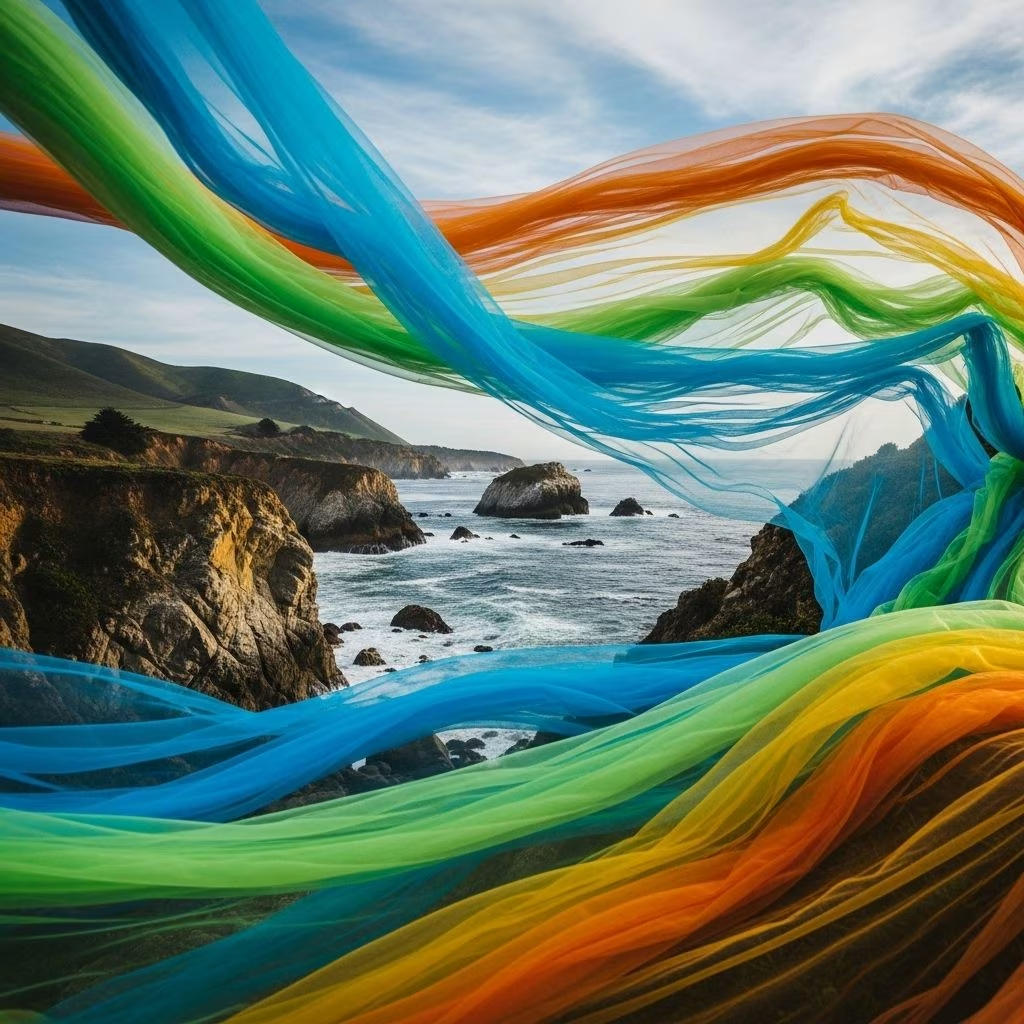
In a series that reinvents the ordinary with every billowing movement, photographer and artist Thomas Jackson transforms strips of brightly colored tulle into ephemeral sculptures, captivatingly suspended over the wild, windswept shores of Northern California. Working with the elements as collaborators, Jackson’s photographs meditate on the intersection of art, nature, and the unpredictable, presenting a dialogue where the manmade and the organic are forever entwined.
The Evolution of an Idea: Creativity Born of Constraints
The year 2020 marked a transformative moment for many artists. For Thomas Jackson, whose previous work often involved elaborate installations of everyday objects in far-flung environments, pandemic restrictions became an unexpected muse. With travel limitations in place, Jackson was confined to landscapes within reach of his California home. Instead of viewing this as a limitation, he found creative liberation in focusing intently on a single stretch of coastline and a uniquely versatile material—nylon tulle.
- Material Choice: Tulle was selected for its exceptional mutability: it could resemble solid matter, liquid, fire, or drifting smoke, depending on its arrangement and interaction with the wind.
- Adaptation: Rather than employing large crews to install and photograph his works, Jackson improvised with what was available in nature—often using sculptural driftwood to elevate and support the light fabric.
- Constraint as Catalyst: The narrowing of scope to a single region and material paradoxically broadened the conceptual possibilities, sparking new explorations of form and process.
Collaboration With Wind: An Unpredictable Partner
Integral to the vibrancy of Jackson’s tulle installations is his approach to the wind as a creative partner rather than a hostile force. The strong off-shore breezes of the Northern California coast—especially at Point Reyes and Stinson Beach—became co-authors in the narrative of each photograph.
- The fabric’s transformation was dictated by the wind. Tulle left slack might tumble gently, evoking a sense of softness, while taut sections could become blazing streaks reminiscent of wildfire or flowing water.
- Jackson often refers to the process as tumultuous; of the installations attempted, more than half ended in failure, as the wind could just as easily demolish a composition as animate it.
- Success came through deference to nature: installations that yielded to the wind, allowing its unplanned movements to inform the final image, were far more likely to create visually striking, dynamic results.
Artist’s Insight
“When my constructions respected and responded to the wind, interesting things would occur. When they defied it, I’d go home unhappy,” Jackson reflects. His method became an act of attunement to the rhythms and energy of the landscape—a practice of art guided by forces beyond full control.
Material and Technique: Tulle as Both Subject and Medium
The tulle used in Jackson’s projects is no ordinary studio prop. Chosen for durability, flexibility, and reusability, nylon tulle interacts beautifully with both light and atmospheric conditions:
- Lightweight and Resilient: The fabric’s delicate density allows it to capture and play with ambient light, creating gradients and translucency against the coastal backdrops.
- Environmental Interaction: Tulle can withstand strong breezes and shifting weather, making it ideal for open-air installations along the Pacific shore.
- Palette and Form: Jackson’s color selections—from fiery oranges to deep blues—offer vivid contrast with the rocky, coastal terrain. Each arrangement is informed by the expected wind conditions, marrying structural improvisation with intentional design.
Setting and Atmosphere: The Power of Place
The California coast, particularly areas like Point Reyes and Stinson Beach, sets the tone for the series. These locations are chosen for their dramatic geology and reliably powerful winds, providing both challenge and inspiration:
- Natural Contrasts: Rugged cliffs, sandy expanses, and the persistent roar of waves create a visually and acoustically immersive environment. The manufactured tulle installations punctuate this setting, intensifying viewers’ awareness of both elements.
- Temporal Context: The ongoing reality of climate risk—namely, wildfire threat and pollution—infuses the work with urgency. Early inspiration for the tulle series was the omnipresent fear of fire, with many pieces resembling flames or smoke.
- Ephemerality: The installations are impermanent by design, shaped and dispersed by the same winds that animate them, leaving no trace but the photographic record.
Conceptual Underpinnings: Between Nature, Artifice, and the Uncanny
Jackson’s practice is not simply one of aesthetic experimentation, but of deep engagement with systems—both natural and constructed. The tulle works are an extension of his ongoing interest in emergent behaviors and systems found in nature.
- Inspiration from Nature: Swarming birds, schooling fish, termite mounds—nature’s self-organizing patterns are models for Jackson’s compositions, which mimic these organic processes with artificial materials.
- Questions of Real and Imagined: The striking juxtaposition of tulle against the coastal backdrop blurs lines between reality and fiction, prompting viewers to question what is staged and what is spontaneous, what is natural and what is human-made.
- Emotional Resonance: Jackson seeks to elicit a blend of “fear and fascination,” echoing nature’s dual capacity to awe and unsettle, a recurring theme in his broader body of work.
Artist Statement
“Under the right circumstances, any object, no matter how fixed in its meaning, can mutate into something new… I want to make images I have never seen before,” Jackson states, articulating his desire to expand the visual vocabulary and invite novel interpretation of the everyday.
Behind the Lens: Method, Experiment, and Accepting Failure
Jackson’s process is rigorous and experimental. Each shoot begins with planning, but the final outcome depends on a complex matrix of environmental conditions, improvisation, and trial and error.
- Camera and Medium: The photographs are captured on 4×5 film, a format that offers exceptional detail and a discipline of deliberation. Post-production is minimal, lending authenticity to each image.
- Installation Setup: Jackson frequently works alone, using driftwood and other found supports to anchor his installations, and must adjust on the fly as wind, light, or unexpected events intervene.
- Rate of Success: Out of every twenty attempts, Jackson considers it a win if just a handful result in compelling images, embracing the inherent unpredictability as a formative part of the creative process.
From Emergent Behavior to Tulle: Artistic Trajectory
Thomas Jackson has long explored the theme of “emergent behavior”—complex outcomes arising from simple interactions—in both his earlier and current work. His previous series involved objects like plastic cups, cheese balls, or napkins suspended in swarms, referencing both natural and artificial collective systems.
- Visual Surrealism: These earlier installations further emphasized the blur between real and surreal, inviting audiences to continually reinterpret familiar objects and spaces.
- Statement on Human–Nature Interaction: Jackson’s broader artistic vision reflects a desire for human-made systems working in sync with nature rather than in opposition—an idea that guides his approach to the tulle series.
Exhibitions and Background
Jackson’s work has garnered significant attention in the contemporary art world, with numerous exhibitions across the United States and accolades recognizing his innovation in installation and photographic art.
- Exhibitions: Galleries such as the Center for Book Arts (New York), the Governors Island Art Fair, and the Gallery at Eponymy (Brooklyn) have featured Jackson’s installations and photographs.
- Achievements: He was named one of the Critical Mass Top 50 and won the “installation/still-life” category of PDN’s The Curator award.
- Origins: Raised in Providence, Rhode Island, Jackson initially worked as an editor and book reviewer before immersing himself fully in art and photography.
Thematic Table: Nature and Artifice in Jackson’s Work
| Element | Natural Counterpart | Jackson’s Artistic Response |
|---|---|---|
| Tulle/Fabric | Fire, water, smoke | Replicates organic forms, transient states |
| Wind | Natural force shaping landscapes | Unpredictable collaborator, animates installations |
| Installations | Animal swarms, emergent systems | Mimics collective behavior in nature with artificial objects |
| Photography | Ephemeral moments in the wild | Documents fleeting, living sculptures before their dissolution |
Frequently Asked Questions (FAQs)
Q1: How does Thomas Jackson suspend tulle for his photographs?
A: Jackson uses natural elements such as driftwood to prop up sections of lightweight tulle. The fabric is arranged with careful planning but ultimately shaped and animated by the wind during the shoot.
Q2: Why focus on the California coastline for these installations?
A: The Northern California coast offers dramatic landscapes, strong and variable winds, and a resonance with contemporary themes of environmental uncertainty—including fire and climate change—which Jackson incorporates into his work.
Q3: Is any digital editing used to create the floating effect?
A: Jackson’s approach involves minimal post-production editing. The floating effect is achieved on-site, with the wind shaping the fabric and film photography capturing the result authentically, rather than relying on computer manipulation.
Q4: What message does Jackson hope viewers take from his tulle series?
A: Jackson invites viewers to reconsider boundaries between nature and artifice, to find beauty in unpredictability, and to imagine new forms of coexistence and collaboration between humanity and the natural world.
Q5: Where can I see more of Thomas Jackson’s work?
A: Jackson showcases his process and new projects on his Instagram account and is frequently exhibited in art galleries and fairs across the U.S.
Conclusion: Ephemeral Beauty, Enduring Questions
Through the vivid lens of Thomas Jackson, swaths of tulle become more than fabric; they are living sculptures, animated by the whimsy and force of coastal wind. Each image, fleeting but immortalized on film, asks us to reflect: In what ways can we relinquish control and become collaborators with the world around us? In inviting nature into his creative process, Jackson not only blurs the lines between reality and artifice but challenges viewers to discover a new appreciation for the unpredictable dance of elements—where even the most fabricated gesture can reveal something elemental and profoundly real.
References
- https://www.thisiscolossal.com/2021/03/thomas-jackson-tulle-photos/
- https://mymodernmet.com/thomas-jackson-fabric-photography/
- https://www.jacksonfineart.com/news/2217-colorful-tufts-of-tulle-float-down-the-california/
- https://jacksonfineart.viewingrooms.com/viewing-room/24-thomas-jackson-new-work/
- https://www.stirworld.com/see-features-the-compositional-photographs-of-thomas-jackson-combine-reality-and-fiction
- https://thomasjacksonphotography.com/information.html
- https://www.jacksonfineart.com/artists/thomas-jackson/
- https://www.thisiscolossal.com/tags/thomas-jackson/