How Did Earth Get Its Name?
Unlike the other planets in our solar system, whose names are borrowed from ancient gods and mythology, Earth is remarkable for lacking ties to any singular mythological figure. The story of how Earth received its name is intertwined with the evolution of language, scientific discovery, and humanity’s self-awareness as planetary inhabitants. This article explores the etymology, linguistic variations, and cultural contexts of the name “Earth,” revealing the fascinating journey through which our planet’s identity emerged.
What Is in a Name? The Uniqueness of ‘Earth’
Consider the familiar planetary roster: Mercury, Venus, Mars, Jupiter, Saturn, and, with the discoveries made later, Uranus and Neptune. Each is named after Greco-Roman deities reflecting ancient astronomers’ fascination with mythology and the patterns they observed in nightly skies. In marked contrast, Earth—or its local linguistic equivalent—stands alone. Its name reflects not a divine being but a connection to the ground beneath our feet.
- Earth is the only planet not named for a Greco-Roman deity.
- The name is derived from words that mean ground or soil.
- Local names for Earth have deep roots in ancient languages rather than mythological traditions.
The Etymological Roots of ‘Earth’
The word “Earth” traces back through the tapestry of Germanic and Indo-European languages, evolving over centuries:
- The Old English word “eorthe” and its cognates in German (“Erde”) and Dutch (“aarde”) all referenced the ground or soil.
- The ancestor of these terms is the Proto-Germanic “ertho,” denoting the material substance of land.
- Earlier still, linguists identify the Proto-Indo-European root “*er-“, meaning “ground” or “earth”.
Unlike the mythic and poetic origins of other planetary names, the name for our planet in English and related languages comes from ordinary speech referring to the place where people lived, walked, and cultivated food.
Comparative Table: Names for Earth in European Languages
| Language | Word for ‘Earth’ | Root/Origin |
|---|---|---|
| English | Earth | Old English ‘eorthe’ |
| German | Erde | Proto-Germanic ‘ertho’ |
| Dutch | Aarde | Proto-Germanic ‘ertho’ |
| French | Terre | Latin ‘terra’ |
| Spanish | Tierra | Latin ‘terra’ |
| Italian | Terra | Latin ‘terra’ |
| Latin | Terra | Proto-Indo-European ‘*ters-‘ (dry) |
From Ground to Globe: When Did ‘Earth’ Become a Planet?
The notion of Earth as a planet is deceptively modern. For most of human history, Earth was not conceived as a sphere orbiting the Sun, but as a static plane or even as the entire cosmos.
- Ancient cultures often pictured Earth as a flat expanse or supported by divine beings or structures.
- Greek philosophers such as Pythagoras and Aristotle contributed to the concept of a spherical Earth, but it was not widely accepted for centuries.
- It wasn’t until the Copernican Revolution in the 16th century—and the work of astronomers like Copernicus, Kepler, and Galileo—that Earth was properly recognized as one planet among others, orbiting the Sun.
Only after this paradigm shift did the language used for the ground beneath our feet, “earth,” become globally synonymous with our planetary identity.
Mythological and Cultural Interpretations of Earth
Although “Earth” is not directly a mythological name, cultures across the world have long associated the ground or land with deities and creation myths.
- In Greek mythology, Gaia is the primordial personification of the Earth.
- In Roman tradition, Terra Mater or Tellus similarly represents the fertile ground and the mother of all life.
- For the Hindu tradition, the goddess Bhumi (Bhudevi) is the Earth personified.
- Norse mythology includes Jörð, a giantess and the mother of Thor.
These figures inform the poetic and spiritual connection humans feel with the planet, even as the common names for Earth in various languages remain more literal and grounded.
Why Don’t We Call Earth by a Mythological Name?
The absence of a mythological name for our planet may be attributed to several factors:
- Historically, Earth was not conceived as a planet and thus didn’t fit the pattern of celestial objects named after gods.
- By the time Earth was classified alongside other planets, the tradition of using local words for “ground” or “soil” was well-entrenched in most languages.
- Names like Gaia and Terra survive today in literature, science fiction, and poetic usage, but the everyday term remains secular and utilitarian.
Earth in Other Languages: A Global Perspective
Across the globe, languages reflect a diversity of ways to name the planet, often rooted in concepts of land, ground, or even motherliness, but seldom in specific mythology.
- Japanese: 地球 (chikyū), combining the characters for “ground” and “sphere”
- Hindi: पृथ्वी (prithvi), also the name of an Earth goddess
- Arabic: الأرض (al-ard), meaning “the land” or “the ground”
- Swahili: Dunia, meaning “world” or “life”
- Chinese: 地球 (dìqiú), also meaning “earth globe”
Although the specifics differ, most commonly these words denote the ground or the world as experienced by humans, reinforcing the deep-rooted link between language, place, and lived reality.
‘Earth’ and Scientific Contexts
In scientific terminology, the legacy of both ancient myth and descriptive language remains. For example:
- Geology—the study of Earth’s physical structure and substance—derives its prefix from the Greek “geo” (Gaia).
- Words like terrestrial (from Latin “terra”) are used in planetary science to describe Earth-like planets.
- In some academic and poetic uses, Gaia hypothesis envisions Earth as a living organism.
The Modern Perception of Our Planet’s Name
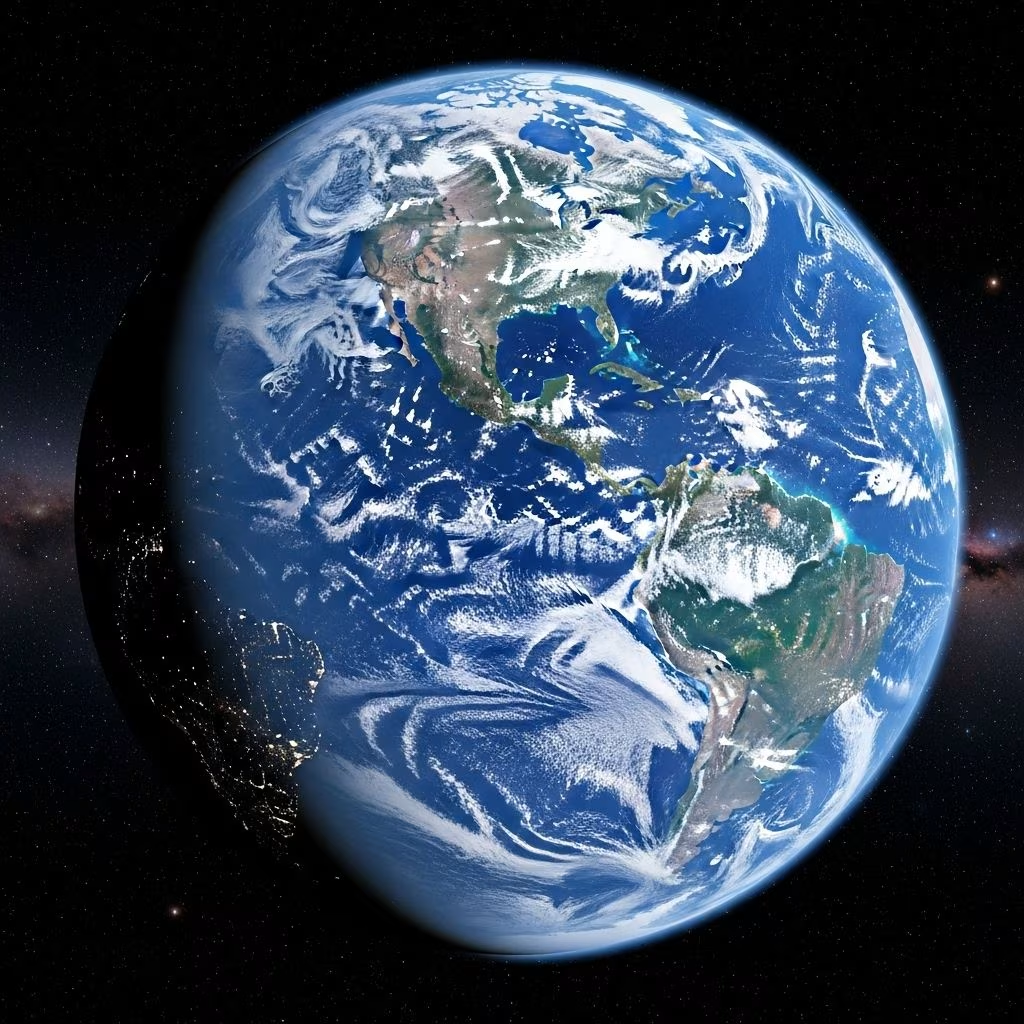
Today, the word “Earth” balances both familiarity and awe. It represents the only home humanity has ever known, while in contemporary contexts it can encompass the entire living world and all its complexities.
- In literature and pop culture, “Planet Earth” often becomes a character in its own right.
- Sustainable advocacy and space science both use “Earth” as a rallying cry for the preservation and appreciation of our unique blue planet.
- International collaborations such as Earth Day reflect the universal and inclusive power of this humble name.
Frequently Asked Questions (FAQs)
Q: Why is the planet called “Earth” and not after a Roman or Greek god?
A: The name “Earth” comes from Old English and Germanic roots describing ground or soil, unlike the other planets which were named for gods. This reflects Earth’s historical status as home and land, not as a visible celestial body deserving a mythological name.
Q: When did people begin to see Earth as a planet?
A: The paradigm shifted during the Renaissance and Scientific Revolution, particularly with the Copernican model introduced in the 16th century, which placed Earth among the planets orbiting the Sun. Before that, Earth was seen as the center of the universe.
Q: Is there a mythological name for Earth?
A: In various mythologies, Earth is personified as deities such as Gaia (Greek), Terra (Roman), Bhumi (Hindu), or Jörð (Norse). However, these names are seldom used in everyday language to refer to the planet as a whole.
Q: What is the oldest recorded name for Earth?
A: The earliest known root is the Proto-Indo-European “*er-” or “*erthō”, meaning ground or earth. Variations of this root are found in most Germanic and some Latin-linked languages. In other ancient cultures, names and concepts varied widely.
Q: How do scientists refer to Earth today?
A: In scientific contexts, “Earth” remains the standard term, but in comparative planetary science, prefixes like “geo-” (Greek for Earth) and “terra-” (Latin for Earth) or even names like “Gaia” for theoretical models are employed.
Key Takeaways and Fun Facts
- Earth is the only planet in our solar system whose name does not derive from Greco-Roman mythology.
- The word “Earth” is rooted in Old English and Germanic, meaning ground, soil, or land.
- The concept of Earth as a planet is only a few centuries old.
- Names for Earth around the globe often reflect links to the ground, the world, or even to motherly aspects.
- Personifications such as Gaia (Greek), Terra Mater (Roman), Bhumi (Hindu), and Jörð (Norse) represent the planet in mythologies, but not in modern nomenclature.
From language and myth to planetary science, the name “Earth” is a narrative of humanity’s relationship with its only home—a story written into the words we use every day.
References
- https://www.brightvibes.com/the-origin-of-tree-huggers-the-brave-men-and-women-who-gave-their-lives-to-protect-our-trees/
- https://www.earthisland.org/journal/index.php/articles/entry/where_did_the_word_tree-hugger_come_from/
- https://www.patagonia.com/stories/the-original-tree-huggers/story-71575.html