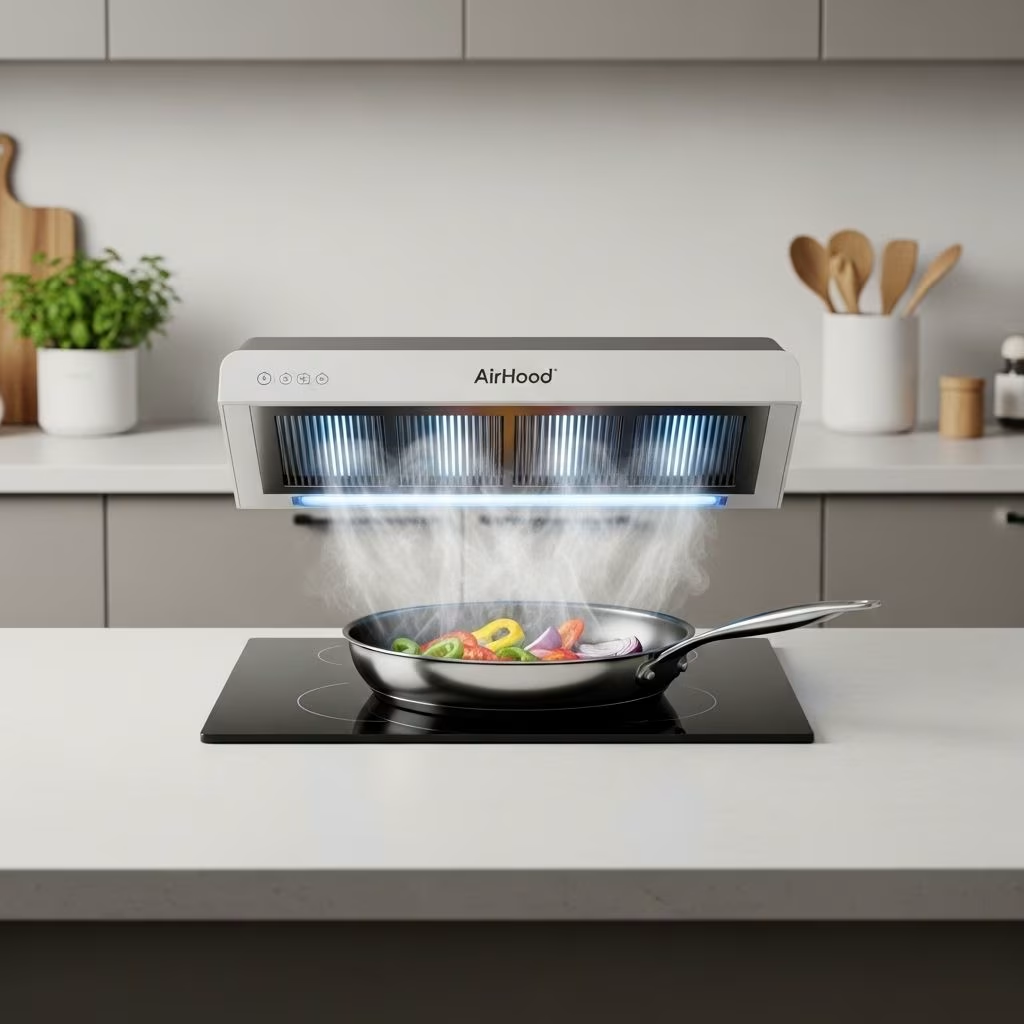
AirHood Review: Testing the Portable Range Hood That Promises Clean Air for Every Kitchen
Many home cooks, especially those living in apartments, dorms, or RVs, know the challenge of managing smoke, grease, and lingering odors when prepping meals in spaces lacking a built-in vent hood. AirHood bills itself as the world’s first portable kitchen air cleaner, attracting viral attention on social media and crowdfunding platforms alike. But does this compact, countertop device genuinely deliver on its promises? This detailed review explores AirHood’s performance, design, filter effectiveness, user experience, and ideal applications—backed by real-world and lab testing.
Background: Why Portable Range Hoods?
Traditional kitchen vent hoods are usually fixed installations that extract air outside, effectively removing smoke, fumes, grease, and odors. In many urban apartments, student housing, RVs, or rental units, such fixed systems are impractical or outright impossible. Residents in these contexts frequently rely on suboptimal solutions—opening windows, running fans, or simply tolerating indoor pollution and odor build-up.
The AirHood aims to fill this niche by offering a portable, plug-and-play ventilation solution designed to sit right on the countertop. Unlike traditional models, it requires no installation or permanent modification—making it appealing for renters, travelers, and those seeking flexibility.
AirHood Product Overview
The AirHood—now available via direct online sales after successful Kickstarter and Indiegogo campaigns—comes in both wired and wireless versions, with several color options (including Cadmium Orange, Space Black, and Ivory White). All models emphasize portability, simple maintenance, and modern styling. The wireless version has a rechargeable battery for flexible placement, while the wired model plugs directly into a standard outlet.
| Feature | Details |
|---|---|
| Versions | Wired or wireless (battery-operated) |
| Battery Life (Wireless) | Up to 480 minutes per charge (approx. 8 hours) |
| Recharge Time | 3 hours |
| Filtration | Dual system: oil filter (dishwasher safe) + activated charcoal filter |
| Filter Life | Charcoal: ~100 hours. Comes with 4 spares. |
| Colors | Cadmium Orange, Space Black, Ivory White |
| Price Range | Wired: $157; Wireless: $212+ (pricing may vary) |
Each AirHood includes a one-year limited warranty, with simple instructions and easy filter access for cleaning and replacement.
How We Tested the AirHood
To assess the AirHood’s claims, we utilized both laboratory-grade equipment and everyday home kitchen scenarios:
- Smoke Test: Controlled amounts of smoke were generated using a smoke machine to simulate typical cooking emissions, distributed over an area equivalent to a single burner.
- Airflow Measurement: Air velocity and pressure were quantified to determine how much air the device could move at maximum setting.
- Noise Level Measurement: Decibel readings were recorded at head height to simulate the cook’s perspective during use.
- Real Kitchen Use: The AirHood was positioned near a stove during actual meal preparation (e.g., sautéing chicken breast, searing salmon) to evaluate real-world effectiveness with various foods known to generate smoke, grease, and odors.
- Indoor Air Quality (IAQ) Monitoring: A PM2.5/volatile organic compound (VOC) sensor measured the change in air quality (fine particulates, gases).
For consistency, we avoided using any built-in kitchen ventilation during tests.
Performance: Smoke, Grease, and Odor Removal
Airflow and Smoke Control
In laboratory conditions, the AirHood earned a 4 out of 5 for maximum airflow—surprisingly close to full-sized, installed range hoods. This means it is quite powerful for its footprint, rapidly drawing in smoke and preventing it from spreading throughout the room. In the home kitchen, the effect was immediately noticeable: placing the AirHood next to a smoking pan led to a visible reduction in smoke wafting away.
Grease and Odor Mitigation
The AirHood’s dual filtration system (oil + charcoal filter) is designed to not only reduce smoke but capture airborne grease droplets and volatile cooking odors. Over a week’s worth of testing with foods like salmon and chicken, the device successfully reduced greasy film on nearby surfaces and kept kitchen odors lower compared to cooking without any ventilation.
Measured Air Quality Improvement
Quantitative IAQ monitoring in a typical dorm-sized test area found the AirHood was able to reduce airborne PM2.5 and VOCs by around 20%. While not a “miracle cure,” this reduction is significant for small, ventless spaces, especially where any improvement counts.
Design and Usability
The AirHood’s form factor is its most immediately striking quality. Designed to sit on any countertop, its lightweight and modern construction complement most kitchen styles. Practical features include:
- Portability: Easily moved to wherever you cook—ideal for multi-use spaces or those who frequently relocate.
- Simple Setup: Unbox, plug in or charge, and place beside your active stove burner.
- User Controls: Straightforward buttons adjust the airflow speed and turn the unit on/off.
- Quiet Operation: While not silent, its sound level is easily tolerable—even in small kitchens—especially at anything below the highest power setting.
Filtration System: Oil and Charcoal Filters
The AirHood’s filtration system is key to its function. Here’s how it works:
- Oil Filter: Captures larger particles and greasy droplets. Easily cleanable—drop in the dishwasher as needed to maintain performance and avoid unpleasant buildup.
- Activated Charcoal Filter: Traps VOCs and odors in a network of carbon molecules. Each filter lasts up to 100 hours; the kit includes four spares, and replacements are available.
The maintenance process is simple: routinely clean the oil filter and replace the carbon filter as required. Maintenance reminders are not built-in, so users should track usage manually.
Pros and Cons
| Pros | Cons |
|---|---|
|
|
Best Use Cases for the AirHood
- Apartment kitchens without built-in hoods
- Dorm rooms and college housing
- RVs and mobile homes, where vent installation is impractical
- Temporary or rented spaces (e.g., Airbnbs, vacation rentals)
- Occasional heavy cooking in spaces that aren’t usually used for food prep
In traditional houses with effective, externally vented range hoods, the AirHood offers minimal additional benefit; the built-in solution is more comprehensive and reliable.
Alternatives and Limitations
The AirHood isn’t meant to replace a full-size, externally vented range hood in a permanent kitchen. For such applications, a professionally installed hood is superior at removing all forms of indoor air pollution. Likewise, opening windows and using standalone fans can assist but rarely match dedicated ventilation for smoke and particulates. The AirHood is a unique solution only where permanent installation isn’t an option.
Key limitations:
- Only covers the immediate cooktop—using multiple burners or a large stovetop may require moving the unit or accepting limited coverage.
- Does not exhaust air outside; instead, filtered air is recirculated indoors—so it helps with light-to-moderate pollution, not heavy-duty use.
- Charcoal filter costs can add up with frequent use.
Frequently Asked Questions (FAQs)
Q: Does AirHood replace a range hood?
A: No, a full-size installed range hood remains the gold standard for smoke and particulate removal in permanent kitchens. The AirHood is designed for situations where no vent is available, providing partial odor and grease control.
Q: How often do I need to replace the filters?
A: The oil filter can be cleaned as often as needed and is dishwasher safe. The activated charcoal filter lasts up to 100 hours of cooking; four are included, and replacements can be purchased separately.
Q: How noisy is the AirHood during operation?
A: On lower settings, it is quiet enough for casual conversation. On high, the sound is noticeable but not disruptive, similar to a bathroom fan.
Q: Can the AirHood be used with all types of stoves?
A: Yes—it works with induction, electric, and gas cooktops. Placement is key: for best results, position it as close as possible to the burner in use.
Q: Who should not buy the AirHood?
A: If your kitchen already has a properly installed, externally vented hood, the AirHood offers little added value. Heavy-duty cooks who need full coverage may also find its capacity limiting.
Final Thoughts
The AirHood portable range hood fills an important niche for anyone seeking cleaner kitchen air in places where traditional extraction is not available or feasible. While not a miracle appliance, its user-friendly design, effective dual-filter system, and portability make it an attractive choice for apartments, student housing, and RVs. For large or heavily used kitchens, however, a built-in, externally vented hood remains unmatched for comprehensive air purification.