


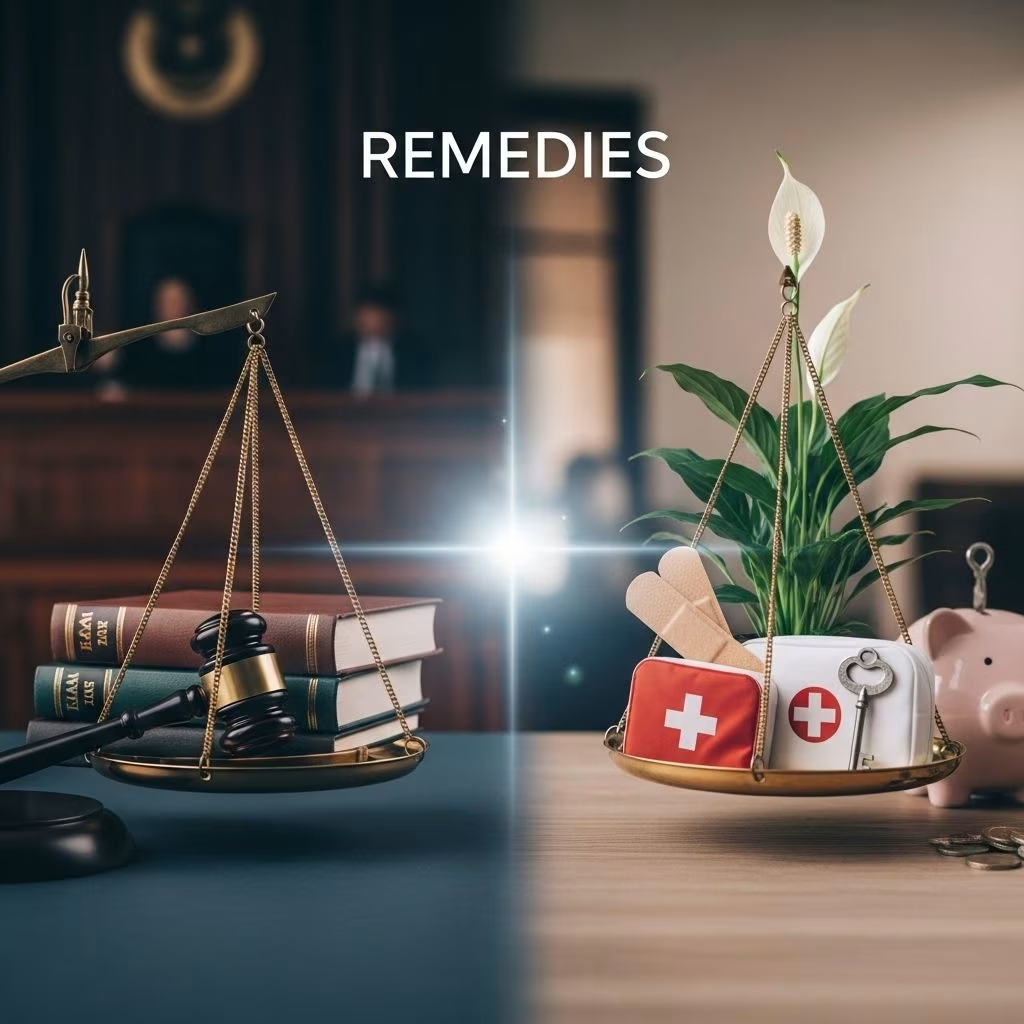
Remedies are fundamental to resolving problems, addressing harm, and restoring balance, whether in law, medicine, or daily life. Understanding the concept of remedies—how they are defined, how they function, and why they matter—is crucial for anyone seeking relief or redress from wrongs or injuries. This article offers a comprehensive exploration of the meaning of remedies, their classifications, and their significance, particularly in the realm of law, but also as they appear in broader contexts.
Definition of Remedies
A remedy is a means of solving or alleviating a problem or difficulty. It refers to anything that cures, corrects, or relieves an undesirable situation, injury, or illness. The concept is broad and can refer to:
- Medical remedies – treatments or substances that cure or relieve diseases or ailments.
- Legal remedies – solutions provided by law or courts to address legal wrongs, enforce rights, or prevent harm.
- Everyday remedies – practical fixes to everyday issues (e.g. using earplugs as a remedy for noise, or informal negotiation to resolve a dispute).
The term originates from the Latin remedium, meaning ‘that which heals or cures’ and has evolved to encompass both literal and metaphorical solutions to challenges.
Remedies in Everyday Life
Outside technical and legal realms, remedies take on a practical, accessible meaning:
- Treating a cold with herbal tea and rest.
- Applying aloe vera to soothe sunburn.
- Solving insomnia with a hot bath or blackout curtains.
Any effective solution that relieves a problem—medical, physical, social, or emotional—can be called a remedy.
Remedies in Law: Meaning and Importance
In the legal realm, a remedy is the means by which a court enforces a right, compensates a loss, or prevents or redresses a wrong. Legal remedies are vital for maintaining justice, enforcing obligations, and ensuring that wrongs are corrected.
- Restores parties to the position they were in before the harm, as far as possible.
- Enforces legal rights when violated.
- Deters future wrongdoing through compensation, punishment, or preventive orders.
- Resolves disputes fairly, under the rule of law.
Without the prospect of remedies, individuals would lack meaningful recourse for rights violations, and the law would lose much of its power and effectiveness.
Categories of Legal Remedies
The law recognizes several types of remedies, which are traditionally grouped as:
- Legal Remedies (Remedies at Law) – primarily monetary damages awarded to compensate for loss or injury.
- Equitable Remedies – non-monetary court orders such as injunctions or specific performance, aimed at achieving fairness when damages are insufficient.
- Declaratory Remedies – formal court declarations that clarify legal rights or obligations, without ordering any specific action or awarding damages.
- Restitutionary Remedies – focused on restoring property or preventing unjust enrichment, so that one party is not unfairly benefited at another’s expense.
- Provisional Remedies – temporary measures to protect interests until a final legal decision is made (e.g., temporary injunctions, asset freezes).
Each category serves a different function and may be appropriate based on the specific facts and goals in a dispute.
Types of Remedies
The main types of legal remedies are detailed below:
Legal Remedies: Damages
- Compensatory Damages – Monetary awards intended to reimburse the injured party for actual losses (e.g., medical bills, lost income).
- Punitive Damages – Money awarded to punish particularly egregious behavior and deter similar actions, over and above actual loss.
- Nominal Damages – Small sums awarded when a legal right is violated but no substantial harm occurred.
- Liquidated Damages – Sum agreed upon by parties in a contract, payable if the contract is breached.
Damages are the default and most common remedy for contract breaches and torts (civil wrongs), unless another form of relief is warranted.
Equitable Remedies
- Injunction – A court order requiring a party to do or refrain from doing a particular act (e.g., stop polluting a river, or cease using a trademark).
- Specific Performance – Requires a party to fulfill their obligations under a contract, commonly used when the subject matter is unique (real estate, rare goods).
- Rescission – Cancels a contract and restores the parties to their pre-contract position.
- Rectification – Corrects a written contract or document to reflect the parties’ true intentions.
Courts grant equitable remedies when legal (monetary) remedies are inadequate to achieve justice or prevent harm.
Declaratory Remedies
- Declaratory Judgment – A statement by a court that defines parties’ rights or obligations in a dispute. It does not require action or provide damages, but clarifies legal standing (e.g., in insurance or contract cases).
Restitutionary Remedies
- Restitution – Restores the injured party to the position they held before the loss or wrong, typically by returning money, property, or its fair value.
Restitution prevents unjust enrichment—ensuring that no one benefits unfairly from another’s loss.
Provisional Remedies
- Temporary Injunctions – Prevent harm while a lawsuit is ongoing.
- Attachment – Seizes property to secure a potential judgment.
- Garnishment – Withholds assets (like wages) to satisfy an eventual court order.
Provisional remedies safeguard rights before a dispute is fully resolved.
Selection and Enforcement of Remedies
Choosing the right remedy is crucial in legal disputes:
- Courts often prefer monetary remedies unless those are inadequate.
- Parties can seek several remedies but cannot receive double recovery for the same harm.
- Some remedies may not be available in certain situations (e.g., specific performance is rare in service contracts).
- Certain legal doctrines (such as election of remedies) require a party to select a single remedy when multiple options exist.
Once awarded, remedies are enforceable by law, with courts having the power to compel compliance, issue further orders, or impose sanctions for violations.
Remedies Beyond Law: Healthcare, Social Policy, and Business
Remedies are not exclusive to law:
- Healthcare: Medicines, therapies, and treatments applied to cure diseases or alleviate symptoms.
- Social Policy: Programs or interventions crafted to address social problems (poverty, discrimination, unemployment).
- Business: Strategic, operational, or financial adjustments addressing organizational challenges (e.g., restructuring as a remedy for inefficiency).
In all fields, remedies share the core objective of resolving problems and restoring balance.
Remedies: Legal vs. Equitable
Appreciating the differences between legal and equitable remedies is key for understanding their application. The table below summarizes the main distinctions:
| Feature | Legal Remedy | Equitable Remedy |
|---|---|---|
| Nature | Monetary compensation | Non-monetary relief (injunction, specific performance) |
| Purpose | Compensate for loss or injury | Enforce obligations or prevent harm |
| Availability | Default in most civil cases | Granted when monetary damages are insufficient |
| Historical Origin | Common law courts | Court of equity (Chancery) |
| Examples | Compensatory damages, punitive damages | Injunction, specific performance, rescission |
Frequently Asked Questions (FAQs)
Q1. What is the simplest definition of a remedy?
A remedy is a solution that solves, relieves, or fixes a problem, injury, or disease, whether through medical treatment, legal relief, or everyday problem-solving.
Q2. Why are remedies so important in law?
Remedies enforce legal rights, compensate for losses, prevent ongoing harm, and restore justice. Without remedies, legal rights would be empty promises with no practical effect.
Q3. What are the main categories of remedies in law?
The primary categories are legal remedies (monetary damages), equitable remedies (injunctive relief, specific performance), declaratory remedies (court declarations), restitutionary remedies (restoring property or value), and provisional remedies (temporary protections).
Q4. When do courts grant equitable remedies?
Courts award equitable remedies when monetary compensation is inadequate, especially in cases involving unique goods, irreparable harm, or ongoing violations.
Q5. Can legal and equitable remedies be awarded in the same case?
Yes. In appropriate cases, especially with complex harm, courts can combine both monetary and equitable relief, provided this does not result in double recovery.
Q6. What is an example of a remedy in tort law?
Compensatory damages paid to a plaintiff for losses suffered in a car accident are a classic legal remedy in tort law. An injunction stopping ongoing harassment is an equitable remedy.
Q7. Are remedies only available through courts?
No. Remedies can be informal or extrajudicial—such as negotiation, mediation, or self-help measures—but court-ordered remedies carry legal force and are enforceable.
Q8. Is restitution the same as compensation?
No. Compensation aims to cover the injured party’s loss, while restitution focuses on restoring the plaintiff’s status or preventing unjust enrichment, sometimes requiring the defendant to return a benefit gained unfairly.
Conclusion
The concept of remedies—be it in law, medicine, or everyday challenges—represents the search for solutions that address harm and restore balance. In law, remedies are the practical mechanisms by which rights are enforced and justice is realized. In daily life, remedies offer comfort, healing, and practical fixes. Mastery of the concept of remedies equips individuals, legal professionals, and organizations with essential tools for advocacy, conflict resolution, and the pursuit of well-being.
References
- https://www.vocabulary.com/dictionary/remedy
- https://mcdougalllawfirm.com/glossary/remedy/
- https://www.law.cornell.edu/wex/remedy
- https://www.upcounsel.com/legal-def-remedies-remedy
- https://www.dictionary.com/browse/remedy
- https://rvcc.pressbooks.pub/businesslaw131/chapter/chapter-14-remedies/
- https://fiveable.me/key-terms/torts/remedy
- https://en.wikipedia.org/wiki/Legal_remedy


