


What Is Object Permanence?
Object permanence is a crucial cognitive concept in child development. It refers to the understanding that objects continue to exist even when they cannot be directly observed—seen, heard, or touched. This realization emerges in infancy and serves as a foundation for more complex cognitive abilities later in life.1
- Before developing object permanence, children behave as if hidden objects or people have disappeared from existence.
- The concept is critical for understanding the world as stable and predictable despite changes in perspective or visibility.4
Origins: Piaget’s Theory and Stages of Cognitive Development
Jean Piaget, a pioneering developmental psychologist, studied how children acquire knowledge. He outlined distinct stages of cognitive growth and positioned object permanence as a key milestone achieved during the sensorimotor stage.2
| Piaget’s Stage | Age Range | Key Developments |
|---|---|---|
| Sensorimotor | Birth—2 years | Object permanence; coordination of senses and movements |
| Preoperational | 2—7 years | Symbolic thoughts; egocentrism |
| Concrete Operational | 7—11 years | Logical reasoning; conservation |
| Formal Operational | 12+ years | Abstract reasoning; hypothetical thinking |
Sensorimotor Stage: The Birthplace of Object Permanence
The sensorimotor stage (birth to age 2) is when children start recognizing that objects and people are individual entities that exist independently of their immediate surroundings.27
- Infants begin life without understanding object permanence.
- This skill develops gradually, signaling the completion of the sensorimotor stage and readiness to move on to more advanced learning.
Piaget’s Six Stages of Object Permanence Development
Piaget further divided the development of object permanence into six sub-stages, detailing how infants move from basic sensory responses to complex mental representations.13
- Reflex Schema (0–1 months): Babies react reflexively, learning how their bodies move without concept of permanence. Objects are experienced only through immediate sensation.3
- Primary Circular Reactions (1–4 months): Infants repeat pleasurable actions centered on their own bodies. There’s emerging awareness as infants may “search” with lips or mouth for objects like a breast or thumb.1
- Secondary Circular Reactions (4–8 months): Babies intentionally interact with their environment (e.g., shaking a rattle). They start to search for partially hidden objects, but may not look for items completely out of view. Visual tracking improves, showing the beginning of permanence.13
- Coordination of Secondary Circular Reactions (8–12 months): Infants intentionally search for objects that are hidden. The earliest true sense of object permanence appears. However, children at this stage tend to make the classic “A-not-B error,” meaning they search for an object where it was first hidden (location A), even after seeing it moved elsewhere (location B).23
- Tertiary Circular Reactions (12–18 months): Infants can solve new problems and track visibly moved objects even across several locations. If the object is moved out of sight, their tracking ability falters. They begin to link actions and outcomes.13
- Invention of New Means Through Mental Combinations (18–24 months): Children fully comprehend object permanence and can mentally visualize objects. They no longer fall for “A-not-B” errors and can reason about invisible displacements (e.g., a toy moved inside a box and the box relocated without them watching).3
Why Is Object Permanence Important?
Reaching object permanence is a landmark in early cognitive growth.2
- It measures completion of the sensorimotor stage (not simply reaching two years old).
- It supports further learning, independence, and problem-solving beyond infancy.
- Once acquired, children can engage in activities requiring memory, imagination, and theory of mind.
Without object permanence, children cannot understand stability in their world. This affects their emotional response (e.g., separation anxiety), memory, and ability to build trusting relationships.4
Examples of Object Permanence
- Peek-a-Boo: A classic game where adults hide their face, illustrating that infants lacking object permanence believe the person has disappeared.
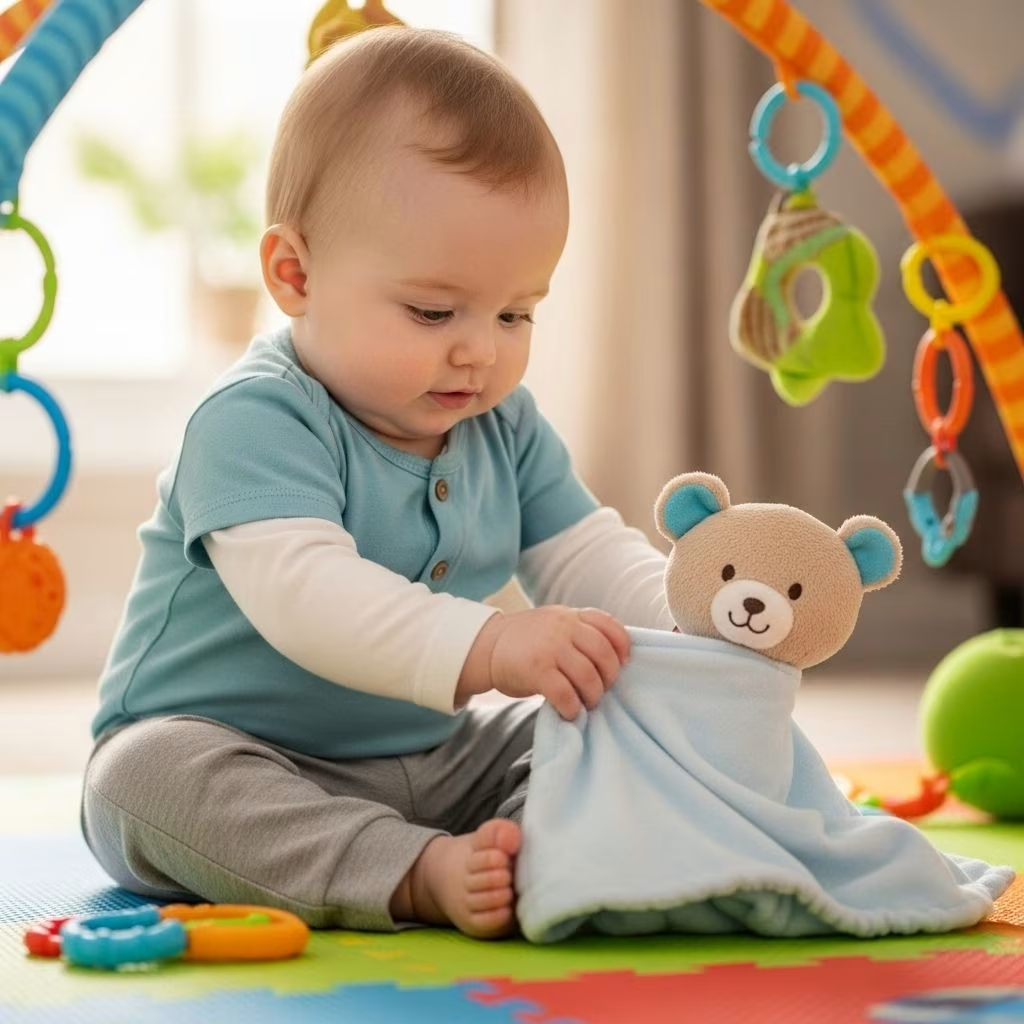
- Hidden Toys: Placing a toy under a blanket lets you watch if a baby tries to find it, a key test in measuring this skill.2
- A-not-B Error: If an object is moved from one hiding spot (A) to another (B) in the baby’s view and they look for it at A, it shows object permanence is still developing.3
Everyday Implications
Acquiring object permanence helps children cope when a caregiver leaves the room and fosters trust by teaching that people and objects don’t simply vanish.
Challenges and Limitations
- Developmental delays or disorders may impact the pace or quality of object permanence acquisition.
- Some children may require additional support or experience to develop this skill.
- Cultural and environmental factors can influence the specific timeline and ways children demonstrate understanding of permanence.
Object Permanence Beyond Infancy
While most research focuses on infants, the concept has broader applications in cognitive and emotional development. Understanding persistence and stability is critical throughout childhood and even influences adult beliefs about consistency in relationships and the physical world.4
- It forms the basis for recognizing patterns, sequences, and cause-effect relationships.5
- Aids in language development by helping children associate words with objects even when those objects are not present.
- Enables pretend play, imagination, and eventual abstract thinking.
Supporting Object Permanence in Your Child
Parents and caregivers can encourage the development of object permanence with simple activities and games:
- Playing peek-a-boo with infants to gently challenge their perception of disappearance.
- Hiding toys under blankets or containers and encouraging the child to search for them.
- Allowing brief separations and reunions to promote comfort with the knowledge of persistence.
- Providing a safe and predictable environment, reinforcing the reliability of objects and people.
Key Takeaways
- Object permanence is the ability to understand that objects exist even out of sight, hearing, or touch.
- Jean Piaget identified specific stages and experiments marking the gradual emergence of this skill in infancy.2
- Acquiring object permanence is necessary for further cognitive and social development.
- Simple games and caregiver practices can help support this aspect of early growth.
- Difficulties with object permanence may signal the need for early developmental intervention.
Frequently Asked Questions (FAQs)
Q: At what age do babies typically develop object permanence?
A: Most infants begin to show signs of object permanence by 6–8 months, reaching full understanding between 18 and 24 months, although this varies individually.68
Q: How did Piaget test object permanence?
A: Piaget used the “Ball and Blanket Study”: he hid a toy under a blanket and observed whether the baby tried to find it. Success indicated some understanding of object permanence.2
Q: Why is object permanence important?
A: It enables children to remember people and objects, build relationships, and engage in more complex learning. Without it, babies believe that things lost from sight no longer exist.4
Q: What is the “A-not-B error”?
A: A common mistake in infants during object permanence development, where they search for a hidden object at its original hiding place (A) even after seeing it moved to a new place (B).3
Q: Can adults struggle with object permanence?
A: While rare, developmental disorders can affect this early skill into later life. However, most adults fully master object permanence, using it as a foundation for memory and reasoning.
Conclusion
Object permanence is a hallmark of human cognitive development. Emerging through distinct predictable stages in infancy, its acquisition signals growing mental complexity and sets the stage for all future learning. Through understanding, observing, and supporting this process, parents and professionals can help foster a child’s ongoing ability to navigate and make sense of a stable, persistent world.
References
- https://www.simplypsychology.org/object-permanence.html
- https://study.com/academy/lesson/piagets-object-permanence-in-infants-definition-examples-quiz.html
- https://en.wikipedia.org/wiki/Object_permanence
- https://williamsburgtherapygroup.com/blog/what-is-object-permanence
- https://activelearningspace.org/cognitive-skills/cause-and-effect-object-permanence/
- https://www.webmd.com/baby/what-age-do-babies-have-object-permanence
- https://www.medicalnewstoday.com/articles/325030
- https://www.ncbi.nlm.nih.gov/books/NBK537095/


