


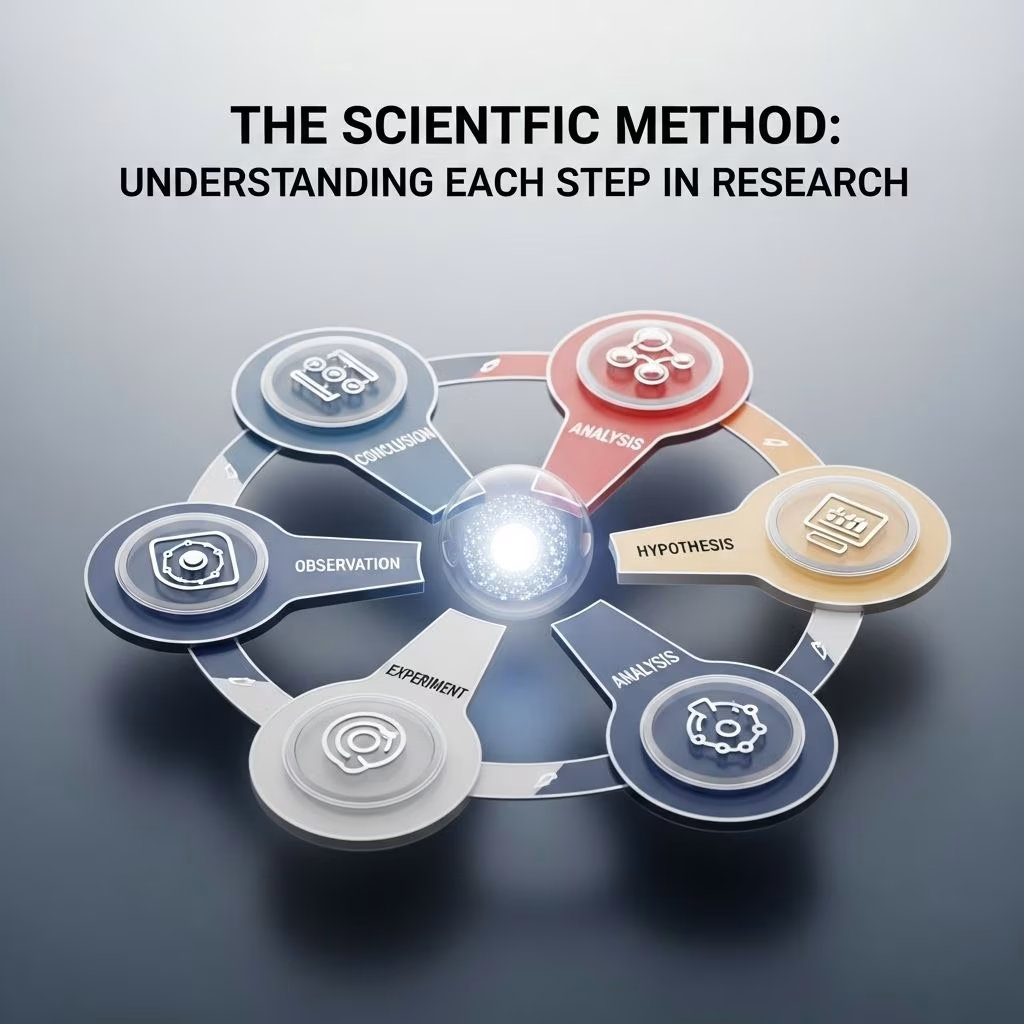
The scientific method is a structured, logical process used by scientists and researchers to explore questions, uncover new knowledge, and draw reliable conclusions. Operating at the heart of all scientific inquiry, this method provides a systematic framework for investigating phenomena, constructing hypotheses, and rigorously testing those ideas through experiments and observation. By following clearly defined steps, the scientific method ensures that findings are reproducible, objective, and grounded in evidence, which is essential to the progress of science.
What Is the Scientific Method?
The scientific method is not just for professional scientists—it is a critical thinking process anyone can use to analyze problems or test ideas. This approach is fundamental in biology, psychology, chemistry, physics, and even in everyday problem solving. While the exact number and naming of steps may vary slightly depending on the source or discipline, the foundational structure remains consistent: inquiry, hypothesis, experimentation, analysis, and communication of findings.
Why Is the Scientific Method Important?
Using a structured method to test ideas reduces bias, increases reliability, encourages collaboration, and leads to robust results. The scientific method ensures that scientific research produces results that can be independently verified, leading to advancements that improve our understanding of the world. It also allows researchers to build upon each other’s work, verify claims, and refine theories.
Overview of the Steps in the Scientific Method
| Step | Description |
|---|---|
| 1. Ask a Question / Make an Observation | Identify a specific, measurable problem or curiosity. |
| 2. Do Background Research | Gather existing information and previous studies. |
| 3. Formulate a Hypothesis | Develop an educated, testable guess or explanation. |
| 4. Conduct an Experiment | Test the hypothesis through systematic observations and controlled procedures. |
| 5. Analyze Data | Evaluate results using logical reasoning and, if appropriate, statistics. |
| 6. Draw Conclusions | Decide whether the data support or refute the hypothesis. |
| 7. Communicate Results | Share your findings with others through reports, presentations, or publications. |
Step 1: Ask a Question / Make an Observation
The first stage involves making a clear observation or asking a focused question. Good questions typically begin with words like how, what, when, who, which, why, or where. To ensure that the question can be explored scientifically, it should be measurable and answerable through experimentation.
- Example: Does listening to classical music impact the concentration levels of college students during study sessions?
- Ask questions that are specific. Instead of “Do people like music?”, ask “Does classical music improve study performance in college students?”
Step 2: Do Background Research
Once the question is established, the next step is to research existing information. This involves reviewing academic literature, former experiments, journal articles, and reliable online resources. Effective background research helps you:
- Avoid repeating mistakes from prior studies
- Formulate a realistic, testable hypothesis
- Identify potential challenges or variables
Sources for background research include scientific journals, books, credible websites, expert interviews, and library databases.
Step 3: Formulate a Hypothesis
A hypothesis is a tentative explanation or educated guess about the answer to your question. It should be specific, measurable, and testable. Frequently, hypotheses are written in an ‘if…then…’ format—for example, “If students listen to classical music while studying, then their test scores will increase.”
- Testable: Your hypothesis must be structured so that it can be supported or refuted through experimentation or data collection.
- Clear prediction: Include a prediction that can be measured or observed.
Example Hypothesis Structure:
If [specific action or change], then [expected result or observation].
Step 4: Conduct an Experiment
This crucial step involves designing and running a systematic test of your hypothesis. A strong experiment uses controlled variables, meaning that other factors (apart from the one being tested) remain constant to ensure fair testing. Experiments can be conducted in a laboratory, natural environment, or through computer simulations, depending on the research question.
- Plan methodically: Define procedures, equipment, timeline, and required materials.
- Control variables: Change only one independent variable at a time while keeping others constant.
- Repeatability: Conduct the experiment multiple times to ensure results are reliable.
During this phase, careful and unbiased data collection is essential. Record all observations and measurements accurately.
Step 5: Analyze Data and Draw Conclusions
After conducting the experiment, analyze the collected data to evaluate whether the results support or reject your hypothesis.
- Quantitative data (numbers, measurements) are often analyzed using statistical methods.
- Qualitative data (descriptions, categories) are analyzed for patterns and recurring themes.
During analysis:
- Organize data in tables, charts, or graphs.
- Identify any trends or unexpected outcomes.
- Determine whether your hypothesis is supported (data agrees) or not supported (data disagrees).
If your hypothesis is not supported, that’s still valuable—unexpected results often lead to new discoveries or hypotheses.
Step 6: Communicate Results
The final stage in the scientific method is disseminating your results to others. Transparent communication ensures that your findings can be verified, replicated, or built upon by other researchers. Scientists typically share outcomes via:
- Research papers or articles in peer-reviewed journals
- Conference presentations, posters, or talks
- Science fairs, classrooms, or community events
- Online platforms and databases
A proper report includes an overview of your method, results, discussion of their significance, and any limitations or ideas for future research.
Iterative Nature of the Scientific Method
It’s important to note that the scientific method is not always a straight line; it is iterative. Scientists often return to previous steps, revising their hypothesis or designing new experiments based on recent findings.
- If results are unexpected, researchers might perform additional background research.
- Negative or inconclusive results prompt the formulation of new hypotheses and experiments.
- Continuous retesting ensures robustness and accuracy.
Applications of the Scientific Method in Everyday Life
Although strongly associated with academic research, the scientific method’s logical sequence applies to everyday situations. For instance:
- If your smartphone fails to turn on (observation), you hypothesize the battery is dead. After charging (experimenting), the device works (data), confirming your hypothesis.
- Cooking a new recipe can be science—you observe, test, analyze, and tweak for better results.
Best Practices for Using the Scientific Method
- Stay objective: Avoid letting personal beliefs taint your process or interpretation of data.
- Use reliable sources: When researching, consult peer-reviewed journals and recognized authorities.
- Keep thorough records: Document each stage and observation meticulously.
- Be open to revision: Science thrives on continuous improvement and learning from failed attempts.
Common Misconceptions About the Scientific Method
- Myth: The steps must be followed strictly in order.
Fact: While order can be important for clarity, real-world research often moves fluidly between steps. - Myth: Only ‘positive’ results have value.
Fact: Negative outcomes are equally important—they inform future research and avoid repeating errors. - Myth: The scientific method is only for scientists.
Fact: Anyone can apply scientific thinking to solve problems and make informed decisions.
Frequently Asked Questions (FAQs) About the Scientific Method
Q: Is the scientific method the same in all areas of science?
A: The foundational steps are similar across scientific disciplines, but implementation can vary depending on the specific field, research question, and type of data analyzed. For example, in biology, the focus may be on living organisms, while in physics, the emphasis is often on physical phenomena.
Q: What is the difference between a hypothesis and a theory?
A: A hypothesis is a testable prediction or educated guess about a specific problem. A theory is a well-substantiated explanation of some aspect of the natural world, backed by a large body of evidence and multiple, consistent experiments.
Q: Can you skip steps in the scientific method?
A: While it’s best to follow each stage, real-world science is often non-linear and iterative. Some steps may overlap, repeat, or be omitted if already thoroughly addressed in prior research.
Q: How do scientists ensure their results are reliable?
A: Reliability is strengthened through fair testing (changing one variable at a time), repetition, peer review, and transparent reporting. Results are considered robust when they are reproducible by others under similar conditions.
Q: Why is communicating results so important in science?
A: Sharing findings allows others to verify, critique, build upon, or challenge conclusions, accelerating the advancement of scientific knowledge.
Quick Tips for Success with the Scientific Method
- Ask clear, focused questions.
- Perform thorough background research before hypothesizing.
- Design fair, repeatable experiments.
- Analyze results with an open mind, not just to confirm expectations.
- Share both positive and negative outcomes—both drive science forward.
Summary
Mastering the scientific method equips individuals with powerful tools for critical thinking and structured problem-solving. By moving systematically from observation and inquiry to hypothesis, experimentation, and clear communication, anyone can contribute to the growing body of knowledge about our world. Whether in a professional lab, classroom, or at home, the scientific method promotes curiosity, rigor, and ultimately, discovery.
References
- https://www.indeed.com/career-advice/career-development/scientific-method-steps
- https://www.sciencebuddies.org/science-fair-projects/science-fair/steps-of-the-scientific-method
- https://www.techtarget.com/whatis/definition/scientific-method
- https://en.wikipedia.org/wiki/Scientific_method
- https://www.simplypsychology.org/steps-of-the-scientific-method.html
- https://www.khanacademy.org/science/biology/intro-to-biology/science-of-biology/a/the-science-of-biology
- https://www.amnh.org/explore/videos/the-scientific-process
- https://www.youtube.com/watch?v=c6Gp2R0wzhU


