


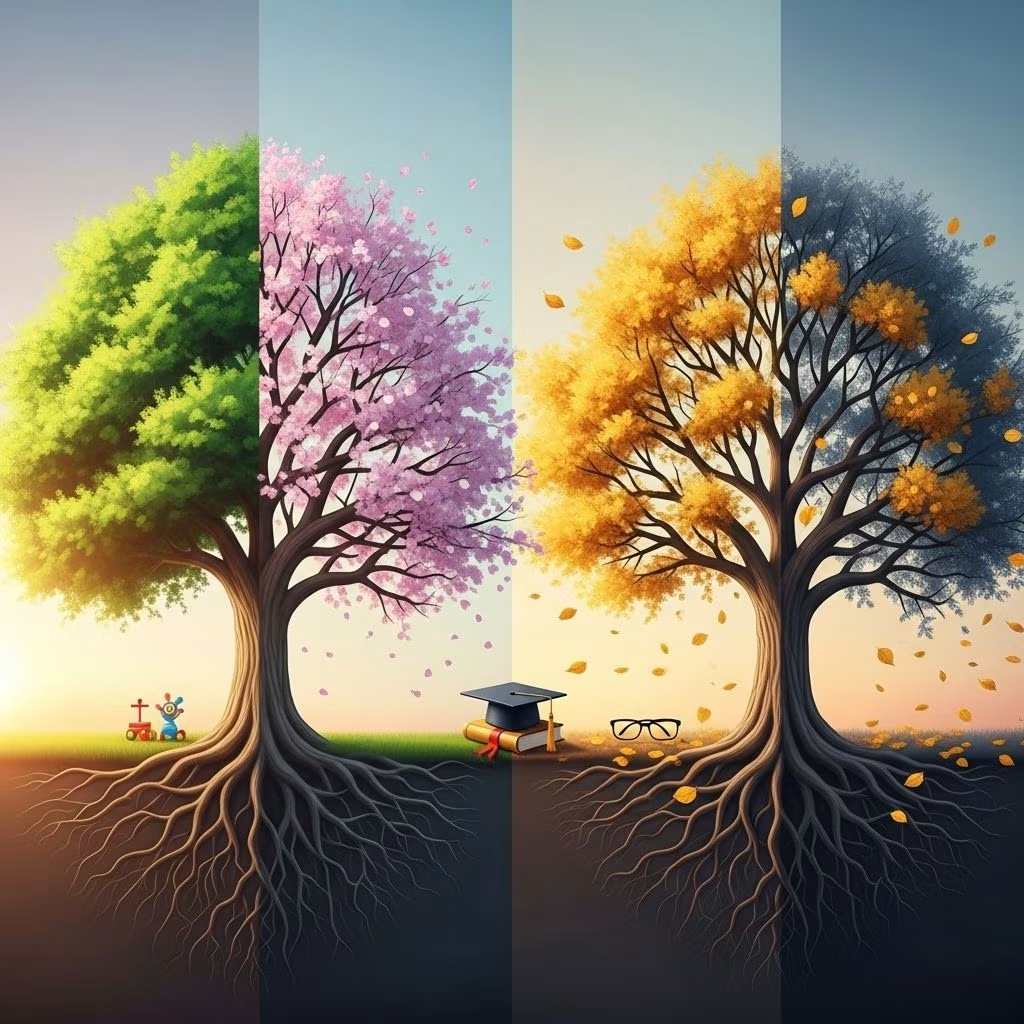
Developmental psychology is the scientific study of how people grow, change, and adapt throughout their lives. This branch of psychology delves into the patterns of physical, cognitive, social, and emotional growth and decline that characterize the human journey from conception to old age. Despite its initial focus on childhood and adolescence, developmental psychology today encompasses the entire lifespan, offering essential insights for families, educators, clinicians, and anyone interested in human nature.
What is Developmental Psychology?
At its core, developmental psychology seeks to explain how and why individuals change over time—how we acquire new abilities, navigate transitions, and maintain core characteristics despite transformation. Unlike early approaches that viewed children simply as miniature adults, modern developmental psychologists recognize that each life stage brings distinct ways of thinking, feeling, and behaving.
Key areas of inquiry include:
- Physical development: Growth of the body and brain, sensory and motor skills.
- Cognitive development: Evolution of thinking, problem-solving, and language.
- Social and emotional development: Changes in relationships, personality, emotions, and identity.
This dynamic discipline draws on biological, social, and cultural influences, striving to answer big questions, such as how nature and nurture interact to shape who we are, and whether development is best viewed as continuous or stage-like in nature.
Brief History of Developmental Psychology
Developmental psychology arose as a distinct domain in the late 19th and early 20th centuries, as psychologists moved away from adult-centric views and began systematically observing how children’s minds differed from those of grown-ups.
- G. Stanley Hall: Often called the “father of adolescence,” Hall was a pioneer in child and adolescent development, arguing that each stage has unique features requiring specialized study and care.
- Jean Piaget: Piaget’s research on children’s reasoning revolutionized developmental psychology, suggesting that children actively construct their understanding of the world in qualitatively different ways from adults.
- Arnold Gesell: Gesell’s work on physical and motor development illustrated how biological maturation sets the pace for changes in skills like walking and talking.
Since these early advancements, the field has expanded to address the entire scope of human growth—from prenatal stages to late adulthood and aging.
Main Goals of Developmental Psychology
Developmental psychology is guided by three principal goals that drive research and practical applications:
- Describe human development by observing how individuals grow and change across life stages.
- Explain the underlying causes and mechanisms that drive developmental change, including biological, psychological, and social factors.
- Optimize development by applying knowledge to foster healthy, adaptive outcomes—e.g., informing parenting, education, or therapies.
Core Concepts in Developmental Psychology
Domains of Development
| Domain | Description | Examples |
|---|---|---|
| Physical | Biological growth, maturation, sensory & motor skills | Walking, puberty, brain development |
| Cognitive | Thinking, memory, language, problem-solving | Language acquisition, moral reasoning, intelligence |
| Social/Emotional | Relationships, personality, emotion regulation | Attachment, identity, coping with stress |
Key Issues and Debates
- Nature vs. Nurture: Debates the degree to which genetics (nature) and environment (nurture) influence development.
- Continuity vs. Discontinuity: Examines whether development is a smooth, gradual process or occurs in distinct stages.
- Stability vs. Change: Considers which characteristics remain consistent across the lifespan and which are likely to change.
Influential Theories in Developmental Psychology
Stage Theories
- Jean Piaget’s Theory of Cognitive Development: Proposes four universal stages—sensorimotor, preoperational, concrete operational, and formal operational—each marked by unique patterns of thinking.
- Erik Erikson’s Psychosocial Stages: Suggests eight key conflicts or crises that must be resolved from infancy through late adulthood, such as trust vs. mistrust and identity vs. role confusion.
- Sigmund Freud’s Psychosexual Stages: Focuses on how early experiences in five stages (oral, anal, phallic, latency, genital) shape personality.
Other Major Theoretical Approaches
- Vygotsky’s Sociocultural Theory: Stresses the role of social interaction and culture in cognitive development, emphasizing language and guidance from others.
- Information Processing Theory: Compares human mental functioning to computers, focusing on how individuals encode, store, and retrieve information over time.
- Ecological Systems Theory (Bronfenbrenner): Argues that development is shaped by multiple environmental systems—from close family and school to broader cultural and societal contexts.
Stages of Human Development
Developmental psychology organizes human growth into major stages, each defined by unique challenges and achievements.
- Prenatal Period: Spanning from conception to birth, tremendous growth and vulnerability mark this stage as fundamental to later development.
- Infancy and Toddlerhood (Birth–age 2): Rapid gains in motor skills, attachment bond formation, language emergence, and sensory exploration.
- Early Childhood (Ages 3–6): Growth in imagination, early logic, self-control, and initial friendships.
- Middle Childhood (Ages 7–11): Mastery of academic skills, increasing independence, peer group importance, moral understanding.
- Adolescence (Ages 12–18): Dramatic physical changes (puberty), pursuit of identity, developing autonomy, complex peer and family relationships.
- Early Adulthood (Ages 19–40): Focus on intimate relationships, career exploration, independent living.
- Middle Adulthood (Ages 40–65): Balancing work and family, reevaluating life goals, physical aging begins.
- Late Adulthood (65+): Coping with retirement, health changes, reflecting on life meaning, and adjusting to loss.
Why Developmental Psychology Matters
- Educators use knowledge of developmental milestones to design age-appropriate curricula and identify learning challenges early.
- Healthcare professionals apply developmental insights to diagnose and support mental health needs at different life stages.
- Parents benefit by understanding how their children’s emotional, cognitive, and social needs evolve across childhood and adolescence.
- Policymakers rely on developmental science to inform public health practices, such as vaccination schedules or childhood nutrition programs.
Research Methods in Developmental Psychology
Studying change over time requires special methods:
- Longitudinal Studies: Track the same group of participants over an extended period to observe individual developmental trajectories.
- Cross-sectional Studies: Examine individuals of different ages at a single point in time, offering snapshots of age-related differences.
- Sequential (Cross-sequential) Studies: Combine both approaches, following multiple cohorts over time for more robust data.
- Observational Methods: Direct observation in naturalistic or laboratory settings, often used for infants and children.
- Self-Report and Parental Report: Questionnaires or interviews to capture subjective experiences and developmental milestones.
Key Terms in Developmental Psychology
- Maturation: Genetically driven natural development, occurring independent of experience.
- Normative Development: Typical sequence and timing of growth milestones experienced by most individuals within a population.
- Idiographic Approach: Focuses on understanding unique individual differences through qualitative study.
Applications, Careers, and Specializations
Developmental psychology has practical significance in various settings, including:
- Educational psychology
- Child development and early childhood education
- Counseling and psychotherapy
- Forensic developmental psychology
- Cultural and ecological psychology
- Aging and geriatric services
Professionals may work as researchers, counselors, clinicians, educators, policy advisors, or developmental specialists in diverse environments.
Influential Figures in Developmental Psychology
- Jean Piaget (Cognitive Development)
- Erik Erikson (Psychosocial Stages)
- Lev Vygotsky (Sociocultural Theory)
- Urie Bronfenbrenner (Ecological Systems Theory)
- Sigmund Freud (Psychosexual Stages)
- Anna Freud (Child Psychoanalysis)
- Arnold Gesell (Maturation)
Frequently Asked Questions (FAQs)
What are the three main goals of developmental psychology?
The three primary goals are to describe, explain, and optimize human development by observing patterns, uncovering driving mechanisms, and applying this knowledge to enhance well-being at all life stages.
How does developmental psychology differ from other branches of psychology?
While other fields may focus on specific aspects—such as cognition (cognitive psychology) or abnormal behavior (clinical psychology)—developmental psychology uniquely emphasizes changes and consistencies across the entire lifespan.
Why is understanding developmental stages important?
Recognizing the different needs and abilities at each life stage allows for better educational strategies, healthier relationships, and more targeted support for mental and emotional health.
What research methods are commonly used in developmental psychology?
Longitudinal, cross-sectional, and sequential studies are most common, along with observational, self-report, and interview techniques—which together clarify both universal and individual paths of development.
Who are some key theorists in developmental psychology?
Notable figures include Jean Piaget, Erik Erikson, Lev Vygotsky, Urie Bronfenbrenner, Sigmund Freud, and Arnold Gesell, each of whom contributed foundational theories on how humans grow, learn, and adapt through life.
Further Exploration: Challenges and Recent Directions
- Contemporary developmental psychology explores the complex interplay of genetics, environment, and culture in shaping personality, resilience, and vulnerability across generations.
- The field now emphasizes a lifespan perspective—no longer focusing solely on children, but recognizing profound changes and growth opportunities in adulthood and aging.
- Researchers acknowledge individual differences and the importance of cultural context, moving away from one-size-fits-all models.
- Modern studies address public health, educational policy, neurodiversity, and aging-related challenges, highlighting the practical value of developmental knowledge for real-world problem-solving.
By understanding the lifelong journey of human development, developmental psychology empowers individuals, families, and societies to foster healthy growth, adapt to life’s challenges, and embrace each stage of the human story with insight and compassion.
References
- https://www.simplypsychology.org/developmental-psychology.html
- https://www.pearson.com/channels/psychology/learn/hannah/introduction-to-psychology/developmental-psychology
- https://www.albert.io/blog/developmental-psychology-ap-psychology-review/
- https://en.wikipedia.org/wiki/Developmental_psychology
- https://www.nu.edu/blog/what-is-developmental-psychology/
- https://www.apa.org/education-career/guide/subfields/developmental
- https://positivepsychology.com/developmental-psychology-stages/


