


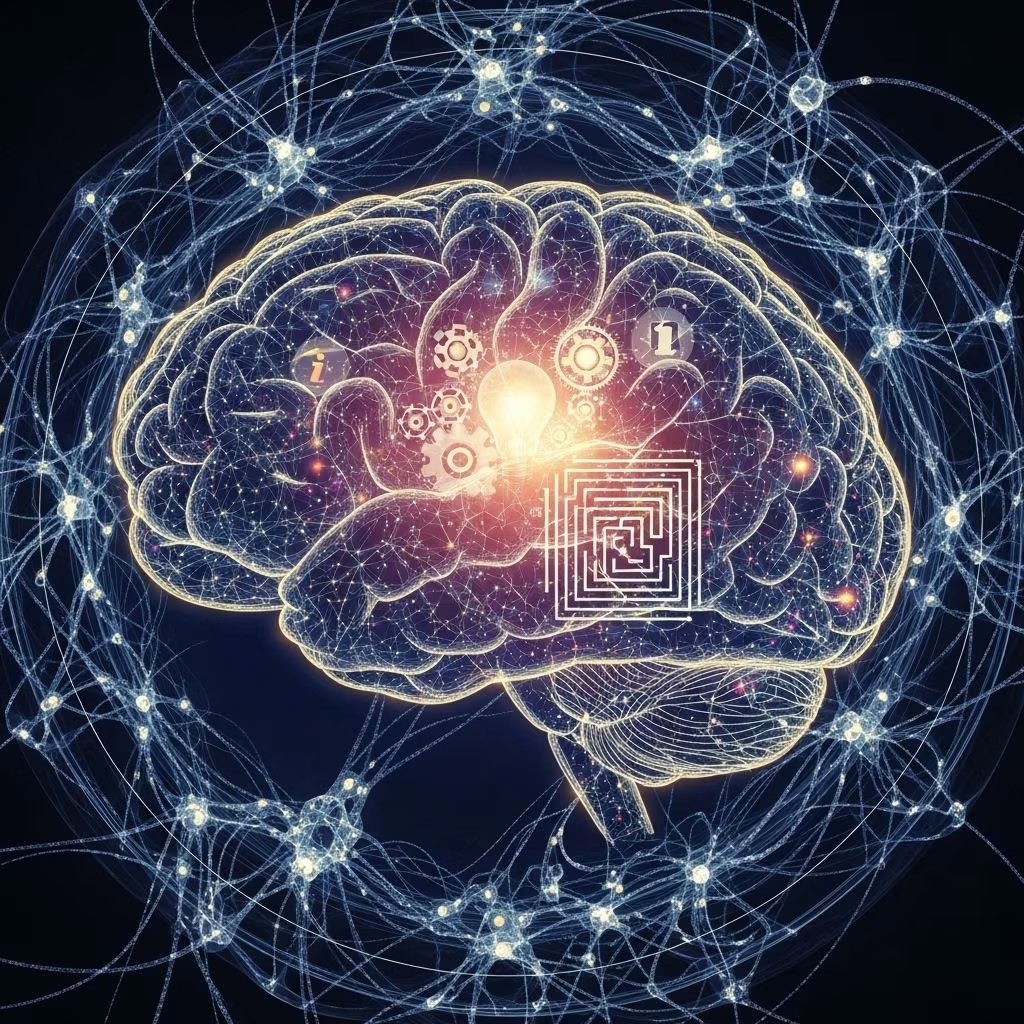
Cognitive Theory: Understanding How We Think and Learn
Cognitive theory is a foundational concept in psychology that seeks to explain how people acquire, process, and store information. By focusing on internal mental processes such as perception, attention, and memory, cognitive theory has dramatically shifted our understanding of human behavior, learning, and mental health. This article explores the key ideas, history, major theorists, and applications of cognitive theory, as well as its strengths and limitations.
What Is Cognitive Theory?
Cognitive theory suggests that thoughts, beliefs, and interpretations shape an individual’s feelings and actions—not simply the external events they experience. This approach contrasts sharply with earlier psychological models like behaviorism, which focused primarily on observable behavior rather than inner experiences.
Cognitive theory forms the backbone for numerous applications in mental health, education, and everyday life by recognizing that:
- People actively interpret and assign meaning to the world
- Mental processes drive decision-making and emotion
- Learning involves building, changing, and organizing internal frameworks
Cognitive theory is central in fields such as cognitive psychology, cognitive science, education, and psychotherapy .
The History of Cognitive Theory
The study of cognition traces its roots back to ancient philosophers like Plato and Descartes, who speculated about perception, knowledge, and the connection between mind and body. Over centuries, philosophical concepts such as mind-body dualism (the mind and body as separate entities), empiricism (knowledge through sensory experience), and nativism (innate mental capacities) laid the foundation for modern cognitive science .
The rise of cognitive psychology as a scientific field occurred in the mid-20th century, in response to the limitations of behaviorism—a theory that dismissed unobservable internal mental processes. Advances in computers and information theory provided a powerful metaphor for the mind as an information processor, prompting new ways to understand mental functions through laboratory experiments and computational models.
- 1950s: Computer science and linguistics influence psychology.
- 1956: The term ‘cognitive psychology’ gains traction.
- 1960s: Cognitive psychology is established as a key discipline, influencing economics, neuroscience, education, and beyond.
Major Theorists in Cognitive Psychology
Cognitive theory would not exist without several key contributors. Their theoretical breakthroughs shaped our current understanding:
- Jean Piaget: Developed a comprehensive theory of cognitive development in children, outlining stages through which children learn to think and reason.
- Albert Bandura: Pioneered social cognitive theory—demonstrating how people learn by observing others and how cognition mediates learning.
- Aaron T. Beck: Founded cognitive therapy, emphasizing the role of negative thought patterns in mental health issues like depression and anxiety.
- Albert Ellis: Created Rational Emotive Behavior Therapy (REBT), focusing on changing irrational thoughts to improve emotional well-being.
Core Principles of Cognitive Theory
Cognitive theory asserts that the human mind works similarly to a computer—receiving information, processing it, and generating responses. The main principles include:
- Behavior is shaped by the mental processes between stimulus and response.
- Internal mental states—such as beliefs, desires, and motivations—directly influence perception, emotion, and action.
- New learning is built upon existing mental frameworks, or schemas.
The Information Processing Approach
Cognitive psychologists use the information processing model to describe how information moves through the mind:
- Input: Sensory data from the environment
- Processing: Transformation, storage, retrieval, and use of information by the mind
- Output: Observable actions or verbal responses
This model allows researchers to break down complex mental tasks into smaller components that are easier to study and understand .
Key Cognitive Processes
Cognitive theory focuses on the processes that dictate how information is managed internally. The core cognitive processes include:
- Perception
- Attention
- Memory
- Thinking and Reasoning
- Language
Perception
Perception refers to how individuals organize and interpret sensory information to understand the world. Rather than passively receiving information, people actively construct meaning, influenced by prior experiences, expectations, and context. Perceptions are subjective and can lead to different interpretations of the same event .
Attention
Attention is the ability to selectively focus on specific stimuli while ignoring others. Since attention is limited in capacity, it determines which information is processed further and which is filtered out. This helps people prioritize what is most relevant to their goals or survival .
Memory
Memory is the process of encoding, storing, and retrieving information. Cognitive psychologists typically divide memory into three major types:
- Sensory Memory: Very brief retention of sensory input (milliseconds)
- Short-Term Memory: Holds information temporarily for manipulation and rehearsal (seconds to minutes)
- Long-Term Memory: Stores information for extended periods, potentially for a lifetime
How information moves between these stages depends on factors like attention, repetition, and meaningful connections with existing memories .
Thinking and Reasoning
Thinking involves mentally manipulating information, forming concepts, solving problems, and making decisions. Reasoning uses logic to draw conclusions or make predictions. Cognitive theory investigates patterns and errors in human reasoning, such as biases and logical fallacies, and how mental models guide problem-solving.
Language
Language involves both production and comprehension, allowing us to represent knowledge, communicate, and think abstractly. The study of language within cognitive psychology has revealed key insights into how humans organize, process, and retrieve verbal information .
Schemas, Assimilation, and Accommodation
A central concept in cognitive theory is that humans rely on internal frameworks, or schemas, to interpret new information.
- Schemas: Mental structures that organize and categorize knowledge from past experience.
- Assimilation: Fitting new information into existing schemas.
- Accommodation: Altering existing schemas or creating new ones to incorporate new information.
This dynamic supports adaptation and learning. When we encounter something unfamiliar, we first try to assimilate it using existing mental models. If this fails, accommodation occurs, resulting in updated or new schemas .
Major Cognitive Models
To clarify how mental processes work, cognitive psychologists propose various models. These models are valuable tools for generating testable predictions and examining mental functions in detail.
| Model | Description |
|---|---|
| Information Processing Model | Describes the flow of information through input, storage, and output stages. |
| Multi-Store Model of Memory | Proposes three distinct memory stores: sensory, short-term, and long-term memory. |
| Working Memory Model | Posits multiple components managing short-term processing, including the phonological loop and visuospatial sketchpad. |
| Schema Theory | Explains how mental frameworks shape perception, learning, and memory. |
These models are continually refined based on empirical research, technological advances, and growing knowledge about the brain.
Applications of Cognitive Theory
Cognitive theory’s concepts have practical implications across various domains:
- Mental Health: Forms the basis for therapies such as Cognitive Behavioral Therapy (CBT) and Rational Emotive Behavior Therapy (REBT).
- Education: Informs teaching strategies that promote meaningful learning, active engagement, and adaptive thinking.
- Artificial Intelligence: Inspires computational models emulating human cognition, guiding AI and machine learning advances.
- Neuroscience: Collaborates with brain imaging to clarify how specific mental processes are realized biologically.
Cognitive Therapies
Cognitive therapy focuses on identifying and challenging automatic negative thoughts and beliefs that contribute to emotional and behavioral problems. Popular approaches include:
- Cognitive Behavioral Therapy (CBT): Uses structured interventions to change maladaptive thinking patterns and promote positive behavior.
- Rational Emotive Behavior Therapy (REBT): Emphasizes restructuring irrational beliefs to improve emotional responses.
These therapies have proven highly effective for conditions such as depression, anxiety, and phobias .
Educational Impact
Cognitive learning theories help educators:
- Recognize students’ pre-existing schemas
- Design lessons that promote active processing and meaningful connection
- Encourage critical thinking and problem solving
Everyday Problem-Solving
Cognitive theory also helps explain how people approach daily decisions, adapt to challenges, and develop expert knowledge in specific domains. By understanding cognitive mechanisms, individuals can improve their own thinking and learning strategies.
Strengths and Limitations of Cognitive Theory
| Strengths | Limitations |
|---|---|
|
|
Frequently Asked Questions (FAQs)
Q: What is cognitive theory?
A: Cognitive theory investigates how internal mental processes—such as perception, memory, and reasoning—shape human behavior, learning, and emotion.
Q: Who are the main contributors to cognitive theory?
A: Major figures include Jean Piaget, Albert Bandura, Aaron Beck, and Albert Ellis, each of whom advanced our understanding of mental processes in unique ways.
Q: How does cognitive theory differ from behaviorism?
A: While behaviorism focuses only on observable behaviors, cognitive theory emphasizes the importance of unobservable mental processes in determining behavior and learning.
Q: What are the practical applications of cognitive theory?
A: Cognitive theory underpins therapies for mental health (like CBT), guides educational strategies, informs artificial intelligence research, and enhances understanding of human learning and decision-making.
Q: What are schemas in cognitive theory?
A: Schemas are mental structures based on previous experiences that help individuals organize and interpret new information.
Key Takeaways
- Cognitive theory has revolutionized psychology by focusing on internal mental processes rather than solely observable behavior.
- Main cognitive processes include perception, attention, memory, thinking, and language.
- Schema theory, assimilation, and accommodation explain how people adapt and restructure knowledge.
- Applications range from therapy and education to technology and neuroscience.
- Cognitive theory’s models are powerful but are most effective when integrated with insights from other psychological perspectives.
References
- https://www.mentalhealth.com/library/cognitive-theory-and-therapies
- https://www.amu.apus.edu/area-of-study/arts-and-humanities/resources/what-is-cognitive-psychology-and-why-is-it-so-important/
- https://www.simplypsychology.org/cognitive.html
- https://study.com/learn/lesson/cognitive-theory.html
- https://www.wichita.edu/services/mrc/OIR/Pedagogy/Theories/cognitive.php
- https://study.com/learn/lesson/video/cognitive-theory.html


