


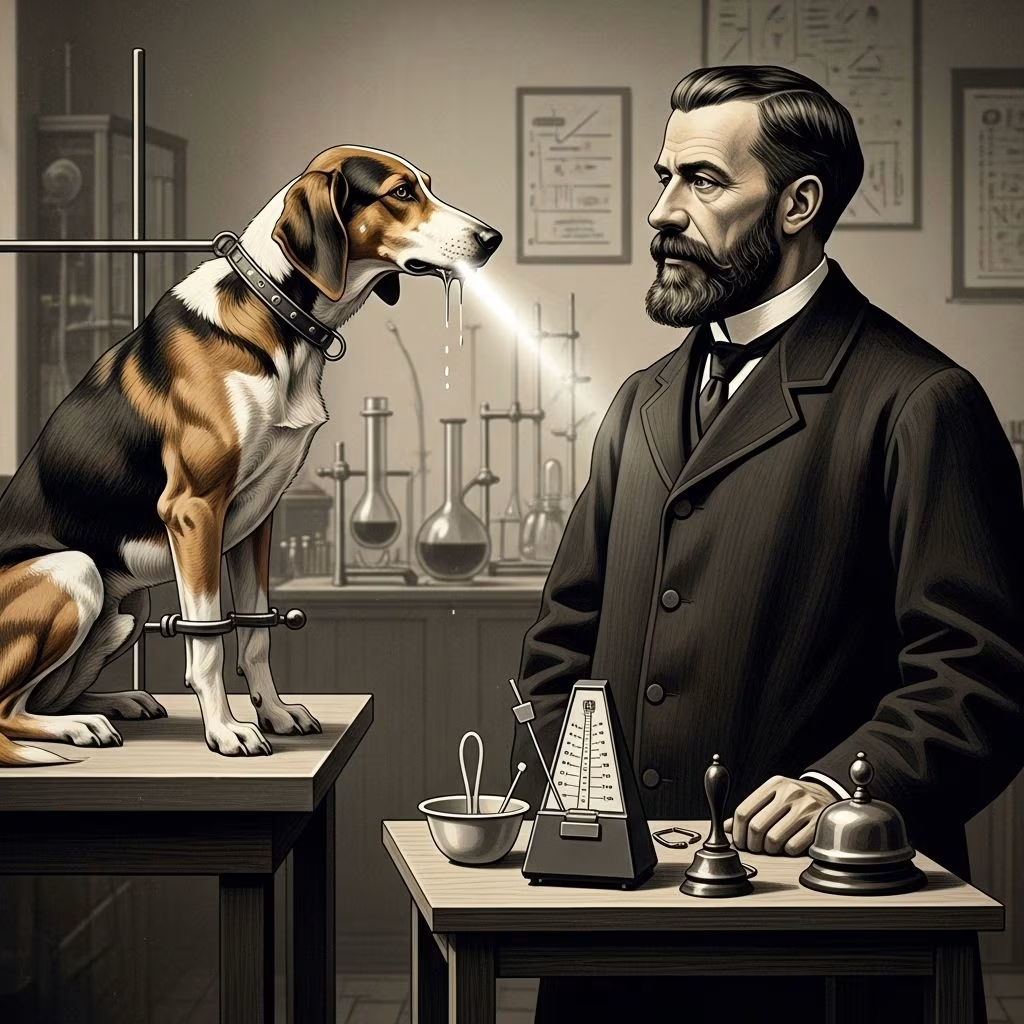
Pavlov’s Dogs: The Experiment That Changed Psychology
In the late 19th and early 20th centuries, Russian physiologist Ivan Pavlov conducted a series of experiments that would dramatically transform the way scientists understand learning and behavior. Initially interested in the digestive processes of dogs, Pavlov stumbled upon a phenomenon that would become known as classical conditioning. His research demonstrated how living beings, both human and nonhuman, can learn to associate neutral events with significant ones, leading to learned responses that are automatic and enduring. This article explores Pavlov’s groundbreaking experiments, the core concepts he developed, and the profound impact his work has had both within and outside of psychology.
Ivan Pavlov: A Brief Background
Ivan Petrovich Pavlov (1849–1936) was a Russian physiologist who won the Nobel Prize in Physiology or Medicine in 1904 for his work on the physiology of digestion. While his original studies focused on the salivary reflexes of dogs in response to food, his accidental discovery of associative learning would eclipse his medical achievements and position him as a key figure in behavioral science.
The Accidental Discovery
Pavlov’s interest initially lay in understanding how digestion worked in dogs—which involved collecting and measuring their saliva. Over time, he observed something curious: the dogs began to salivate not only when they tasted food, but also at the mere sight of the lab assistant or the sound of footsteps approaching. These cues, which had no inherent connection to feeding, were somehow acquiring the power to trigger a biological response. This observation led Pavlov down the path of uncovering the mechanisms behind what would later be called classical conditioning.
Designing the Dog Experiments
To methodically explore this newfound phenomenon, Pavlov designed a specific experimental setup:
- Dogs were kept in an isolated environment and restrained in harnesses to eliminate distractions and other variables.
- A food bowl was positioned in front of each dog.
- A special device measured and recorded the amount of saliva produced by the dogs’ salivary glands.
- Various neutral stimuli (such as bell sounds, metronome ticks, or even light cues) were introduced prior to the actual presentation of food.
By repeatedly pairing a neutral stimulus with the food, Pavlov and his team observed that the dogs began to salivate at the sound or sight of the stimulus alone—even when no food appeared. This was a transformative insight into how living beings can learn by association.
Key Concepts in Classical Conditioning
Understanding Pavlov’s findings requires familiarity with a handful of essential terms:
| Term | Definition | Example from Pavlov’s Experiment |
|---|---|---|
| Unconditioned Stimulus (UCS/US) | A stimulus that naturally and automatically triggers a response without prior learning. | Food presented to the dog |
| Unconditioned Response (UCR/UR) | An unlearned, naturally occurring response to an unconditioned stimulus. | Dog salivating at food |
| Neutral Stimulus (NS) | A stimulus that initially produces no specific response other than focusing attention. | Sound of a bell before conditioning |
| Conditioned Stimulus (CS) | A previously neutral stimulus that, after becoming associated with the unconditioned stimulus, eventually triggers a conditioned response. | Bell after being paired with food |
| Conditioned Response (CR) | A learned response to a previously neutral stimulus, now conditioned. | Dog salivating at the sound of the bell |
The Stages of Classical Conditioning
Classical conditioning unfolds across several stages:
- Before Conditioning
- The unconditioned stimulus (food) produces an unconditioned response (salivation).
- The neutral stimulus (bell) elicits no response.
- During Conditioning
- The neutral stimulus is presented before the unconditioned stimulus on several occasions.
- The dog begins to associate the two events.
- After Conditioning
- The previously neutral stimulus, now the conditioned stimulus, triggers a conditioned response (salivation) even without the presence of food.
This transformational process demonstrates how behavior can be shaped and how seemingly unrelated cues can acquire profound psychological significance through simple association.
Temporal Contiguity: Timing Is Everything
Pavlov’s work spotlighted the importance of temporal contiguity—the close succession in time between the neutral stimulus and unconditioned stimulus. Conditioning is most effective when the neutral stimulus appears just before the unconditioned stimulus; significant delays impair the formation of the association. This insight underlies systematic learning approaches both in animals and in educational contexts for humans.
Beyond Bells: Generalization, Discrimination, and Extinction
Pavlov expanded his research beyond the classic bell example to explore additional principles:
- Generalization: Once conditioned, an animal may respond similarly to stimuli resembling the conditioned stimulus. A dog conditioned to a bell might also salivate to a chime or a buzzer.
- Discrimination: With further training, the animal can learn to distinguish between the conditioned stimulus and other similar stimuli, only responding to the specific one paired with the unconditioned stimulus.
- Extinction: If the conditioned stimulus is no longer followed by the unconditioned stimulus (e.g., the bell rings but food never appears), the conditioned response will gradually weaken and disappear—a process called experimental extinction.
- Spontaneous Recovery: After extinction, a pause followed by presenting the conditioned stimulus again may cause the conditioned response to re-emerge temporarily, indicating the association is not entirely erased.
Illustrating Classical Conditioning with Everyday Examples
Pavlov’s discoveries are not limited to laboratory dogs—they apply across many aspects of daily life. Here are a few examples:
- Emotional Reactions: A child bit by a dog might later feel anxious not just around dogs but also when hearing barking, due to learned associations.
- Advertising: Marketers pair neutral products with appealing imagery, sounds, or endorsements to elicit positive emotional responses.
- Phobias: Traumatic events paired with harmless cues can lead to irrational fears, as found in the famous Little Albert experiment.
- Food Aversion: Illness or discomfort after eating a certain food may condition someone to feel nauseated by its sight or smell in the future.
The Enduring Impact of Pavlov’s Work
Pavlov’s research provided a scientific framework for understanding how automatic responses can be learned, forming a cornerstone for behaviorism—a major school of psychological thought. His demonstration that learning can occur through association challenged prior notions that behavior arose solely from conscious thought or innate instincts. These concepts continue to inform research in fields such as:
- Education and pedagogy
- Addiction psychology
- Animal behavior and training
- Therapy for anxiety, phobias, and other mental health conditions
Classical Conditioning vs. Operant Conditioning
| Classical Conditioning | Operant Conditioning | |
|---|---|---|
| Discovery | Pavlov (dogs, early 1900s) | B.F. Skinner (rats, pigeons; 1930s–1950s) |
| Focus | Association between stimuli | Association between behavior and consequences |
| Key Mechanism | Involuntary (reflexive) responses | Voluntary (intentional) behaviors |
| Main Example | Dog salivating to bell | Rat pressing lever for food |
While Pavlov’s classical conditioning explains automatic, reflexive learning, operant conditioning describes how consequences shape voluntary behaviors. Both are fundamental to behavioral psychology.
Limitations and Modern Research
Pavlov’s findings are foundational but not without critiques or limitations:
- Classical conditioning focuses on involuntary responses and cannot account for the acquisition of more complex, conscious behaviors.
- Individual differences (such as age, temperament, and prior experience) influence ease of conditioning and generalization.
- Not all associations are learned equally: biological predispositions shape which cues are more easily linked (e.g., taste aversion).
Contemporary studies have built on Pavlov’s methods, revealing how genetics, brain chemistry, and environmental context all interact in the learning process. Functional imaging now allows scientists to observe brain changes as classical conditioning occurs in humans and animals.
Real-World Applications of Classical Conditioning
- Therapy: Techniques such as systematic desensitization and exposure therapy help individuals overcome anxiety and phobias by creating new, healthier associations with feared stimuli.
- Education: Reinforcement of positive emotions toward learning environments or tasks can encourage engagement and retention.
- Animal Training: Pet trainers use classical conditioning to teach obedience, reduce fear, and build useful associations for domestic and working animals.
- Healthcare: Understanding conditioned immune or nausea responses has led to more effective patient care and medication routines.
Pavlov’s Legacy in Psychology
Pavlov’s discovery revolutionized our perspective on how living beings adapt to their environment. His meticulous approach inspired generations of behavioral scientists, leading to landmark research by figures such as John B. Watson (with Little Albert), and later to the development of cognitive-behavioral therapy and mindfulness-based interventions. Today, classical conditioning principles continue to shape studies in neuroscience, education, clinical psychology, and even marketing.
Frequently Asked Questions (FAQs)
What is the main takeaway from Pavlov’s dog experiments?
Pavlov’s experiments show that a neutral stimulus can, through association with an unconditioned stimulus, come to elicit a conditioned response. This process became known as classical conditioning.
Is classical conditioning only applicable to animals?
No, classical conditioning is a universal learning mechanism. Humans also learn many responses, both positive and negative, through similar associative processes.
Can conditioned responses be eliminated?
Yes, through a process known as extinction. If the conditioned stimulus is repeatedly presented without the unconditioned stimulus, the conditioned response will gradually disappear. However, spontaneous recovery can sometimes bring back the response after a rest period.
How is classical conditioning used in modern therapy?
Therapists often use techniques based on classical conditioning to help people unlearn fears or form new associations. For example, exposure therapy systematically helps clients break the association between a phobia and anxiety.
How does classical conditioning differ from operant conditioning?
Classical conditioning involves learning associations between two stimuli and is mainly concerned with automatic, involuntary responses. Operant conditioning, in contrast, involves learning based on consequences—rewards and punishments—linked to voluntary behaviors.
Summary Table: Key Takeaways from Pavlov’s Classical Conditioning
| Feature | Description |
|---|---|
| Key Researcher | Ivan Pavlov |
| Core Idea | Associating a neutral stimulus with a meaningful one leads to a learned, reflexive response |
| Core Components | Unconditioned stimulus/response, neutral/conditioned stimulus, conditioned response |
| Main Applications | Therapy, animal training, marketing, education, neuroscience |
| Scientific Legacy | Foundation of behavioral psychology, inspiration for further research and therapeutic innovation |
References
- https://www.psychologistworld.com/behavior/pavlov-dogs-classical-conditioning
- https://www.structural-learning.com/post/ivan-pavlovs-theory
- https://www.youtube.com/watch?v=jd7Jdug5SRc&vl=en
- https://en.wikipedia.org/wiki/Classical_conditioning
- https://www.ncbi.nlm.nih.gov/books/NBK470326/
- https://www.webmd.com/mental-health/classical-conditioning-how-it-works


