


What Is the Zone of Proximal Development?
The Zone of Proximal Development (ZPD) is a foundational concept in educational psychology introduced by Lev Vygotsky. The ZPD represents the gap between what a learner can do independently and what they can achieve with guidance and encouragement from someone more experienced, such as a teacher, parent, or knowledgeable peer. Vygotsky’s work emphasizes the crucial role that social interaction and collaboration play in cognitive and skill development, particularly during early childhood and formative years.
Understanding the ZPD can profoundly influence teaching strategies, classroom practices, and approaches to learning by focusing on tailored support that helps learners reach their full potential.
Origins and Definition of the Zone of Proximal Development
Lev Vygotsky, a Soviet psychologist active during the early 20th century, coined the term zone of proximal development (ZPD) in the 1920s. He defined it as:
“The distance between the actual development level as determined by independent problem solving and the level of potential development as determined through problem solving under adult guidance or in collaboration with more capable peers.”
This definition highlights three zones or levels of ability:
- Current (or actual) development level: What a learner can do alone, without help.
- Zone of proximal development: What a learner can do with help, guidance, or collaboration.
- Beyond current capability: What a learner cannot do, even with support.
The ZPD identifies the sweet spot for learning, where support and challenge are optimally balanced, promoting growth and mastery.
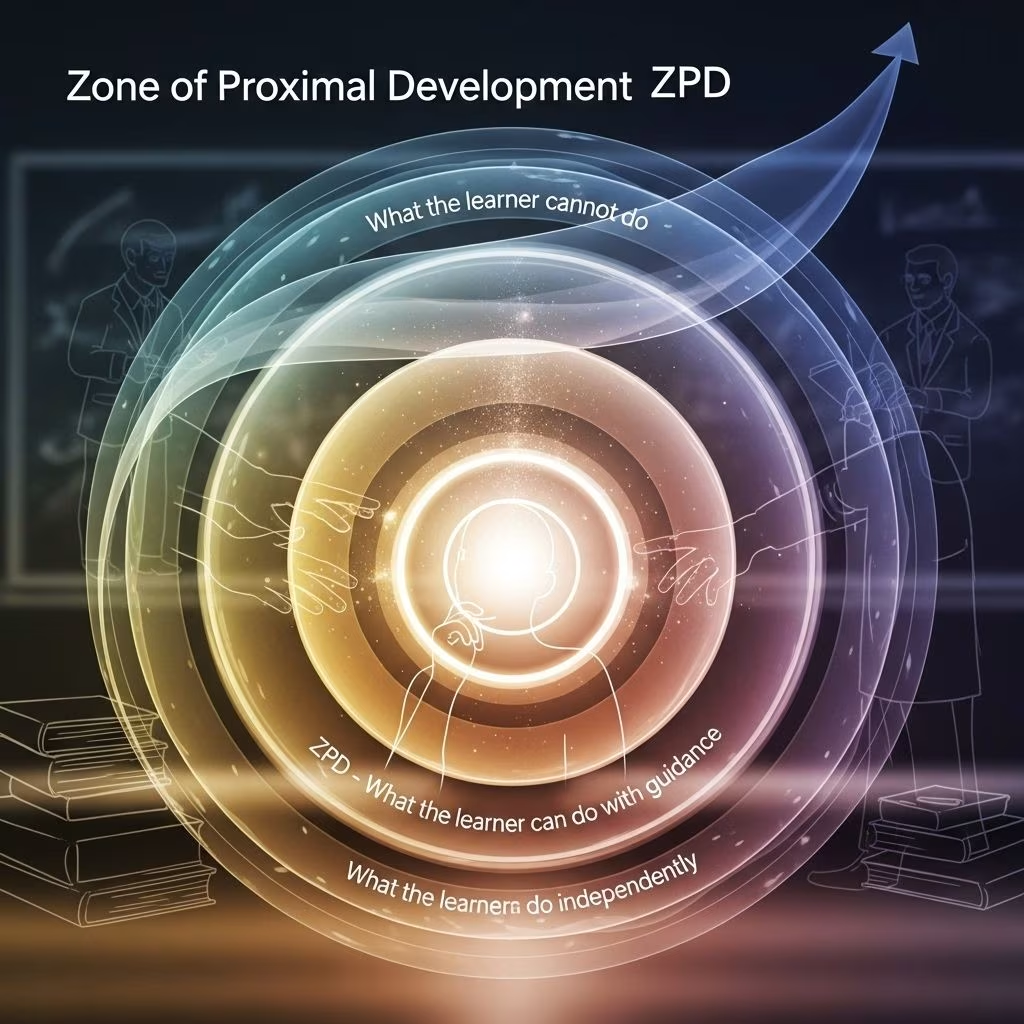
Visualizing the ZPD: A Concentric Circles Model
The ZPD is often represented with a diagram of three concentric circles:
- Innermost Circle: Tasks the learner can accomplish independently.
- Middle Circle (ZPD): Tasks the learner can accomplish with immediate assistance.
- Outer Circle: Tasks beyond the learner’s current reach, even with support.
This visualization helps educators and caregivers pinpoint where to focus their guidance and where learners are likely to benefit most from support.
The Role of the More Knowledgeable Other (MKO)
Central to the ZPD is the idea of the More Knowledgeable Other (MKO). This can be a teacher, parent, coach, or peer who possesses greater knowledge, skill, or understanding in the area being learned. The MKO guides the learner by:
- Demonstrating strategies or concepts
- Offering targeted feedback
- Breaking down tasks into manageable steps
- Encouraging reflection and critical thinking
Through social interaction within the learner’s ZPD, the MKO helps bridge the gap between what the learner can do alone and new levels of independence.
Scaffolding: Supporting Growth Within the ZPD
Scaffolding is a complementary teaching approach closely tied to the ZPD. It refers to the process of giving students temporary support as they acquire new skills or concepts and gradually withdrawing that support as they become more capable.
- Teachers gauge students’ understanding and adjust support as needed.
- Support can be verbal hints, cues, question prompts, demonstrations, or modeling.
- Scaffolding helps sustain engagement, effort, and confidence.
- As learners grow more competent, the scaffolding is removed, and they work more independently.
This process helps learners move from assisted to independent performance in a supportive, nurturing environment.
Examples of the Zone of Proximal Development in Action
- Early Literacy: A child is learning to read. Alone, she can recognize some words but cannot read a new story. With a parent guiding her to sound out unfamiliar words and discussing pictures, she reads the story successfully.
- Mathematics: A student can solve basic addition problems alone but struggles with two-digit subtraction. With the teacher’s step-by-step guidance and sample problems, the student begins to understand and solve subtraction tasks.
- Physical Skills: A child can’t climb a rope unaided. A sports instructor provides a foothold and tips on grip, helping the child achieve the climb. Over time, support is reduced as the child becomes more skilled.
Table: Independent vs. ZPD vs. Unreachable Tasks
| Category | Description | Example |
|---|---|---|
| Independent Tasks | Skills performed without help | Reading familiar words; Counting objects |
| Zone of Proximal Development | Skills achieved with appropriate support | Reading a new book with prompts; Solving new math problems with guidance |
| Unreachable Tasks | Skills beyond the learner, even with aid | Solving advanced calculus for a young child |
Applying the Zone of Proximal Development in Education
The ZPD provides a framework for designing instruction and support tailored to each learner’s needs.
Best Practices for Educators and Caregivers
- Assess the learner’s current knowledge and skill level. Use observation, questioning, and informal assessment to determine what the student can do independently.
- Identify the ZPD. Find what the learner can do with assistance but not yet alone.
- Provide targeted, responsive support. Give just enough assistance to help the learner progress—this could be hints, demonstrating a process, or collaborating closely.
- Gradually reduce support (scaffolding withdrawal). As the learner grows more proficient, slowly let them take on more responsibility for solving and applying skills.
- Foster collaboration. Encourage group work and peer teaching so students can benefit from each other’s strengths.
By continuously evaluating students’ needs and adjusting guidance accordingly, teachers optimize learning within each student’s ZPD, promoting both confidence and competence.
Why the Zone of Proximal Development Matters
The ZPD is a valuable tool for:
- Maximizing learning: Focused instruction within the ZPD leads to deeper understanding and more significant progress.
- Personalizing education: By identifying each learner’s ZPD, instruction moves beyond a one-size-fits-all approach.
- Building collaborative learning communities: Social interactions and teamwork boost cognitive and social skills.
- Fostering resilience and motivation: Achieving success with support leads to increased confidence and motivation.
Teachers who recognize and respond to students’ ZPD are more effective at fostering growth and closing achievement gaps.
The Connection Between Scaffolding and the ZPD
Scaffolding provides the structure, support, and gradual release that learners need to move through their ZPD. This teaching method involves:
- Offering clear guidance and supports for new or difficult tasks
- Adjusting the type and amount of help based on learner needs
- Encouraging independent attempt and problem solving
- Withdrawing support as the learner gains confidence and skill
Scaffolding is not a one-time event but a dynamic, responsive process that adapts to the learner’s progress within their ZPD. It recognizes that learners need different types and levels of support at various stages.
Frequently Asked Questions (FAQ) About the ZPD
What is the main idea behind the Zone of Proximal Development?
The ZPD describes the range of tasks a learner cannot perform alone but can master with support from a more knowledgeable guide, emphasizing the importance of social learning and guided instruction in development.
How is the ZPD different from what a student can do independently?
The ZPD goes beyond independent ability; it concerns what learners can accomplish only with guidance, focusing instruction on their immediate potential rather than their current mastery.
What is a “more knowledgeable other” (MKO)?
An MKO is anyone—teacher, parent, peer, or coach—with more experience or skill in a given area, who provides guidance, modeling, or feedback to help the learner progress within the ZPD.
Why is scaffolding important in the learning process?
Scaffolding ensures learners get the right amount of support when tackling new tasks, promoting confidence, incremental mastery, and eventually, independence as support is gradually withdrawn.
How can parents use the ZPD at home?
Parents can observe their child’s abilities, provide guidance on tasks just beyond their current skill, encourage trying new challenges with support, and celebrate progress, fostering both learning and self-assurance.
ZPD Across Different Age Groups
- Early childhood: Guidance might mean helping a child stack blocks, solve a simple puzzle, or learn to tie shoelaces.
- Elementary school: It involves supporting reading comprehension, writing, or mathematical reasoning, gradually increasing independence as skills grow.
- Adolescence and adulthood: The ZPD concept extends to higher-order reasoning, problem-solving, social-emotional skills, and even workplace learning through mentorship and collaboration.
This universality means the ZPD is relevant in all educational settings, from preschool development through lifelong learning.
Critiques and Limitations of the ZPD
- Vague boundaries: It can sometimes be challenging to precisely define each learner’s ZPD for specific subjects or tasks.
- Over-reliance on guidance: Too much support may hinder independence or creativity if not carefully tapered.
- Group versus individual differences: Classroom settings may not always allow for truly personalized identification of every student’s ZPD.
- Assessment challenges: Standardized evaluations often fail to capture what students can do in supportive or collaborative environments.
Still, most educators recognize the value of the ZPD as a guide for structuring effective, responsive instruction and fostering meaningful learning experiences.
Key Takeaways
- The ZPD highlights the importance of guided interaction and learning just beyond a student’s current capability.
- Scaffolding provides temporary, adaptive support, enabling learners to expand their skills within their ZPD.
- Effective teaching involves ongoing assessment, flexible support, and fostering independence.
- The ZPD is relevant across ages and learning contexts, from preschool to adulthood.
Further Reading and Resources
- Mind in Society by Lev Vygotsky
- Research and educational psychology texts on scaffolding and social constructivist theory
- Online resources on differentiated instruction and collaborative learning
References
- https://en.wikipedia.org/wiki/Zone_of_proximal_development
- https://www.nwea.org/blog/2025/the-zone-of-proximal-development-zpd-the-power-of-just-right/
- https://kb.ndsu.edu/it/131836
- https://www.simplypsychology.org/zone-of-proximal-development.html
- https://mybrightwheel.com/blog/what-is-the-zone-of-proximal-development
- https://www.wested.org/resource/zone-of-proximal-development/
- https://fiveable.me/key-terms/ap-psych/zone-of-proximal-development
- https://www.mcw.edu/-/media/MCW/Education/Academic-Affairs/OEI/Faculty-Quick-Guides/Sociocultural-Theory-of-Cognitive-Development.pdf


