


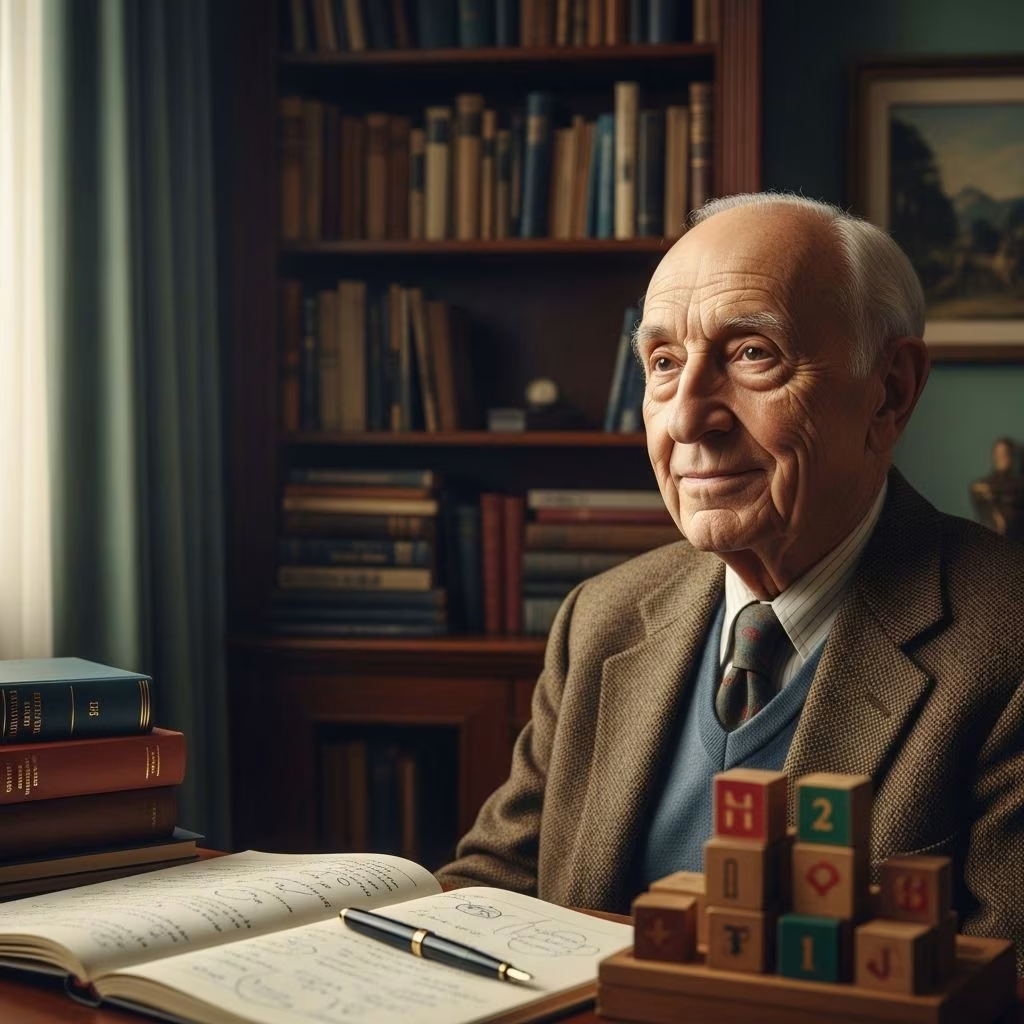
Jean Piaget: Pioneer of Cognitive Development and Educational Theory
Jean Piaget’s work stands as a cornerstone in developmental psychology, profoundly shaping our understanding of how children think, learn, and acquire knowledge. His innovative theories transformed both psychology and education, laying the groundwork for contemporary approaches to teaching and learning.
Early Life and Background
Jean William Fritz Piaget was born on August 9, 1896, in Neuchâtel, Switzerland. His father, Arthur Piaget, was a historian, while his grandfather’s interests in philosophy and biology ignited young Piaget’s passion for the natural sciences. By age 11, Piaget had already embarked on research, notably publishing findings on an albino sparrow. By 15, several of his studies on mollusks gained him recognition among European zoologists.
Piaget’s formal education began at the University of Neuchâtel, where he studied zoology and philosophy, earning a doctorate in natural sciences in 1918. This multidisciplinary background would later serve as an essential foundation for his pioneering work in psychology, particularly his approach to understanding the origins and development of human knowledge.
Journey into Psychology and Epistemology
After receiving his doctorate, Piaget’s fascination shifted from the biological world to the psychological and philosophical domains, specifically epistemology — the study of knowledge, its nature, and how it is acquired. This interest led Piaget to Zürich, where he studied psychoanalysis under prominent figures such as Carl Jung and Eugen Bleuler. He then moved to Paris in 1919, collaborating with Théodore Simon on psychometric research for French children.
During his Paris years, Piaget created and administered reading tests, meticulously examining the types of errors children made. This experience sparked his curiosity about the cognitive processes underlying children’s reasoning and propelled his lifelong research into developmental psychology.
Personal Life: Marriage and Family Influence
In 1923, Piaget married Valentine Châtenay. The couple had three children, each becoming an integral part of Piaget’s observational studies. As was common among theorists, Piaget’s research benefited from closely observing his own children, whose developmental milestones informed many of his groundbreaking theories about early cognition and learning.
Career Milestones and Academic Legacy
In 1921, Piaget returned to Switzerland and was appointed director of the Institut J.J. Rousseau in Geneva. He soon joined the faculty at the University of Geneva, where he remained for much of his career, developing and refining his theories on child development and cognition.
- 1921: Director, Institut J.J. Rousseau
- 1925–1929: Professor, University of Neuchâtel
- 1929 onward: Professor of child psychology, University of Geneva
- 1955: Founded the International Centre for Genetic Epistemology, Geneva
Throughout his prolific career, Piaget published over 50 books and monographs, solidifying his reputation as a leading figure in developmental psychology.
Jean Piaget’s Core Theory: Cognitive Development
Piaget’s most influential contribution is his Theory of Cognitive Development, which systematically explains how children construct a mental model of the world and progress through a sequence of cognitive stages. He believed that intelligence develops through a dynamic interplay between biological maturation and environmental experience, and that children are active learners who construct understanding through interaction and exploration.
The Four Stages of Cognitive Development
| Stage | Age Range | Main Characteristics |
|---|---|---|
| Sensorimotor | Birth to ~2 years | Learning through senses, motor actions; object permanence develops |
| Preoperational | 2 to 7 years | Symbolic thought, pretend play; egocentrism, limited logical reasoning |
| Concrete Operational | 7 to 11 years | Logical thinking about concrete events; conservation and classification emerge |
| Formal Operational | 12 years and up | Abstract reasoning, hypothetical thinking; problem-solving skills advance |
Each stage reflects a qualitative change in how children think, reason, and perceive their environment:
- Sensorimotor: Infants discover the world through movements and sensory experiences, gradually realizing objects exist out of sight (object permanence).
- Preoperational: Young children engage in symbolic play and language development but exhibit egocentric thinking, struggling to see perspectives other than their own.
- Concrete Operational: Children begin applying principles of logic to tangible objects, understanding concepts like conservation, reversibility, and classification.
- Formal Operational: Adolescents develop the capacity for abstract and systematic thought, enabling them to reason about complex ideas and hypothetical scenarios.
Key Concepts and Methods in Piaget’s Work
Schemas
Piaget introduced the concept of schemas — mental frameworks that help individuals organize and interpret information. Schemas evolve through experience, becoming increasingly sophisticated as children interact with their environment.
- Assimilation: Integrating new information into existing schemas.
- Accommodation: Modifying existing schemas or developing new ones to incorporate novel information.
- Equilibration: Achieving a balance between assimilation and accommodation.
Genetic Epistemology
Piaget’s conceptual framework, known as genetic epistemology, sought to explain the development of human knowledge from a biological and psychological perspective. He founded the International Center for Genetic Epistemology in Geneva in 1955, fostering interdisciplinary study and collaboration in the field.
Research Methods
Piaget pioneered the semiclinical interview, an approach combining standardized questioning and open-ended follow-up, enabling him to probe children’s spontaneous reasoning and beliefs. This method revealed the transition from intuitive to logical thought and the importance of social interaction in intellectual growth.
Major Phases of Piaget’s Research
- Zoological and Biological Phase: Early research on mollusks and philosophical explorations of life’s origins.
- Sociological Model of Development: Investigated how children’s thinking evolves from egocentrism to sociocentrism via social interaction.
- Biological Model of Intellectual Development: Incorporated concepts from evolutionary biology and genetics to explain cognitive change.
- Logical Model of Intellectual Development: Studied development of logic and mathematical reasoning in children.
- Study of Figurative Thought: Examined non-logical thought forms, such as intuitive and symbolic reasoning.
Impact and Legacy
Piaget’s theories radically transformed developmental psychology and education:
- Educational Practice: Emphasized the importance of child-centered, discovery-based education. Piaget advocated that “only education is capable of saving our societies from possible collapse, whether violent, or gradual”.
- Influence on Early Childhood Education: Piaget’s constructivist approach is foundational to modern teaching strategies, encouraging active learning, exploration, and inquiry.
- Research Institutions: He established collaborative research centers, most notably the International Center for Genetic Epistemology, which helped institutionalize developmental studies as a major discipline.
- Citations and Recognition: By the end of the 20th century, Piaget was recognized as the second most-cited psychologist after B. F. Skinner.
In addition to his scientific achievements, Piaget influenced generations of educators and psychologists by insisting that children are not simply passive recipients of knowledge but active constructors who engage with their environment, peers, and ideas.
Frequently Asked Questions (FAQs)
Q: Why is Jean Piaget considered a pioneer in developmental psychology?
A: Piaget developed the first systematic theory of cognitive development, showing that children progress through distinct stages of understanding and reasoning.
Q: What are Piaget’s four stages of cognitive development?
A: The stages are Sensorimotor (birth–2yrs), Preoperational (2–7yrs), Concrete Operational (7–11yrs), and Formal Operational (12yrs+), each with unique cognitive capabilities.
Q: How did Piaget’s research impact educational theory?
A: Piaget’s work underpins modern constructivist approaches, advocating for hands-on discovery, individualized pacing, and the adaptive structuring of educational experiences.
Q: What research methods did Piaget use?
A: Piaget employed naturalistic observation, structured interviews, and semiclinical questioning to uncover authentic thought processes in children.
Q: Was Piaget’s work influenced by his own children?
A: Yes, Piaget’s longitudinal observations of his three children provided insight into developmental milestones and key patterns in childhood cognition.
Conclusion: Jean Piaget’s Enduring Influence
Jean Piaget’s pioneering research profoundly shifted the focus of psychology and education, championing the significance of child-centered investigation and constructivist methodologies. His legacy endures in classrooms, curricula, and research institutions worldwide, inspiring new generations to ask how children think, learn, and grow — and how we, as a society, can nurture their extraordinary potential.
References
- https://en.wikipedia.org/wiki/Jean_Piaget
- https://www.britannica.com/biography/Jean-Piaget
- https://teachkloud.com/psychology/10-major-child-development-theorists-and-their-theories-summarised/
- https://www.educationcorner.com/jean-piaget/
- https://psychologywriting.com/jean-piagets-cognitive-development-theory/
- https://thedecisionlab.com/reference-guide/psychology/schemas


