


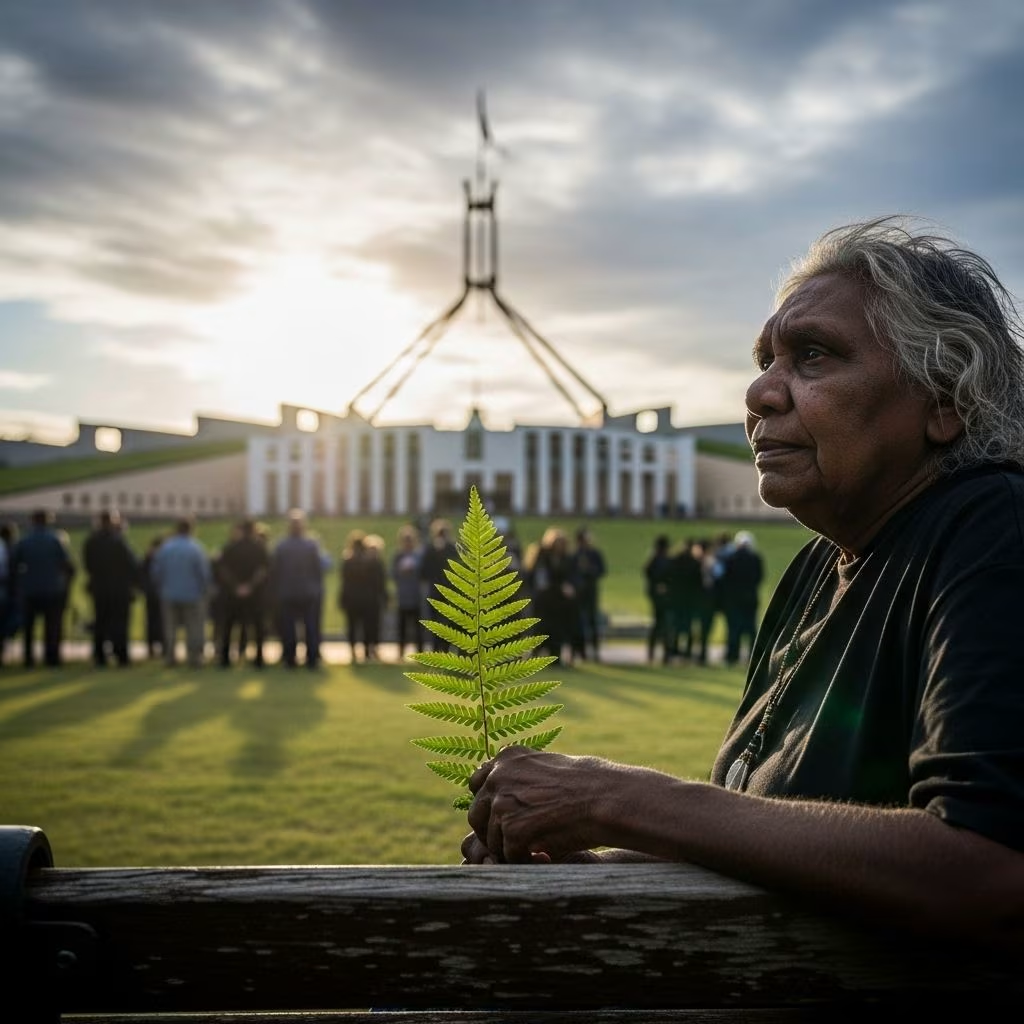
On February 13, 2008, Australia witnessed one of the most significant moments in its modern history. Prime Minister Kevin Rudd stood before Parliament and delivered a formal apology to Aboriginal and Torres Strait Islander peoples, particularly addressing the trauma inflicted upon the Stolen Generations. This momentous occasion represented decades of advocacy, pain, and the persistent calls for acknowledgment from Indigenous communities across the nation. The apology was not merely a political gesture but a profound recognition of historical injustices that had scarred generations of Aboriginal and Torres Strait Islander families.
The events leading to this historic day were marked by resistance, grassroots movements, and an unwavering determination from Indigenous Australians to have their suffering acknowledged. The National Apology became a watershed moment that attempted to bridge the divide between Indigenous and non-Indigenous Australians, opening pathways for healing, reconciliation, and a more honest reckoning with the nation’s past. Understanding this pivotal moment requires examining the context of the Stolen Generations, the journey toward the apology, and its lasting impact on Australian society.
Understanding the Stolen Generations
The term Stolen Generations refers to Aboriginal and Torres Strait Islander children who were forcibly removed from their families by Australian federal and state government agencies between approximately 1910 and 1970. These removal policies were implemented under the guise of assimilation, with authorities believing that Indigenous children, particularly those of mixed descent, should be separated from their families and culture to be raised in Western institutions or adopted by white families. The underlying racist assumption was that Indigenous culture was inferior and that removing children from their communities would somehow benefit them.
The impact of these policies was devastating and multigenerational. Children were placed in missions, orphanages, and foster homes where many experienced abuse, neglect, and the systematic erasure of their cultural identity. They were forbidden from speaking their languages, practicing their traditions, or maintaining connections with their families and communities. The psychological, emotional, and spiritual trauma caused by these separations has reverberated through generations, contributing to ongoing issues including mental health challenges, substance abuse, and the breakdown of family structures within Indigenous communities.
Estimates suggest that between one in three and one in ten Indigenous children were removed from their families during this period, affecting virtually every Aboriginal and Torres Strait Islander family across Australia. The policies represented a form of cultural genocide, deliberately aimed at destroying Indigenous cultures and assimilating Aboriginal peoples into white Australian society. The long-term consequences of these policies continue to affect Indigenous communities today, manifesting in intergenerational trauma and contributing to significant disparities in health, education, and economic outcomes between Indigenous and non-Indigenous Australians.
The Journey Toward Recognition
The path to the National Apology was neither swift nor straightforward. For decades, survivors of the Stolen Generations and their descendants fought tirelessly for recognition and acknowledgment of the injustices they had endured. The breakthrough came in 1997 when the Human Rights and Equal Opportunity Commission released the Bringing Them Home report following a comprehensive national inquiry into the separation of Aboriginal and Torres Strait Islander children from their families. This landmark report documented the experiences of the Stolen Generations through powerful personal testimonies and confirmed that government policies had inflicted profound and lasting harm upon Indigenous communities.
The report made 54 recommendations, including that federal, state, and territory governments, as well as various agencies involved in the removal policies, issue formal apologies to the Stolen Generations. The response was mixed but significant. Between 1997 and 1999, all state and territory parliaments officially apologized to the Stolen Generations, their families, and communities for the laws, policies, and practices that had governed forcible removal. However, the federal government under Prime Minister John Howard consistently refused to issue a national apology, offering instead a Motion of Reconciliation in 1999 that expressed “deep and sincere regret” but stopped short of a formal apology.
This refusal sparked widespread public outcry and galvanized the reconciliation movement. In 1998, thousands of Australians participated in the Sorry Book campaign, which led to the establishment of the first National Sorry Day on May 26, 1998. This grassroots movement became known as “the people’s apology,” demonstrating that ordinary Australians recognized the need for formal acknowledgment even if their government did not. In May 2000, nearly 250,000 Australians walked across the Sydney Harbour Bridge in support of reconciliation and to protest the federal government’s lack of an official apology, with thousands more participating in similar walks across bridges throughout the country.
The Historic Day: February 13, 2008
The election of Kevin Rudd’s Labor government in 2007 brought renewed hope for a national apology. Rudd had committed to delivering the apology during his campaign and immediately began consulting with Indigenous Australians about what form it should take. On February 13, 2008, the Australian Parliament gathered for what would become one of the most emotionally charged and historically significant sessions in its history. For the first time ever, Parliament House began with a Welcome to Country ceremony, performed by Aunty Matilda House, a Ngambri Elder, who welcomed visitors to her Country alongside dancers from across Australia and the Torres Strait Islands.
The ceremony included the presentation of a message stick to the Prime Minister by Aunty Matilda’s grandchildren, serving as a tangible symbol of communication and connection. As Aunty Matilda explained, message sticks had been “a means of communication used by our peoples for thousands of years. They tell the story of our coming together.” This powerful gesture set the tone for the day, acknowledging Indigenous protocols and centering Indigenous voices in the proceedings.
When Prime Minister Rudd rose to deliver the apology, the nation held its breath. Big screens were erected in parks and communal areas across Australia as hundreds of thousands of people gathered to witness this historic moment. Many Stolen Generations members were present at Parliament House itself, alongside Indigenous leaders, activists, and supporters who had fought for decades to reach this point. The apology acknowledged the profound grief, suffering, and loss inflicted upon Aboriginal and Torres Strait Islander peoples through successive government policies, particularly the removal of children from their families and communities.
The motion included powerful words of acknowledgment: “We apologise for the laws and policies of successive Parliaments and governments that have inflicted profound grief, suffering and loss on these our fellow Australians. We apologise especially for the removal of Aboriginal and Torres Strait Islander children from their families, their communities and their country. For the pain, suffering, and hurt of these Stolen Generations, their descendants and for their families left behind, we say sorry.” The apology continued, addressing mothers, fathers, brothers, and sisters, acknowledging the breaking up of families and communities, and recognizing the indignity and degradation inflicted on a proud people and culture.
The response was immediate and overwhelming. As Prime Minister Rudd concluded his speech, a wave of tears, relief, and applause swept through the crowd at Parliament House and across the nation. People who had waited their entire lives to hear these words from their government openly wept. For many Stolen Generations survivors, the apology represented validation of their experiences and suffering, acknowledgment that what had been done to them was wrong, and recognition of the profound injustice they had endured.
Responses and Reactions
Following the apology, Aunty Lorraine Peeters, a member of the Stolen Generations, presented the Prime Minister and the Leader of the Opposition with a glass Coolamon made by Bai Bai Napangardi, a Balgo artist. Inside the Coolamon was a message thanking Parliament, stating that the apology showed compassion and opened a path for walking together in the future. The Speaker of the House accepted the Coolamon on behalf of Parliament, cementing this symbolic exchange as part of the historic record.
Tom Calma, the Aboriginal and Torres Strait Islander Social Justice Commissioner at the time, was asked by the Stolen Generations Alliance and the National Sorry Day Committee to respond to the apology on behalf of Indigenous Australians. His response emphasized that while the apology was a crucial first step, it needed to be accompanied by concrete actions to address the ongoing disadvantages faced by Indigenous communities. The apology had opened a door, but genuine reconciliation would require sustained commitment, policy changes, and resources dedicated to closing the gaps in health, education, and economic opportunity between Indigenous and non-Indigenous Australians.
The apology was widely celebrated both nationally and internationally as a significant step forward in Australia’s relationship with its Indigenous peoples. Many observers noted that it helped bridge the historic divide between Indigenous and non-Indigenous Australians, fostering a sense of shared national responsibility for addressing past wrongs. The day came to be remembered as National Sorry Day, observed annually on May 26, serving as a time for reflection, recognition of the past, and promotion of unity and healing among Australia’s diverse communities.
The Path Forward and Ongoing Challenges
While the National Apology represented a profound symbolic gesture, it also highlighted the significant work that remained to achieve genuine reconciliation and address ongoing inequalities. The apology explicitly acknowledged this reality, with Prime Minister Rudd stating: “A future where this Parliament resolves that the injustices of the past must never, never happen again. A future where we harness the determination of all Australians, Indigenous and non-Indigenous, to close the gap that lies between us in life expectancy, educational achievement, and economic opportunity.”
However, the years following the apology have revealed persistent challenges. Disturbingly, the rate of Aboriginal child removal has actually increased since 2008, though the circumstances and stated justifications differ from the historical Stolen Generations policies. Contemporary removals are typically framed as child protection measures, but Indigenous advocates and organizations have raised serious concerns about systemic bias, inadequate support for Indigenous families, and the failure to keep Aboriginal children in Aboriginal care when removal is deemed necessary.
This troubling trend underscores that while the apology was an essential step in acknowledging historical injustices, it has not automatically resolved the underlying issues of inequality, discrimination, and the ongoing marginalization of Indigenous communities. The gaps in life expectancy, health outcomes, educational achievement, and economic opportunity between Indigenous and non-Indigenous Australians remain stark, despite various government initiatives aimed at “Closing the Gap.”
Nevertheless, the National Apology continues to hold profound significance for many Indigenous Australians and for the nation as a whole. It represents official recognition of historical wrongs, validation of the experiences and trauma of the Stolen Generations, and a commitment—however imperfectly realized—to creating a more just and equitable future. The apology has become a touchstone in conversations about reconciliation, treaty, and constitutional recognition of Indigenous Australians.
Personal Stories and Lived Experiences
Behind the historical facts and political proceedings are countless personal stories of survival, loss, and resilience. Members of the Stolen Generations have shared experiences of being torn from their mothers’ arms, growing up not knowing their families or culture, and spending lifetimes searching for their relatives and identity. Many describe the profound psychological impact of being told they were unwanted, of having their Indigenous heritage denied or denigrated, and of navigating a world where they felt they belonged nowhere—rejected by the Indigenous communities they were removed from and never fully accepted by white Australian society.
The apology provided a measure of healing for many survivors, though some have emphasized that words alone cannot undo the damage caused by the removal policies. For some, the apology came too late—their parents and loved ones had already passed away without seeing official acknowledgment of the injustices they endured. For others, particularly younger generations affected by intergenerational trauma, the apology represented a starting point for understanding their family histories and beginning their own healing journeys.
Indigenous elders and leaders have consistently emphasized that true reconciliation requires more than symbolic gestures. It demands systemic changes to address inequality, genuine respect for Indigenous sovereignty and self-determination, constitutional recognition, and treaty negotiations that acknowledge Indigenous peoples as the original owners and custodians of the land. The National Apology, while historically significant, is viewed by many Indigenous Australians as one step in a much longer journey toward justice and genuine partnership.
Commemorating and Moving Forward
The anniversary of the National Apology is now marked annually, with events held across Australia to remember the significance of that day and to reflect on progress made and challenges that remain. These commemorations serve multiple purposes: honoring the resilience and strength of the Stolen Generations and their descendants, educating non-Indigenous Australians about this painful history, and maintaining momentum for ongoing reconciliation efforts.
Educational initiatives have increasingly incorporated the history of the Stolen Generations and the National Apology into school curricula, ensuring that younger generations understand this crucial chapter of Australian history. Cultural institutions, including the National Museum of Australia, have developed exhibitions and resources that preserve the stories and experiences of the Stolen Generations for future generations.
The legacy of the National Apology extends beyond its immediate historical moment. It has influenced subsequent policy discussions about Indigenous affairs, contributed to broader conversations about national identity and history, and inspired similar movements in other countries with histories of colonial injustice against Indigenous peoples. The apology demonstrated that nations can and should confront uncomfortable truths about their pasts, and that acknowledgment, while not sufficient on its own, is a necessary foundation for genuine reconciliation and healing.
Frequently Asked Questions
Q: What exactly were the Stolen Generations?
A: The Stolen Generations refers to Aboriginal and Torres Strait Islander children who were forcibly removed from their families by Australian government agencies between approximately 1910 and 1970. These children were placed in institutions, missions, or adopted by non-Indigenous families as part of assimilation policies aimed at erasing Indigenous culture and identity.
Q: Why did it take so long for the federal government to apologize?
A: Despite the 1997 Bringing Them Home report recommending a formal apology, the federal government under Prime Minister John Howard refused for nearly a decade, offering only a statement of “regret” instead. The apology finally came in 2008 when Kevin Rudd’s government was elected, having made the apology a campaign commitment.
Q: What impact did the National Apology have on Indigenous communities?
A: The National Apology provided validation and acknowledgment for many Stolen Generations survivors and their families. It represented official recognition of historical injustices and opened pathways for healing, though many Indigenous Australians emphasize that the apology must be accompanied by concrete actions to address ongoing inequalities and injustices.
Q: When is National Sorry Day observed?
A: National Sorry Day is observed annually on May 26. It was first established in 1998 as part of a grassroots movement and serves as a time for all Australians to reflect on the history of the Stolen Generations and commit to reconciliation.
Q: Has the situation improved for Indigenous children since the apology?
A: While the apology was an important symbolic gesture, the rate of Aboriginal child removal has actually increased since 2008, though under different circumstances and justifications. This highlights that systemic issues affecting Indigenous families and communities require ongoing attention and meaningful policy interventions beyond symbolic acknowledgment.
Q: What happens at National Apology anniversary events?
A: Anniversary events typically include speeches from Indigenous leaders and government officials, cultural performances, storytelling from Stolen Generations survivors, and opportunities for reflection and education. These events serve to honor those affected by removal policies and maintain focus on ongoing reconciliation efforts.
References
- https://www.ebsco.com/research-starters/law/national-apology-apology-australias-indigenous-peoples
- https://aiatsis.gov.au/explore/stolen-generations
- https://en.wikipedia.org/wiki/Apology_to_Australia’s_Indigenous_peoples
- https://deadlystory.com/page/culture/history/Apology_to_the_Stolen_Generations
- https://www.nma.gov.au/defining-moments/resources/national-apology
- https://www.pm.gov.au/media/apology-stolen-generations-anniversary-breakfast
- https://www.youtube.com/watch?v=RThkO3XBThs
- https://dcj.nsw.gov.au/about-us/apology-stolen-generations.html
- https://www.aph.gov.au/Visit_Parliament/Art/De-commissioned/De-Commissioned_Pages/Custom_Media/Apology_to_Australias_Indigenous_Peoples


