Everything You Need to Know About Reading Your Birth Chart
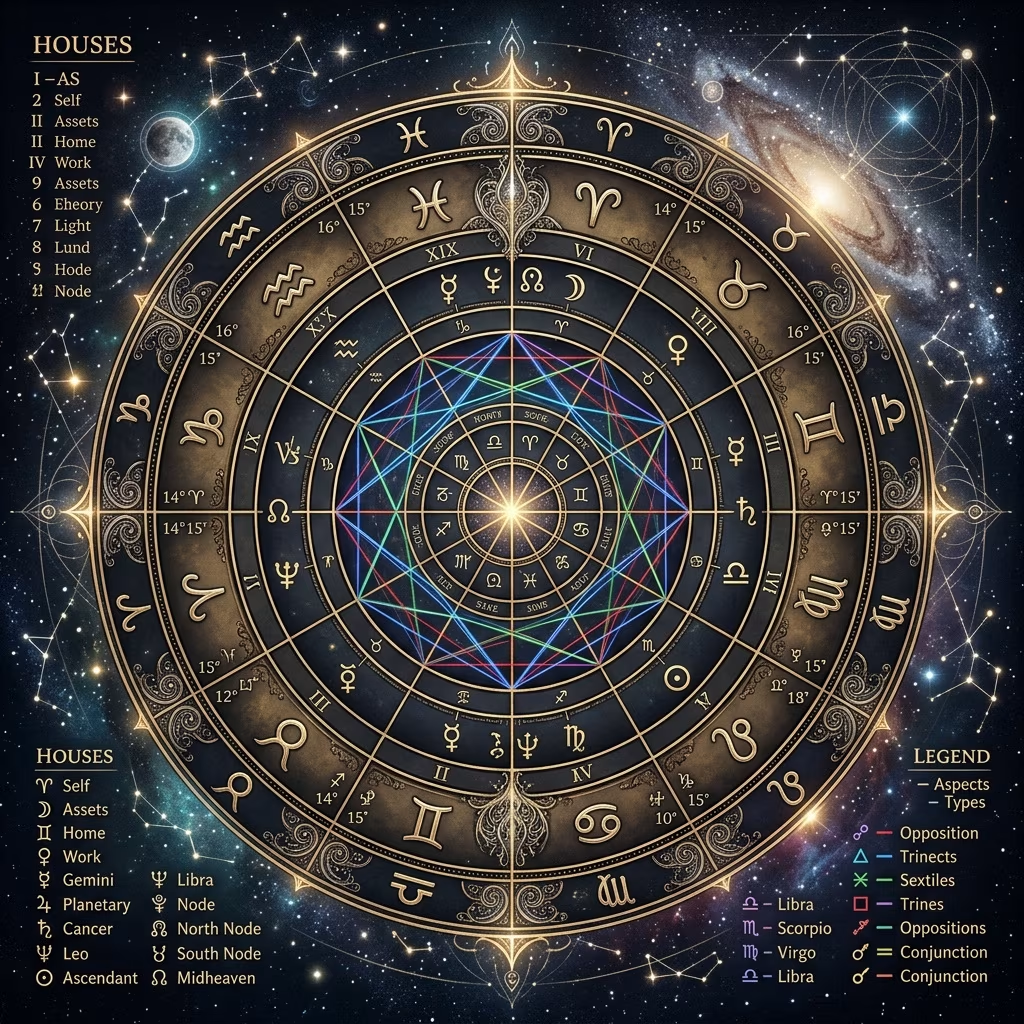
A birth chart, also called a natal chart, is a cosmic snapshot of the sky at the exact moment you were born. This chart, divided into twelve segments known as houses, shows the positions of the Sun, Moon, planets, and other celestial points, each revealing unique insights about your personality, motivations, relationships, and life path. If you want to delve deeper into who you are beyond your Sun sign, understanding your complete birth chart is essential.
What Exactly Is a Birth Chart?
A birth chart pinpoints the precise location of the planets, Sun, and Moon in the zodiac at your time and place of birth. Unlike daily horoscopes, which only factor in your Sun sign, your full chart reveals your individuality through the interplay of planets, signs, and houses. To create your birth chart, you’ll need three details:
- Date of birth
- Time of birth
- Place of birth
With this data, an astrologer or online calculator draws your natal chart—a circular mandala full of symbols and lines. Each point unlocks a piece of your cosmic DNA.
Breaking Down the Birth Chart: The Essentials
Your astrology birth chart consists of three main components:
- Planets – The forces that act in your life
- Zodiac Signs – How those forces manifest
- Houses – Where those energies play out
| Component | Role | Influence |
|---|---|---|
| Planet | Force/energy | Drives desires, motivations, inner life |
| Zodiac Sign | Mode/style | Colors how planets express themselves |
| House | Life area | Shows where themes show up (relationships, work, home, etc.) |
How To Read Your Birth Chart Step-By-Step
- Identify the planets’ positions
Each planet (including the Sun and Moon, called ‘luminaries’) sits in a specific zodiac sign within your birth chart. These reveal different sides of your personality:
- Sun – Your core identity and life path
- Moon – Your emotions and instinctive reactions
- Mercury – Communication style and thinking process
- Venus – Love, beauty, values
- Mars – Drive, aggression, passion
- Jupiter – Luck, growth, optimism
- Saturn – Responsibility, limitations, discipline
- Uranus – Rebellion, innovation, sudden change
- Neptune – Dreams, intuition, confusion
- Pluto – Transformation, power, depth
- Locate each planet in a house
Your chart divides into 12 houses, each representing a different life domain. For instance, having Venus in the 7th house highlights relationships, while Jupiter in the 2nd house emphasizes financial luck.
- Notice the zodiac sign for each planet
The sign adds layers to planetary meaning. For example, Mars in Libra acts with diplomacy, while Mars in Aries charges ahead impulsively.
Interpretation flows like this: Planet + Sign + House = Insight into a life theme. For example: Mercury (thought and speech) in Sagittarius (adventurous, blunt) in the 3rd House (communication, learning) reveals a person who loves to discuss broad ideas and may be direct or outspoken.
The Planets in Your Birth Chart Explained
Each planet exerts a distinct influence. Here’s a breakdown:
- Sun: Core self, identity, ego. Where you ‘shine’ in life—the traits you aspire to embody.
- Moon: Emotions, intuition, your private self—often the side only those close to you see.
- Rising Sign (Ascendant): Outer personality, first impressions, your approach to new situations.
- Mercury: Communication, logic, learning style.
- Venus: Romantic life, values, creativity, aesthetics.
- Mars: Motivation, assertiveness, willpower.
- Jupiter: Expansion, growth, optimism, style of luck.
- Saturn: Structure, responsibility, life’s lessons.
- Uranus: Change, individuality, disruption.
- Neptune: Imagination, escapism, spirituality.
- Pluto: Transformation, regeneration, deep power.
Your Sun sign is just the beginning. Interpreting Moon, Rising, and planetary placements reveals a multi-dimensional view of your character and tendencies.
A Quick Guide to the Zodiac Signs
Every chart contains all twelve zodiac signs. Even if you don’t have a planet in a sign, each aligns with a house, bringing subtle flavor to that part of life. The sign a planet occupies shapes how its energy expresses itself:
- Aries: Direct, energetic, pioneering
- Taurus: Steady, sensual, practical
- Gemini: Curious, adaptable, communicative
- Cancer: Nurturing, emotional, protective
- Leo: Creative, proud, generous
- Virgo: Analytical, detail-oriented, service-driven
- Libra: Harmonious, diplomatic, relationship-focused
- Scorpio: Intense, passionate, secretive
- Sagittarius: Adventurous, philosophical, blunt
- Capricorn: Ambitious, disciplined, practical
- Aquarius: Innovative, group-oriented, eccentric
- Pisces: Mystical, empathetic, imaginative
When interpreting your chart, always start by looking at which sign each planet occupies and how this interacts with the house and the planet’s nature.
The 12 Astrological Houses: Life’s Stages and Stories
The birth chart’s 12 houses provide a map for where planetary energies manifest. Here is an overview of each house:
| House | Life Theme | Zodiac Ruler |
|---|---|---|
| 1st | Identity, beginnings, self-image | Aries |
| 2nd | Money, values, possessions | Taurus |
| 3rd | Communication, siblings, learning | Gemini |
| 4th | Home, roots, family | Cancer |
| 5th | Creativity, romance, children | Leo |
| 6th | Health, service, routines | Virgo |
| 7th | Partnerships, marriage, contracts | Libra |
| 8th | Shared resources, rebirth, transformation | Scorpio |
| 9th | Travel, beliefs, higher education | Sagittarius |
| 10th | Career, reputation, ambitions | Capricorn |
| 11th | Friends, groups, social causes | Aquarius |
| 12th | Secrets, intuition, endings | Pisces |
Planets sitting in a house make those life themes stand out. For example, Mars in the 10th House fuels career ambition; Venus in the 4th brings harmony at home.
12th House: The House of the Unseen
Ruled by Neptune and Pisces, the 12th house is associated with intuition, dreams, and the unconscious. Planets here may manifest more subtly and mystically, signaling energetic gifts or psychic sensitivities.
Empty Houses vs. Full Houses: What Does It Mean?
- Full Houses: Houses containing several planets. The themes of this house are pronounced in your life.
- Empty Houses: No planets present. This simply means the house’s themes play a quieter role—every chart has at least two empty houses.
Don’t worry if you see empty houses in your chart. You will still experience those life areas, just with less intensity.
A Note on Retrograde Planets
Some planets may appear with an “R,” showing they were retrograde at your birth. Retrograde planets represent energies turned inward. For example, Mercury retrograde at birth may indicate you process thoughts deeply and may be reflective, while Mars retrograde fosters inner motivation over outward action. Having retrogrades does not mean you are ‘doomed’—these energies simply play out more privately in the psyche.
Other Vital Points in Your Chart
- North and South Nodes: Always placed exactly opposite each other, these ‘Nodes of Destiny’ point to your soul’s past (South Node) and life purpose or destiny (North Node). Examining these will give clues about karmic patterns and future direction.
- Chiron: The asteroid Chiron marks your deepest wound—and where you will heal and grow by helping others.
Frequently Asked Questions (FAQs)
Q: What do you need to read your birth chart?
A: You need your birth date, birth time, and location. The more accurate this information, the more precise your chart will be and the better your interpretation.
Q: Can I interpret my own chart or do I need an astrologer?
A: You can start interpreting basic components using free online resources and guides. For deeper, more nuanced readings, consulting a professional astrologer can add insight, especially when considering aspects and planetary interactions.
Q: What if my chart has lots of planets in one area?
A: This signifies that those life themes (represented by the house and sign) play a major role in your experience and personality. It’s called a ‘stellium’ and magnifies that zone of the chart.
Q: Does having empty houses mean I won’t experience those areas of life?
A: Not at all. You will still have experiences related to each house, but they might not be as central to your life’s story. Everyone has empty houses—the chart is designed that way.
Q: How important are retrograde planets in the birth chart?
A: Retrogrades indicate into energies that are internalized. They offer opportunities for self-reflection and growth and should not be seen negatively.
Summary Table: Steps to Reading Your Birth Chart
| Step | Action | What You Learn |
|---|---|---|
| 1 | Find Sun, Moon, Rising signs | Discover core identity, emotions, outward persona |
| 2 | Check planetary positions in zodiac signs and houses | See how life themes and personality express |
| 3 | Note aspects, retrogrades, nodes | Understand deeper challenges, karma, and growth edges |
| 4 | Synthesize for a full story | Develop a rich, holistic self-understanding |
Final Thoughts: Your Cosmic Blueprint
Astrology is a rich, multi-layered system for understanding yourself and your journey. The birth chart goes far beyond Sun sign astrology: it highlights your habits, talents, challenges, relationships, and soul mission. Whether you’re a beginner or growing in your astrology practice, exploring your birth chart can reveal insights you’ll return to again and again. Remember, your chart is not your fate—it is a map of potential, ready for you to consciously explore and activate as you choose. Happy chart reading!
References
- https://www.cosmopolitan.com/lifestyle/a33312810/astrology-birth-chart/
- https://www.cosmopolitan.com/uk/horoscopes/a26085821/birth-chart/
- https://www.astrologysolutions.com.au/cosmo_natal.html
- https://www.elle.com/culture/books/a61870797/birth-chart-hack-the-astrology-advantage/
- https://www.youtube.com/shorts/AgoUN7RMMQo
- https://awakened-woman.com/2023/02/17/empowerment-series-astrologer-psychic-seen-in-cosmopolitan-e-news-popsugar-and-us-weekly-esoterica-esa-shares-love-predictions-with-aw/