How to Read Your Birth Chart: A Beginner’s Guide
Astrology offers profound insights into our personalities, life paths, and relationships. At the heart of this ancient practice lies the birth chart—a detailed map of the sky at the exact moment you were born. Although a birth chart might seem complex at first glance, understanding its core elements can empower you with self-awareness, clarity, and guidance in your life’s journey.
This introductory guide will untangle the basics of chart reading, covering sun, moon, and rising signs, the roles of planets, the importance of houses, and how aspects create the unique tapestry of your astrological DNA.
What Is a Birth Chart?
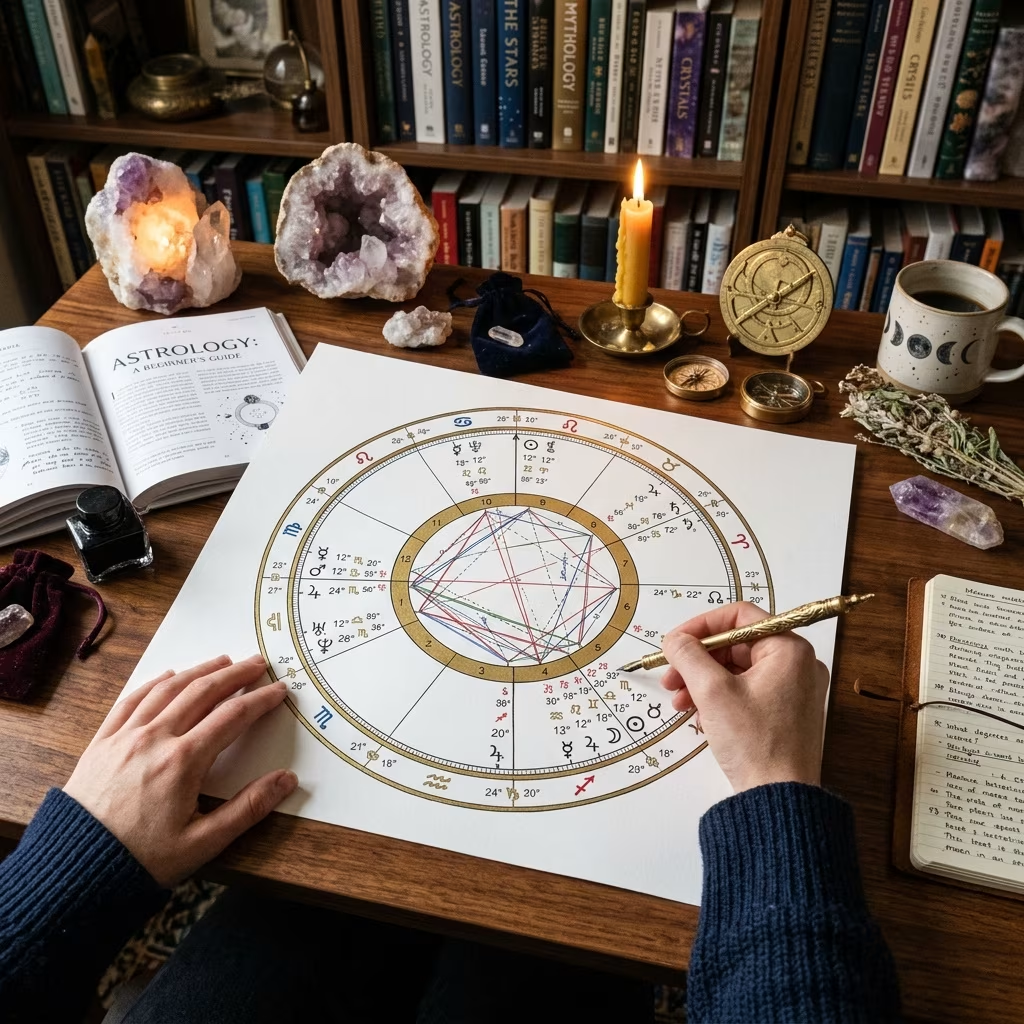
A birth chart (also called a natal chart) captures a “snapshot” of the sky when you entered the world. Imagine the cosmos frozen in time, with planets positioned in distinct zodiac signs and segments called houses. Astrologers see this chart as your cosmic fingerprint, illuminating your strengths, challenges, purpose, and patterns that guide your growth.
Unlike scientific diagrams that place the sun at the center, astrology positions Earth—and, more specifically, you—at the chart’s focal point. As each planet journeys through the zodiac, its position at your birth shapes a unique story of potential and destiny.
- A birth chart is circular, divided into 12 slices—one for each zodiac sign.
- It contains planets (the ‘what’), zodiac signs (the ‘how’), and houses (the ‘where’).
Key Components: Planets, Zodiac Signs, and Houses
To understand a birth chart, you need to look at three essential elements:
- Planets: Represent energies or functions (what drives you).
- Zodiac Signs: Express how those energies manifest.
- Houses: Show where in your life these energies are focused.
Together, they provide a multidimensional view of your individuality. Every chart contains the same planets, signs, and houses, yet their placements completely personalize the story.
Understanding Your “Big Three”: Sun, Moon, and Rising Signs
If you’re new to astrology, the best place to start is by exploring your Sun, Moon, and Rising Sign (also known as your Ascendant). These three elements compose the core of your astrological identity:
| Component | What It Represents | How to Find It |
|---|---|---|
| Sun Sign | Your core essence, ego, and life’s purpose. | Zodiac sign the sun occupied at birth. |
| Moon Sign | Your inner world, emotions, and instinctive reactions. | Zodiac sign of the moon at birth. |
| Rising/Ascendant | How others perceive you; your “front door” to the world. | Zodiac sign on the eastern horizon at birth. |
- Sun Sign: Your identity and what fuels your core vitality. This is what most people know as their “star sign.”
- Moon Sign: Your emotional landscape, instincts, and subconscious needs.
- Rising Sign: Your first impression, appearance, and outward style—the lens through which you view the world and how the world views you.
Together, these three provide a holistic overview—your sun is your spirit, the moon is your soul, and your ascendant is your mask or approach to life.
The Planets: What They Represent in Your Chart
Beyond your “big three,” each planet occupies a zodiac sign and house, coloring specific areas of your personality and life path.
| Planet | Keywords | What It Rules |
|---|---|---|
| Mercury | Communication, intellect, learning | Thinking, speaking, writing, logic |
| Venus | Love, beauty, values | Relationships, art, pleasure |
| Mars | Action, drive, passion | Energy, assertiveness, ambition |
| Jupiter | Growth, expansion, luck | Philosophy, abundance, optimism |
| Saturn | Structure, discipline, responsibility | Limits, lessons, karma |
| Uranus | Innovation, change, rebellion | Sudden shifts, originality |
| Neptune | Dreams, intuition, spirituality | Inspiration, illusion, imagination |
| Pluto | Transformation, power, rebirth | Deep change, regeneration |
Personal planets (Sun, Moon, Mercury, Venus, and Mars) more directly shape your core personality. Social and outer planets (Jupiter, Saturn, Uranus, Neptune, Pluto) influence generational themes and life transitions.
What Are Zodiac Houses?
The 12 houses divide the birth chart into different realms of life, like slices of a cosmic pie. Each house symbolizes specific areas—self-image, resources, communication, home, creativity, work, partnerships, transformation, philosophy, career, friendships, and karma. The planets’ location in these houses indicates the arenas where their influences are most strongly felt.
| House | Key Themes | Main Focus |
|---|---|---|
| 1st (Ascendant) | Self, appearance, first impressions | How you present to the world |
| 2nd | Values, possessions, money | What you value, financial foundations |
| 3rd | Communication, learning, siblings | Early education, mental activity, local travel |
| 4th | Home, family, foundation | Roots, ancestry, private self |
| 5th | Creativity, romance, children | Fun, self-expression, pleasure |
| 6th | Work, health, routines | Daily habits, service, wellness |
| 7th | Partnerships, marriage, contracts | One-to-one relationships |
| 8th | Transformation, shared resources | Sex, power, rebirth |
| 9th | Philosophy, travel, higher learning | Expansion, beliefs, adventure |
| 10th (Midheaven) | Career, reputation, ambitions | Your public image, achievements |
| 11th | Friends, groups, ideals | Networks, social causes, community |
| 12th | Spirituality, endings, the subconscious | Hidden strengths, karma, release |
Where a planet lands reveals where you’re likely to experience its influence most powerfully. For example: Mars in the 10th house? Expect ambition and drive in your career. Venus in the 5th? Love and creativity flourish through artistic or playful activities.
How the Big Three Work Together
Your sun, moon, and rising signs form the foundation for interpreting every other chart element. Here’s a quick example for context:
- Sun in Leo: Confident, generous, spotlight-loving.
- Moon in Cancer: Emotionally sensitive, nurturing, craves security.
- Rising in Libra: Socially graceful, diplomatic, seeks harmony.
This person expresses Leo’s boldness most naturally when they’re feeling safe and cared for (Cancer moon), and they present as tactful and charming (Libra rising).
How To Use the Birth Chart for Insight and Growth
Think of your birth chart as a self-inquiry tool, not a set of rigid rules. Key ways to engage with your chart include:
- Understanding core personality patterns, including strengths and blind spots.
- Exploring relationships by comparing charts (synastry).
- Identifying life periods—like Saturn return (around ages 28-30)—that bring major growth opportunities.
- Reflecting on current planetary movements (transits) and how they activate your chart for yearly or monthly themes.
Common Birth Chart Aspects
Beyond planets and signs, aspects—or the geometric relationships between planets—further individualize your chart. These can show ease (trines, sextiles) or challenge (squares, oppositions), shaping how planetary energies interact in your life.
- Conjunction (0°): Planets blend their energies, enhancing each other’s effect.
- Sextile (60°) & Trine (120°): Supportive, flowing relations that bring natural talent or ease.
- Square (90°): Friction, challenge, creates motivation to grow.
- Opposition (180°): A tug of war requiring balance and integration.
How to Find Your Birth Chart
To interpret your chart, you need:
- Your birth date
- Exact time of birth
- City and country of birth
Inputting these into a trusted astrology website or app generates your free chart, marked with planetary positions, signs, and house placements. For more advanced exploration, you can later look into asteroids or minor points, but start simple.
Bringing It All Together: Interpreting Your Chart
Learning to read your chart is like assembling a cosmic puzzle. Here’s how to approach it:
- Identify the Big Three: What are your sun, moon, and rising signs? Which houses do they occupy?
- Check personal planets: Mercury, Venus, and Mars for communication, love, and motivation styles.
- Note planet placements in houses: Where are these energies most likely to manifest?
- Observe major aspects between planets: Do you see themes of harmony or tension?
Astrology is both an art and a science, always open to interpretation. Use it as a tool to ask deeper questions about what drives you and what paths foster your true growth.
Frequently Asked Questions (FAQs)
Q: What do I need to generate my birth chart?
A: You’ll need your birth date, exact time, and place of birth. The more precise your birth time, the more accurate your chart.
Q: Is astrology scientifically proven?
A: While astrology is not recognized as a science, many find personal meaning and guidance through its archetypes and symbols.
Q: Can my birth chart predict my future?
A: Birth charts reveal tendencies and patterns. Predictive astrology observes ongoing planetary movements (transits) to highlight likely themes, but free will and personal choices always play a major role.
Q: Can my chart tell me about relationships?
A: Yes. The 5th, 7th, and 8th houses, along with Venus and Mars, are key for understanding love and intimacy in your chart. Comparing charts (synastry) can reveal compatibility dynamics.
Q: What does it mean if I have many planets in one sign or house?
A: This is called a “stellium”—it amplifies the influence of that sign or house in your life, making related themes particularly strong or central.
Quick-Start Checklist for Birth Chart Beginners
- Get your exact birth details (date, time, place).
- Use a reputable astrology website or app to calculate your chart.
- Start with your big three: sun, moon, and rising signs.
- Locate planets in signs and houses for further insights.
- Look at house meanings to see where each theme appears in your life.
- Notice aspects: Are the planets supporting or challenging each other?
- Reflect and journal about recurring chart themes or insights.
Final Thoughts: Astrology as Self-Discovery
Reading your birth chart can be both an inspiring and humbling adventure into the intricacies of your personality, potential, and life path. Remember: astrology is a vast language—you don’t have to master it all at once. Begin with curiosity, honor your unique cosmic blueprint, and allow your chart to guide your journey of self-awareness and growth.