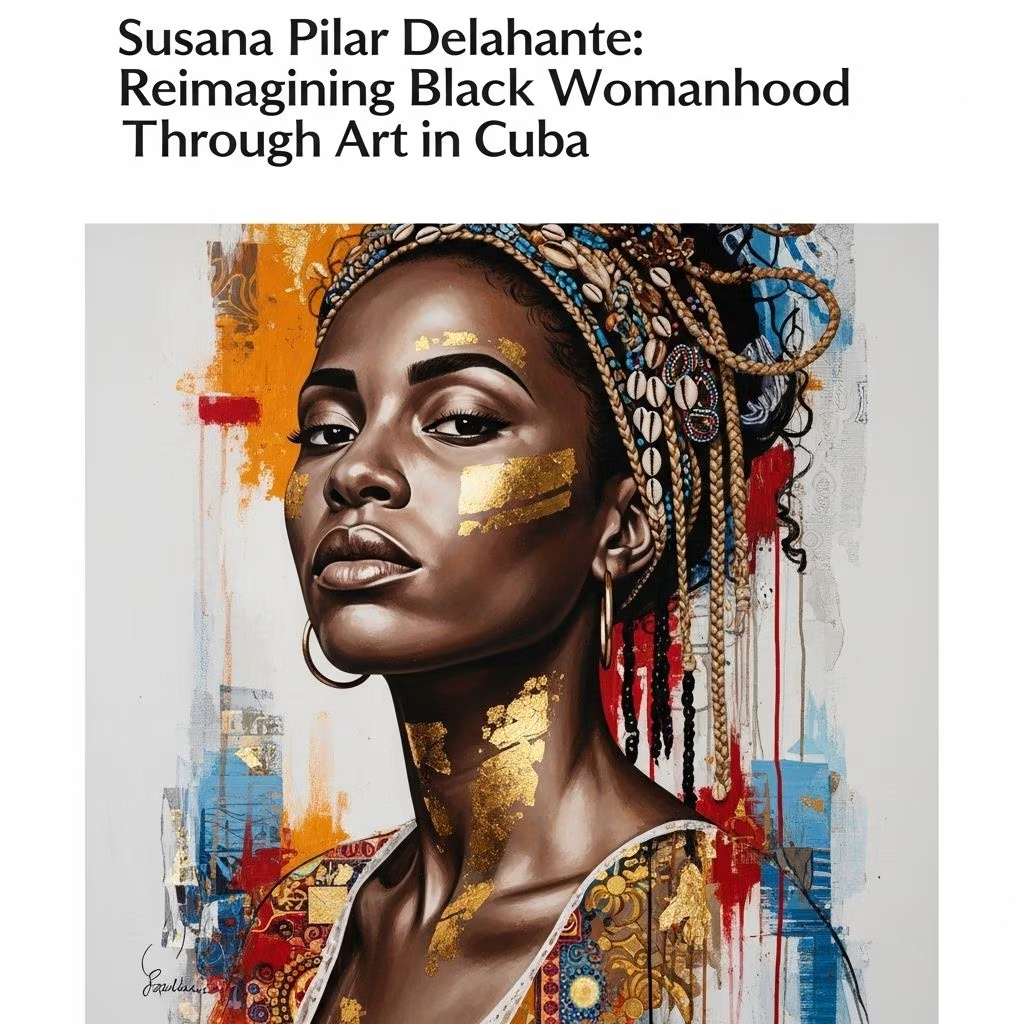
Susana Pilar Delahante: Reimagining Black Womanhood Through Art in Cuba
Susana Pilar Delahante Matienzo stands at the forefront of contemporary Cuban art, using installation, performance, and photography to reclaim narratives of Black women sidelined by history. Born in Havana in 1984, her work serves as a reflection not only of her personal journey but also of broader struggles that Black and mixed-race women face in Cuba and beyond.
The Sensation of Arrival: An Art Installation in Havana
In 2015, Delahante debuted an ambitious site-specific installation in Havana that would fundamentally reshape how art can engage memory, body politics, and collective identity. The project’s primary focus was the visibility and celebration of natural Black hair, which in Cuba, as in much of the world, has often been a subject of stigma and discrimination.
The installation set out to challenge beauty standards, asserting pride in African-rooted aesthetics and questioning the Eurocentric norms enshrined in Cuban society. Through this, Delahante invited viewers not just to observe, but to engage and interrogate their own perceptions.
The Central Themes of Delahante’s Work
- Body and Identity: Her art explores the ways in which bodies, especially those of Black women, serve as living archives and sites for historical memory and erasure.
- Race and Gender: Intersections of identity are critically posed in her installations, dissecting how racism, sexism, and colonial legacies shape lived realities.
- Memory and Archive: Delahante reclaims oral and visual histories, particularly those obscured or denied by institutional archives, to restore agency and subjectivity to Black women.
- Public Participation: The artist favors immersive environments where the audience becomes an active participant in reconstructing and experiencing history.
Anatomy of an Installation: Honoring Black Heritage and Hair
One of Delahante’s signature projects, launched during the 12th Havana Biennial, was “Lo Llevamos Rizo: Competition for Natural Afro Hair”. This event, which evolved into an ongoing movement across Cuba, created a powerful stage for Black women to showcase the diversity and beauty of natural hair textures.
Key Features of the Installation:
- An open call inviting participants from across the country, emphasizing inclusivity.
- Large-scale portraits and photo displays, celebrating contestants in their natural state and forming a visual counter-archive.
- Interactive workshops and conversation circles, promoting dialogue on hair, heritage, and identity.
This work continues Delahante’s larger mission: to address the pressure Black women face to alter their appearance, reclaim pride in their heritage, and challenge long-standing prejudices perpetuated through media and education.
Reclaiming the Archive and Counter-Memory
Cuban policies have often rendered histories of Afro-descendant, Indigenous, and Asian women invisible, preferring sanitized narratives or outright forgetting. Delahante’s installations serve as acts of resistance against these omissions. She constructs new forms of archives—blending photography, oral histories, staged tableaux, and digital technologies like AI.
In her 2024 exhibition Achievement at Vienna’s Secession, Delahante created a staged archive room filled with what appeared, at first glance, to be black-and-white photographs dating from the 16th to the 19th centuries. These images showed Black women not as enslaved or marginalized, but as business owners, intellectuals, and joyful members of society, directly rewriting the conditions under which their lives were historically recorded—or unrecorded entirely.
Upon deeper exploration, viewers discovered that these images were AI-generated, and each image’s caption contained directives for what and how to depict. This intervention underlines the artist’s engagement with technology as a tool for reimagining and thus reclaiming lost narratives.
Performance as Embodied History
Delahante frequently employs her own body as a medium, treating it as an archive of displacement, resilience, and lived experience. In performances, both in Cuba and on international stages, she references the forced migrations from Africa and Asia that shaped her family and nation. The body stands as a site of political contest, memory, and possible healing.
Key elements of her performative works include:
- Referencing personal and collective family memories that defy official records.
- Exploring the affective dimensions of migration, diaspora, and belonging.
- Positioning herself—and by extension, the audience—as agents in witnessing and reclaiming history.
Iconic Interventions: The Dome Adorned with Bantu Knots
One of the most striking visual interventions curated by Delahante was her transformation of the Vienna Secession’s iconic dome. Traditionally gilded with around 2,500 golden leaves, the dome was temporarily covered in black sheaths, visually referencing the traditional Bantu knots—a Zulu hairstyle symbolic of African heritage.
This homage translates the intimate, individual act of hair-braiding into a monumental, collective gesture—elevating a historically overlooked symbol of Black womanhood into a position of architectural and cultural prominence.
Expanding Visual and Cultural Lexicons
Delahante’s work doesn’t operate solely within the realm of visual art—it also triggers critical conversations about:
- The global circulation of beauty standards, and their local impact.
- The rights of Black women to shape their own narratives and images.
- The power of contemporary art to confront and heal social wounds.
- Technological innovation as a path to restorative counter-memory.
Impact and Reception
Delahante’s installations have received both national and international acclaim, resonating particularly with women’s rights activists, scholars in African diaspora studies, and new generations of Caribbean artists. Her exhibitions in locations as varied as Havana, Vienna, and Berlin have helped highlight Cuba’s complex relationship to race, gender, and postcolonial identity.
Through the interplay between photographic realism and creative fiction, Delahante’s art underscores how official archives have often been mechanisms of exclusion. She invites her viewers to question the boundaries between memory, imagination, and documented truth.
Related Works and International Collaborations
| Year | Exhibition | Focus | Location |
|---|---|---|---|
| 2015 | Lo Llevamos Rizo | Celebration of natural afro hair | Havana, Cuba |
| 2022 | Berlin Biennale | Migration, memory, performance art | Berlin, Germany |
| 2024 | Achievement | AI, archives, Black women’s lives | Vienna, Austria |
The Personal Is Political: Artist’s Background and Motivation
Susana Pilar Delahante’s pursuit of these themes is deeply informed by her family’s own experiences. The artist, of African and Chinese heritage, has faced personal and familial instances of discrimination. These experiences fuel her determination to give visibility to the realities—especially the violence and erasures—that women like her encounter.
Her research-driven approach pairs personal memory with academic inquiry, resulting in work that both documents and reimagines what has been lost to history.
Frequently Asked Questions (FAQs)
Q: Why does Susana Pilar Delahante focus on hair in her installations?
A: Hair operates as both a site of political contest and a marker of identity in Black communities. By celebrating natural hair, Delahante confronts beauty norms that have marginalized Black women and affirms African heritage in Cuban culture.
Q: How does technology feature in her artwork?
A: Recently, Delahante has embraced artificial intelligence to generate compelling images that disrupt and correct the historical archive, providing visual evidence for alternative histories of Black women otherwise absent from traditional records.
Q: What is the significance of the Bantu knot dome intervention?
A: Transforming Vienna’s Secession dome into a visual representation of Bantu knots draws international attention to the significance of African beauty traditions. It also asserts Black womanhood as a subject worthy of monumental recognition.
Q: How does Delahante’s personal history influence her work?
A: Delahante channels her family’s Afro-Cuban and Chinese roots, as well as personal experiences with discrimination, into artwork that critically examines questions of memory, identity, and the body.
Conclusion: A Lasting Legacy in Contemporary Art
Through bold installations and participatory projects, Susana Pilar Delahante Matienzo consistently recasts the narrative surrounding Black women in Cuba. Her work challenges viewers to confront uncomfortable truths, embrace alternate histories, and envision empowered futures through the lens of feminist and anti-racist thinking. In doing so, she continues to expand what art can achieve as a force for social change and historical recovery.
References
- https://www.galleriacontinua.com/artists/susana-pilar-22/biography
- https://secession.at/ausstellung_susana_pilar_delahante_matienzo_en
- https://contemporaryand.com/magazines/susana-pilar-delahante-reclaiming-space-through-performance/
- https://www.stirworld.com/see-features-susana-pilar-delahante-matienzo-s-achievement-reconsiders-black-history
- https://thomasjlax.com/Susana-Pilar-in-Conversation-with-Thomas-J-Lax
- https://secession.at/presse_susana_pilar_delahante_matienzo_en
- https://www.cosmopolitan.com/style-beauty/beauty/news/a42153/susana-delahante-art-installation-cuba/
- https://artgalleries.tufts.edu/exhibitions/95-cuban-virtualities-new-media-art-from-the-island
- https://www.arteinformado.com/agenda/f/achievement-231390