A Children’s Bible: Lydia Millet’s Unsettling Climate Fable
Lydia Millet’s novel A Children’s Bible stands as a powerful meditation on the themes of generational responsibility, climate anxiety, and the urgent failures of adulthood. Through stark prose and searing allegory, Millet conjures a near-future – or, perhaps, all-too-present – world in which disaster tests the bonds of family and the fate of humanity itself. This article delves into the novel’s structure, literary resonance, and what it reveals about our collective response to existential threats.
The Premise: Summer Vacation Upended by Apocalypse
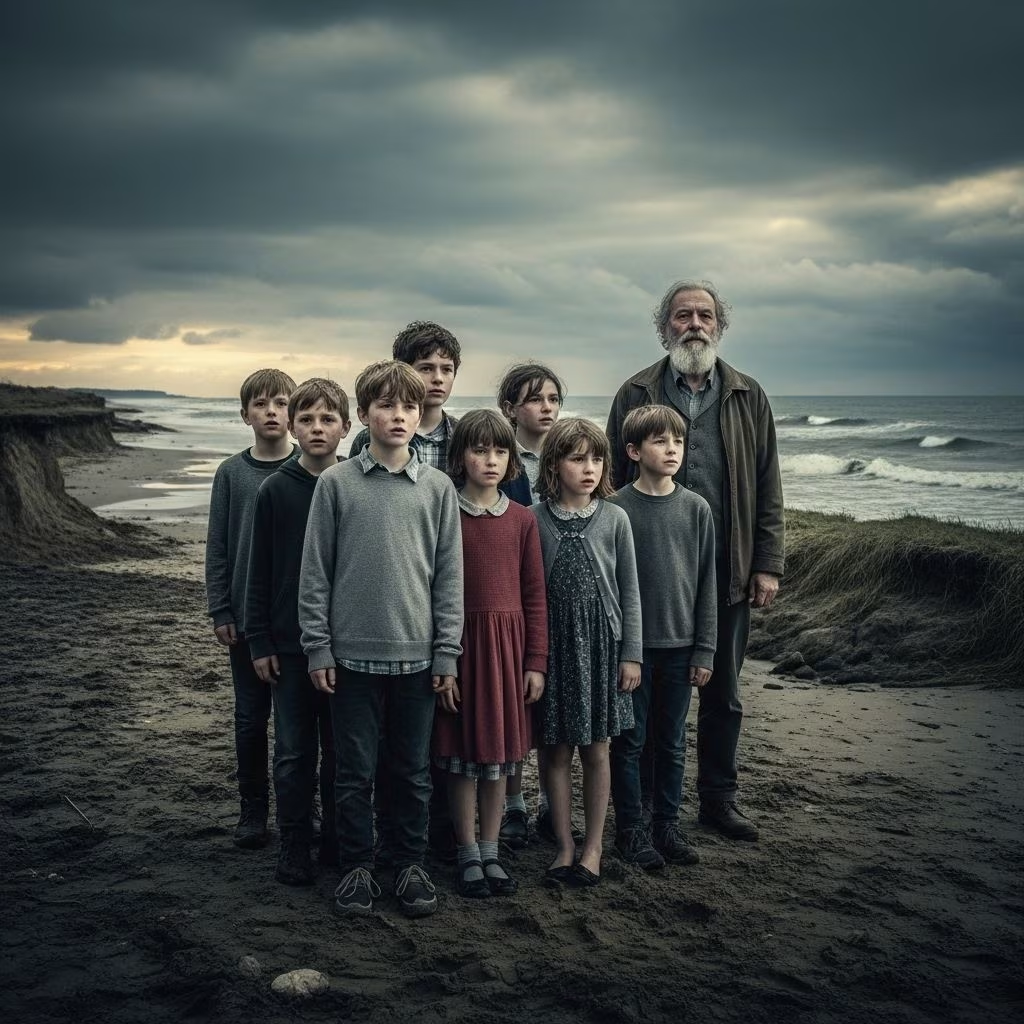
The narrative begins benignly enough: a group of families rents a sprawling summer house on the East Coast, gathering parents and children for what promises to be a carefree vacation. But when a catastrophic hurricane strikes, the cracks in both the environment and family structures grow impossible to ignore. As the world outside dissolves into chaos, the children are left to survive on their own, forced from their Edenic garden into a frightening new reality.
- The story centers on Evie, the narrator, speaking for a collective of children rather than as a singular protagonist.
- The parents retreat into denial, distracted by parties, alcohol, and fleeting pleasures, symbolizing a whole generation’s avoidance of uncomfortable truths.
- With the adults increasingly unreliable, the children must band together to seek safety and meaning in a world stripped of order.
Generational Tensions: Parents in Denial, Children Forced to Lead
One of Millet’s most pointed critiques is aimed at the divide between generations—the sense that adults, despite their knowledge, have failed to act on the climate crisis, bequeathing their children a broken planet. Through the children’s eyes, parents become less individuals and more a monolithic symbol of generational neglect.
- Collective Voice: Evie rarely refers to herself in the first person, instead using “we” to emphasize group experience and the shared angst of the younger generation.
- Resentment and Burden: The children’s anger is less about personal slights and more about inheriting a world in collapse. As Evie observes, “We knew who was responsible, of course: it was a done deal before we were born.”
- Role Reversal: The adults’ inability to respond leads the teenagers to adopt adult roles, organizing, foraging, and caring for the youngest while elders indulge in escapism.
This generational critique reflects a broader trend in contemporary fiction, where the anxieties of Millennials and Gen Z—those most at risk from climate change—are central to the narrative voice.
Biblical Allegory and Mythic Resonance
The novel is saturated with biblical references and echoes of myth. A literal children’s Bible, read by one of the youngest, Jack, becomes a source of guidance and allusion as disaster unfolds. Through these devices, Millet elevates the children’s odyssey from a mere survival story to a broader parable about stewardship and sacrifice.
- Allusive Structure: From motifs of a lost Eden to Moses leading people to safety, echoes of Cain and Abel, and the Flood, the narrative draws on scripture to frame contemporary crisis in timeless terms.
- Guiding Lessons: Jack translates biblical lessons simply: “If you have a good garden, don’t leave it,” reflecting the lost innocence and the environmental ethic neglected by adults.
- Ultimacy: The use of religious allegory lends mythic and moral weight, prompting the reader to consider the deeper significance of contemporary catastrophe.
For readers steeped in biblical stories, these references invite a deeper reading while remaining broadly accessible and respectful to a diversity of beliefs.
The Collapse of Authority and Inadequacy of the Old World
Millet’s portrayal of the adults is unsparing. The parents’ passivity and selfishness stand in sharp relief to the resourcefulness and resolve of the young. Rather than rise to meet the emergency, the adults cling to their creature comforts, paralyzed by a fear of property loss or the fleeting pleasure of party decadence.
- As the hurricane approaches, parents attempt half-hearted preparations, more concerned with the “security deposit” than their children’s future.
- When the home is inevitably flooded and the situation turns grim, parents surrender to hedonism—a haze of “mimosas and afternoon happy hours”.
- Their skills and knowledge, once suited to privilege and peacetime, are revealed as irrelevant in a world undone by ecological crisis.
This depiction echoes the real-world sense among climate activists that promises of safety and stability made by their elders are hollow, their authority eroded by inaction.
The Children’s Quest: Survival, Solidarity, and Sacrifice
Amid the breakdown, the narrative shifts to the children who, abandoned in many respects, must improvise new systems of support and ethics. The story at times alludes to Lord of the Flies but carves its own path, exploring solidarity rather than savagery.
- The children’s journey sees them encounter a cast of characters who complicate the notion of saviors and villains, including a groundskeeper (echoing Moses), a mysterious older woman, and other fellow survivors.
- New systems emerge: leadership is distributed, rules are adapted, and the wounds of youth—fear, isolation, the burden of care—are met with resilience.
- Difficult choices, including to leave the parents behind, force the children to confront the grim ethical landscape of survival.
Whereas Golding’s classic painted a grim view of human nature, Millet’s children operate in gray areas—struggling with gender identity, loyalty, and compassion under pressure.
Style and Tone: Prose at the Brink
Millet’s narrative voice is restrained, almost detached, mirroring the emotional shell so often adopted by younger generations overwhelmed by relentless bad news. The spare, almost reportorial narration strips the apocalyptic scenario of melodrama, underscoring the numbness and desensitization brought on by constant existential threat.
- The lack of emotional histrionics keeps the story from sentimental excess, focusing instead on the grit and necessity of the present moment.
- This voice aligns with how many real-life youth activists articulate the climate crisis: urgent, angry, clear-eyed, and often skeptical of empty words.
Critiques: Vivid Ideas, Flat Characters?
While many reviewers praise the novel’s ambition and clarity, some note a trade-off in emotional engagement due to the flattening of secondary characters. Evie’s distance from both adults and other children makes it difficult for readers to connect emotionally with individual stakes, even as the larger metaphors resonate.
- Some parents are rendered as caricatures, representing broad generational failures more than complex individuals.
- Background characters often lack nuance, making the impact of events less personally harrowing than they might be in more character-driven novels.
Still, the book’s allegorical ambition compensates for some limitations in depth, sharpening its focus on collective experience over individual psychology.
Climate Fiction and the Next Generation
A Children’s Bible joins a growing body of climate fiction (“cli-fi”) that blurs the boundaries between speculative and literary modes. By threading contemporary anxieties through the lens of biblical fable, Millet places her novel at the crossroads of realism, myth, and urgent activism.
- The narrative’s focus on youth activism, resilience under duress, and moral reckoning distinguishes it from more dystopian visions, instead emphasizing agency and collective power.
- The book functions as a warning and a rallying cry, illustrating how generational apathy can have devastating consequences while also revealing the remarkable capacity of youth to create new futures from the wreckage left to them.
Key Themes in Table Format
| Theme | Description |
|---|---|
| Generational Divide | Sharp critique of adults’ inaction on climate change and the burdens placed on youth. |
| Biblical Allegory | Extensive use of scriptural motifs to recast contemporary crisis as mythic and moral. |
| Climate Catastrophe | Environmental disaster serves as both setting and metaphor for lost innocence and betrayal. |
| Coming of Age | Children are forced to take adult responsibilities in a world where the old order has collapsed. |
| Survival and Solidarity | Youth construct new systems of meaning, ethics, and care amid disaster. |
Frequently Asked Questions (FAQs)
Q: What is the main message of Lydia Millet’s A Children’s Bible?
A: The novel explores how the failures of older generations to address climate change force young people to become leaders and caretakers amid disaster, framing the issue as both a moral and existential crisis.
Q: Is the book heavily religious?
A: While biblical references and motifs are central to the narrative, the book is not religious in agenda; rather, it uses these myths to deepen its allegory and explore universal questions of responsibility and meaning.
Q: How does the book depict parents and adults?
A: Parents are largely portrayed as symbolic of a complacent, pleasure-seeking generation that fails to respond effectively to crisis, highlighting a broader societal critique.
Q: How suitable is the book for younger readers?
A: The thematic content is best suited to mature teens and adults, due to its bleak atmosphere and mature discussion of climate anxiety, family dysfunction, and existential peril.
Q: Does the story offer hope?
A: While the atmosphere is grim and unsentimental, the resilience and solidarity of the children point toward the possibility of building new meaning and systems even in the wake of catastrophe.
Conclusion: Why A Children’s Bible Matters Now
Lydia Millet’s A Children’s Bible is more than a work of speculative fiction. It is a cry of alarm and a call to accountability, employing biblical allegory and unflinching social critique to hold up a mirror to our collective failure—and our potential redemption. Its spare style and mythic echoes underline the gravity of our current moment, where young people stand at the edge of a world they did not break but must now attempt to rebuild. Although harrowing, the novel insists on the enduring strength and creativity of new generations facing unprecedented challenge.
References
- https://bellarminelion.com/opinions/2025/02/28/a-book-review-of-lydia-millets-a-childrens-bible/
- https://www.thecrimson.com/article/2020/10/7/childrens-bible-review/
- https://www.christiancentury.org/review/books/lydia-millet-s-children-s-bible-believable-climate-fable
- https://handbuiltcity.org/2023/06/26/book-review-a-childrens-bible-by-lydia-millet/
- https://chireviewofbooks.com/2020/05/26/young-climate-activists-and-the-language-of-god-in-a-childrens-bible/
- https://cannonballread.com/2021/07/a-childrens-bible-mobius_walker/