


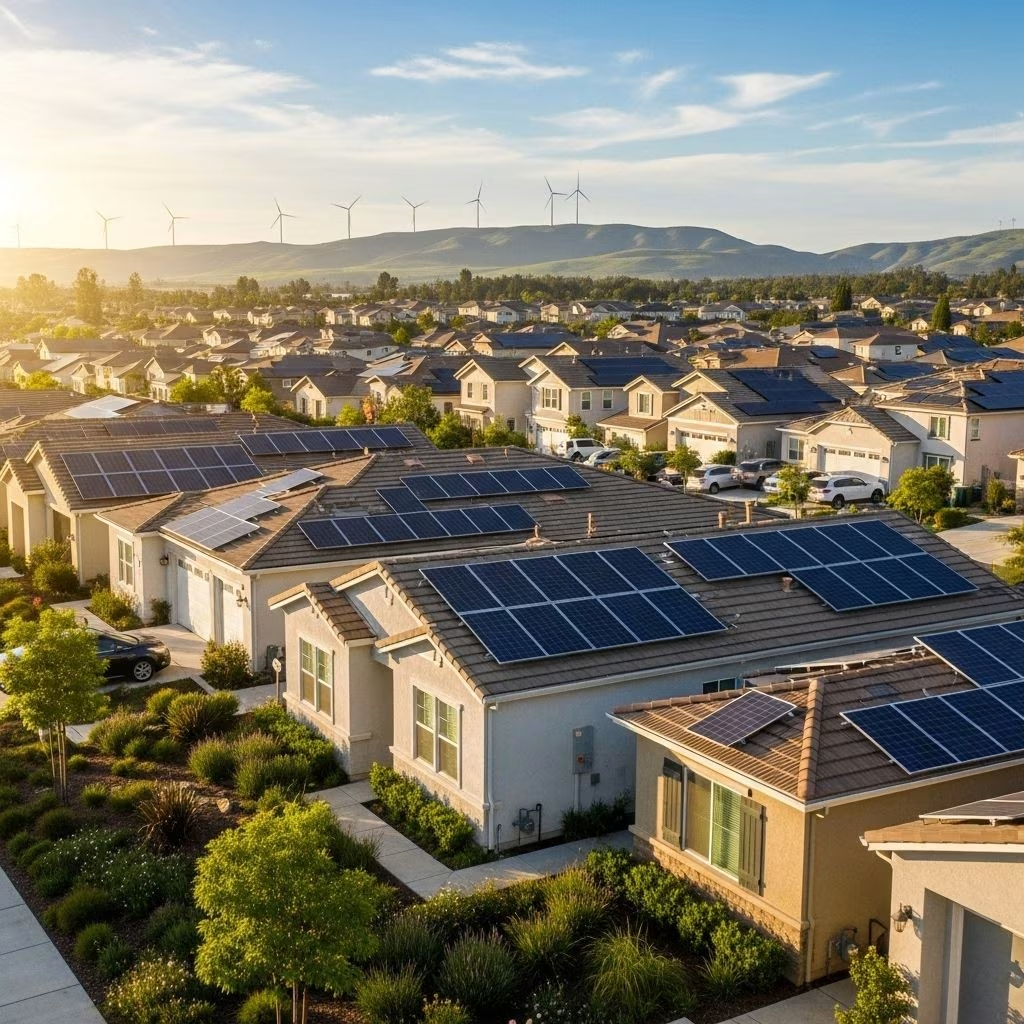
Environmental Groups Push for More Rooftop Solar in California
California has long been regarded as a leader in clean energy and climate action. Yet, in recent years, policies affecting rooftop solar have become a flashpoint among environmental groups, utility companies, and state regulators. After changes to net metering policy drastically cut the value of exported solar power, advocates argue California risks undermining its clean energy goals, harming consumers, and stalling progress on climate equity. This comprehensive look examines the key issues, policy changes, stakeholder positions, and the potential outcomes in the ongoing debate over rooftop solar in the Golden State.
California’s Rooftop Solar Landscape
California boasts more rooftop solar installations than any other state, with over two million solar systems deployed on homes and businesses. This distributed energy resource plays a significant role in meeting California’s ambitious targets for renewable energy and greenhouse gas reductions. Rooftop solar is especially valued for its ability to reduce transmission needs, increase local energy resilience, lower system-wide electricity costs, and empower consumers financially.
- California ranks number one in rooftop solar adoption, according to industry data.
- High sunshine and expensive retail electricity rates make rooftop panels attractive for homeowners and business owners alike.
- Rooftop solar provides critical support for the state’s push to decarbonize its grid and reach carbon neutrality by 2045.
Net Energy Metering: How the Policy Works
Historically, California incentivized rooftop solar through Net Energy Metering (NEM), a billing policy where customers receive credits for excess electricity sent to the grid. This policy allowed solar owners to offset their electricity bills at close to the retail rate, making the economics attractive and boosting rapid adoption. However, as installed rooftop solar capacity soared, utilities began arguing the policy created unfair cost shifts to non-solar customers and undermined grid revenue recovery.
| Version | Key Features | Compensation Rate | Status |
|---|---|---|---|
| NEM 1.0 & 2.0 | Full retail-rate credits, long-term grandfathering | 1:1 (retail) | Closed to new customers as of April 2023 |
| NEM 3.0 | Reduced export credits, incentives for pairing with batteries | Roughly 75–80% lower | Current policy since April 2023 |
A Drastic Shift: The NEM 3.0 Controversy
In April 2023, the California Public Utilities Commission (CPUC) implemented NEM 3.0, slashing export compensation by 75–80% for new rooftop solar owners served by PG&E, Southern California Edison, and SDG&E. The stated intent was to align credits more closely with the true value of solar exports and ensure grid costs are more equitably distributed.
This major shift drew immediate backlash from environmental groups, solar industry advocates, and many consumers. They argue:
- The value proposition for rooftop solar fell sharply, harming adoption rates and making it harder for homeowners to recoup installation investments.
- The state lost more than 17,000 solar jobs and saw installer bankruptcies and a rapid drop in new residential installations.
- Climate and equity goals are jeopardized, especially in disadvantaged and lower-income communities that stand to benefit most from distributed solar.
Environmental Groups File Legal Challenge
Shortly after the CPUC’s NEM 3.0 decision, a coalition of prominent environmental organizations—including the Center for Biological Diversity, The Protect Our Communities Foundation, and the Environmental Working Group—filed a lawsuit against the CPUC. The petition argued that:
- The new policy violated state climate laws by stifling distributed solar growth when state law specifically requires expanding such clean energy.
- The CPUC failed to fully account for the benefits of rooftop solar, such as reduced need for costly new transmission lines, grid reliability, and customer-sited storage for resiliency.
- Billions spent on utility transmission upgrades are driving up rates for everyone, while the benefits of local solar are ignored.
In August 2025, the California Supreme Court sided with the environmental groups and ordered the policy back to the Court of Appeal for further review, ruling that the lower court had failed to fully consider the Legislature’s intent and the impacts on environmental justice communities.
Utility Arguments Versus Independent Analysis
Electric utilities and their supporters maintain that rooftop solar shifts costs onto non-solar households, claiming this cost shift amounts to $8 billion. However, independent research found that distributed solar generated a net $1.5 billion in cost savings to the grid as of 2024. This highlights a deep divide in the data and rationale underpinning the debate.
- Utilities argue for reduced compensation to reflect the infrastructure and ongoing grid costs that solar customers avoid.
- Environmental advocates assert that distributed solar reduces grid strain, lowers overall system costs, increases resilience, and supports rapid electrification of vehicles and buildings.
- Rising rates are attributed primarily to utility transmission and distribution spending, which increased by over 300% in a decade, while usage remained flat.
Incentives and Battery Integration
Despite the blow from NEM 3.0, California still offers multiple incentives to make residential solar, particularly paired with batteries, more affordable. These include:
- Federal tax credits (the Investment Tax Credit – ITC) that can offset up to 30% of installation costs.
- California-specific rebates and local programs that further reduce the up-front cost, with average incentives worth approximately $6,780 for panels and up to $6,700 for batteries.
- Programs like the California Solar for All Program target low-income and disadvantaged communities for additional support.
A typical solar installation with a battery now pays back in about eight years, due to persistently high electricity prices.
The Role of Batteries in the New Era
NEM 3.0 incentivizes customers to store excess solar energy instead of sending it to the grid for a reduced price. Pairing rooftop solar with a home battery system now represents the best path for California residents to maximize their solar investment. Batteries allow households to consume their own solar power during peak hours, avoid high utility rates, and increase resilience during outages or blackouts.
- Home batteries have become integral to new installations, with substantial rebates lowering their cost.
- Batteries help California manage strain from grid outages and support reliability during wildfires, heatwaves, and other grid emergencies.
- The shift to more localized, resilient energy resources is critical for equity and climate adaptation.
Equity and Environmental Justice Concerns
Environmental groups and social justice advocates consistently warn that the current rooftop solar policies harm the very communities California’s climate mandates are designed to prioritize. Barriers to entry—such as high upfront costs and reduced payback from new net metering rules—mean that low-income and disadvantaged neighborhoods risk being left out of the clean energy transition. Protecting and expanding access to local solar is viewed as essential to ensure environmental and financial benefits are shared widely.
- Programs serving marginalized communities must continue and expand to address historical disparities in energy access and pollution impacts.
- Grid upgrades paid through rate increases disproportionately impact those with the fewest resources.
- Environmental justice provisions in state law require regulators to consider how policies affect vulnerable populations.
Recent Legislative and Regulatory Actions
The policy battle continues to play out in Sacramento and the courts. In 2025, legislators removed anti-solar provisions from a proposed bill (AB 942) that would have undermined contracts for approximately two million current solar owners. Grassroots mobilization played a key role in protecting existing solar investments and ensuring reforms would not retroactively harm early adopters.
- Opposition from tens of thousands of Californians persuaded legislators to protect rooftop solar contracts, illustrating the scale of public support.
- Legislative fixes and court rulings are likely to shape solar’s landscape for years to come, potentially reopening the door to stronger incentives and broader participation.
Challenges Beyond Policy: Delays and Utility Compliance
Even when customers choose to go solar, real-world challenges remain. Utilities, especially PG&E and Southern California Edison, have faced criticism and investigations for delaying rooftop solar hookups, causing financial hardship for customers and further slowing market momentum. Regulatory attention is now turning to enforce deadlines and ensure fair treatment for new solar owners.
- Routine delays in connecting new rooftop systems have squeezed owners financially, with a growing chorus demanding accountability for utility inaction.
- Efficient interconnection is vital for sustaining solar’s growth and public trust in the process.
What’s Next for Rooftop Solar in California?
The coming years will determine whether California can maintain its leadership in distributed clean energy while addressing equity concerns and grid reliability. As the courts review the CPUC’s NEM 3.0 decision and lawmakers debate further reforms, stakeholders are calling for:
- Restoration or redesign of net metering policy to ensure continued rapid rooftop solar deployment.
- Expansion of incentives, financing mechanisms, and targeted programs for disadvantaged communities.
- Greater accountability for utility spending, including a critical reassessment of escalating transmission and distribution costs.
- Policies that reward grid resiliency, environmental stewardship, and public benefit over shareholder value.
Frequently Asked Questions (FAQs)
Q: Is rooftop solar still worth it for homeowners in California under NEM 3.0?
A: Yes. Although compensation for exported solar power fell sharply, high electricity rates and incentives still make rooftop solar, especially paired with batteries, a financially viable investment for many Californians. Payback periods now typically hover around eight years.
Q: What legal actions are environmental groups taking?
A: Environmental organizations are challenging the CPUC’s NEM 3.0 policy in court, arguing it violates state laws requiring ambitious buildup of clean and distributed energy, and fails to protect disadvantaged communities.
Q: What can be done to make rooftop solar more equitable?
A: Expansion of targeted incentives for low-income and marginalized communities, streamlined interconnection, and restoration of robust net metering policies are all key to ensuring the benefits of clean energy are shared widely.
Q: How do home batteries change the economics of solar post-NEM 3.0?
A: Home batteries allow customers to store excess solar generation on-site, use it during expensive peak hours, and avoid selling power back to the grid at low rates—significantly improving return on investment.
Q: What are the main arguments for and against rooftop solar expansion?
A: Proponents highlight climate benefits, grid savings, job creation, and resilience, while opponents claim cost shifts to non-solar customers and rising grid costs. Independent analyses challenge some utility claims, suggesting solar’s net benefits outweigh costs.
Conclusion
As California navigates the complex path to a decarbonized and equitable energy future, the debate over rooftop solar stands as a proxy for broader questions of justice, affordability, and resilience. The outcome will shape the state’s energy landscape, climate action trajectory, and reputation for innovation for decades. With legal, policy, and grassroots action all converging, the stakes for distributed solar—and California’s communities—could not be higher.
References
- https://solarrights.org/blog/2025/07/16/dont-break-the-solar-contract/
- https://www.cleanenergyconnection.org/article/are-solar-panels-still-worth-it-california-2025
- https://pv-magazine-usa.com/2025/08/07/california-supreme-court-orders-solar-net-metering-policy-to-be-rereviewed-by-appeals-court/
- https://www.solarreviews.com/solar-incentives/california
- https://calmatters.org/economy/2025/08/california-supreme-court-rules-on-net-metering-cuts/
- https://www.cpuc.ca.gov/industries-and-topics/electrical-energy/demand-side-management/customer-generation/state-of-california-solar-for-all-program
- https://calmatters.org/economy/2025/10/rooftop-solar-hookups-miss-deadlines/


