


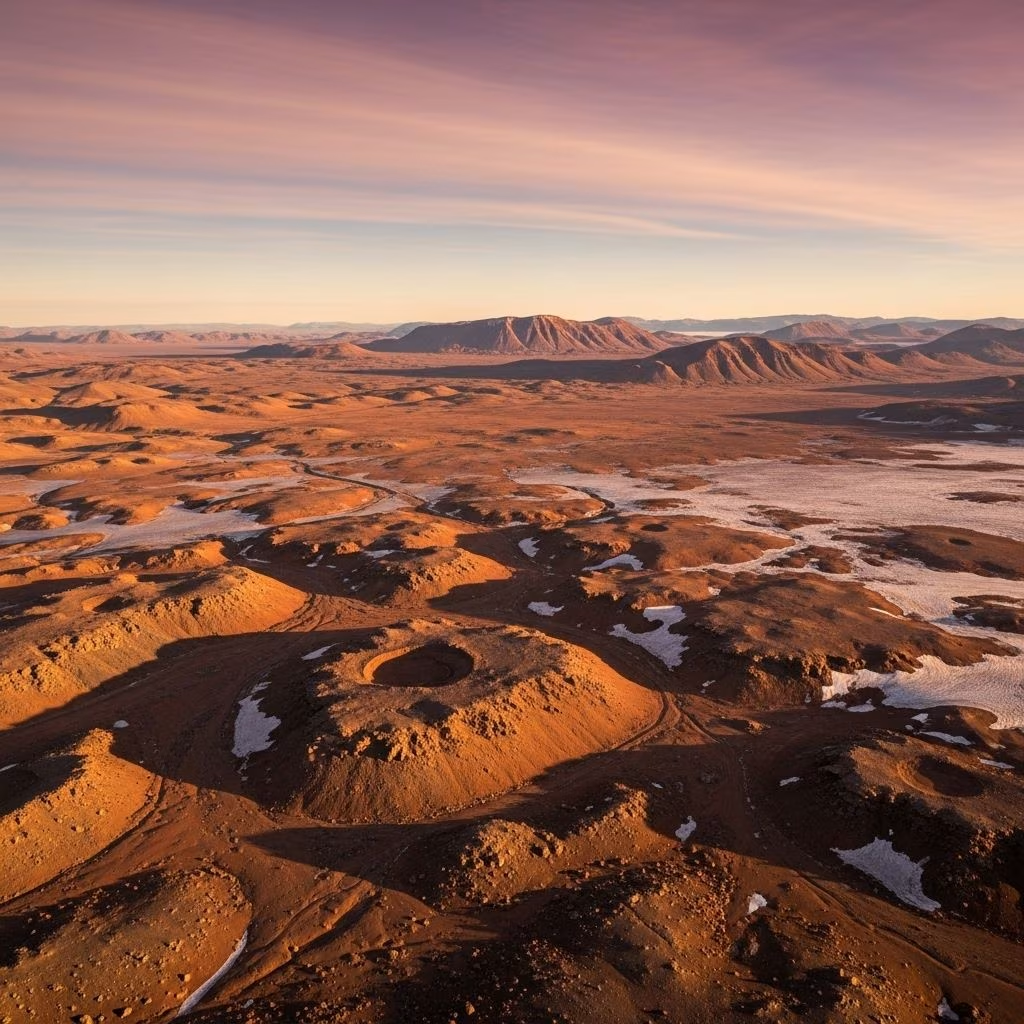
Devon Island: Earth’s Martian Mirror
Hidden in the far reaches of the Canadian Arctic lies Devon Island, the world’s largest uninhabited island and a landscape so stark and inhospitable that it is frequently called the most Mars-like place on Earth. With wind-blasted rocks, polar desert, and ancient impact craters, this remote landmass has become a proving ground for planetary scientists and NASA engineers aiming to prepare for Mars exploration.
Where Is Devon Island and Why Does It Matter?
Devon Island is located in the Canadian Arctic Archipelago, at about 75° North latitude, nestled between Baffin Bay and the Arctic Ocean as part of Nunavut’s Queen Elizabeth Islands. It covers 55,247 square kilometers (21,331 square miles), an area comparable to West Virginia or Croatia. Its closest communities are hundreds of kilometers away, and there are no permanent human settlements on the island.
The intense cold, dry climate, and barren landscape have made Devon Island an international focal point for researchers seeking an Earth analog to Mars. During Arctic summers, average daytime temperatures can reach only a few degrees above freezing, mimicking the frigid, desolate scenes found on Mars. These Martian-like characteristics make the island invaluable for field testing space technology, training astronauts, and studying planetary geology.
The Haughton Impact Crater: Devon’s Scientific Gem
Perhaps the most unique feature on Devon Island is the Haughton Impact Crater. Formed approximately 23–39 million years ago when a comet or asteroid slammed into what was then a lush temperate forest, the crater is some 20 kilometers (12.4 miles) in diameter. As the highest-latitude impact crater known on Earth, it presents researchers with a pristine natural laboratory to study impact cratering—one of the most influential processes in shaping planetary surfaces.
- The crater lies firmly in the so-called “frost rubble zone”—a frigid, polar desert strongly reminiscent of Mars’ ancient environment.
- Its geology boasts a striking similarity to certain Martian craters, with layers of shattered rock, permafrost, and sparse, reddish soils.
- This location allows researchers to draw direct comparisons to features on Mars, helping to interpret similar surface structures observed by orbiters and rovers on the Red Planet.
What Makes Devon Island So Much Like Mars?
Devon Island’s value as a Mars analog stems from a rare convergence of climate and geology:
- Climate and Isolation: The extreme cold, with minimal annual precipitation, creates a polar desert that is largely snow and ice-free in summer. Few other places on Earth combine such dryness, cold, and remoteness while remaining accessible for research deployment.
- Geological Similarities: The island features glacial landforms, barrens, permafrost polygons, and exposed sedimentary rocks that closely parallel what has been imaged and measured on Mars, especially in regions near the Martian poles or in highland terrains.
- Lack of Life and Vegetation: Devon Island’s minimal biodiversity and absence of permanent vegetation mirror current Martian conditions, where any life that exists would need to be subterranean and exceedingly resilient.
As Dr. Pascal Lee, the renowned NASA researcher and a leader of Arctic Mars analog research, puts it: “By setting ourselves up in this polar desert, we will experience an environment that most closely resembles the surface of Mars.”
Haughton-Mars Project: A Mars Research Station on Earth
Since the late 1990s, Devon Island’s Haughton Crater has hosted the Haughton-Mars Project (HMP), a collaborative partnership originally sponsored by the US National Research Council, NASA, and The Mars Society. Today, it operates the world’s largest privately managed polar research station from this remote base.
- Researchers spend weeks to months living in tents or temporary shelters, operating much like a crew on Mars would: cut off from most outside contact, relying on imported supplies, and dealing with extreme environmental conditions.
- The project focuses on simulating aspects of Mars exploration rarely possible elsewhere—testing everything from rover designs and spacesuits to remote-operated tools and sample-return mechanisms.
- Devon Island’s natural hazards demand meticulous planning for safety, mirroring the risks and operational constraints that astronauts would face on Mars.
These expeditions offer a preview of what living and working on Mars could demand, helping scientists, engineers, and astronauts adapt to the unforgiving red planet. Technologies and strategies proven here will inform future Mars missions, minimizing the risk of unexpected failures on the real Martian surface.
Key Research Achievements and Insights from Devon Island
- Devon has enabled the first field trials for Martian surface vehicle prototypes—robots deployed on the island have helped refine driving techniques, software, and instrumentation that now guide actual Mars rovers.
- Human and robotic teams have tested advanced communications, navigation, life-support protocols, and even emergency procedures for “evacuation” in case of injury—practices directly relevant to future Mars exploration.
- Scientific teams have mapped the crater and surrounding polar desert, drawing close analogs to Martian surface evolution, permafrost dynamics, and the survival limits of extremophile microbes.
- The project has illuminated how impact craters evolve in icy settings, shedding light on similar formations observed by Mars orbiters.
Comparing Devon Island and Mars: A Quick Reference Table
| Feature | Devon Island | Mars |
|---|---|---|
| Atmosphere | Earth-like but thin (Arctic dry air) | Extremely thin (mainly CO₂) |
| Temperature (summer/day) | 0° to 8°C (32°–46°F) | -28°C (−18°F) near equator (daytime) |
| Surface Features | Impact craters, permafrost, glacial valleys | Vast impact craters, permafrost regions, dust, dunes |
| Lifespan of Ice | Perennial permafrost, summer melt ponds | Sub-surface ice, little to no liquid water |
| Lack of Vegetation | Very sparse mosses, lichens | None currently detected |
| Accessibility | Remote but reachable in summer | Possible via advanced robotics or future crewed missions |
The Limitations of Earth Analogs: What Devon Island Does Not Reproduce
While Devon Island comes remarkably close to simulating Mars, it is not a flawless match. Key differences include:
- Atmosphere: Mars’ atmosphere is about 100 times thinner than Earth’s, and it is overwhelmingly composed of carbon dioxide, unlike the mix of nitrogen and oxygen on Earth.
- Gravity: Mars has roughly 38% of Earth’s gravity, a dynamic impossible to replicate on the island.
- Surface Sediments: Mars is covered with dunes, ripples, and fine dust that create challenges for exploration. Devon Island notably lacks these pervasive sand features, as its windblown sediments remain limited in size and scope.
- Solar Radiation: Without Earth’s ozone layer and strong magnetic field, Mars is barraged by harsher cosmic and solar radiation.
Therefore, some technologies and strategies must be tested in specialized chambers or through simulation instead.
Why Conduct Mars Exploration Research on Devon Island?
With so few places on Earth offering comparable extremity, Devon Island is repeatedly chosen for Mars simulation missions because:
- The polar desert is isolated yet reachable, allowing researchers to trial new technologies while maintaining some connection for emergencies.
- Its geology, climate, and impact features offer a testbed to anticipate Martian surface operations.
- It challenges teams to collaborate under duress, solve logistical problems, and perform advanced science in difficult settings.
- By studying the Haughton Crater’s geology and biology, researchers learn to distinguish truly Martian processes from common Earth analogs, informing how we interpret distant data from planetary missions.
Global Impact: Fostering Innovation and Exploration
The Haughton-Mars Project and similar expeditions have left an indelible mark on the field of planetary science and human spaceflight:
- Technologies first fielded on Devon Island, such as advanced rovers, autonomous support vehicles, and high-resolution mapping tools, have influenced ongoing Mars rover missions.
- Life-support and habitat protocols developed in this isolated environment serve dual uses: for space exploration and for maintaining human safety in polar or remote terrestrial industries.
- Insights gained from biological surveys—such as extremophile microbes—are guiding search strategies for Martian life.
- Outreach programs and media features from the Haughton-Mars Project help to inspire a new generation of science, engineering, and flight professionals.
Frequently Asked Questions (FAQs)
Q: Why was Devon Island chosen as a Mars analog over Antarctica or deserts?
A: Devon Island offers a combination of Martian-like dryness, cold, terrain, and isolation, but is more accessible in summer than Antarctica and is less vegetated and less populated than most desert locations. This makes it uniquely suited for Mars mission simulations and equipment field trials.
Q: What is the main purpose of the Haughton-Mars Project?
A: The Haughton-Mars Project provides a field research station to test technologies, operational protocols, and human factors for upcoming Mars missions, simulating mission operations in a low-resource, extreme environment.
Q: Do researchers discover potential life forms on Devon Island?
A: Devon Island is mostly barren, but scientists study its few hardy extremophile microbes. These organisms help guide strategies for seeking simple life on Mars.
Q: What key feature is missing on Devon Island that is present on Mars?
A: Active sand dunes and dust ripples are pervasive on Mars but are notably absent on Devon Island, limiting the ability to test some robotic mobility and surface interaction scenarios.
Q: Has Devon Island inspired actual Mars mission design?
A: Yes, field experiences from Devon Island expeditions have directly shaped rover missions, spacesuit development, and crew training for Mars analog missions.
Conclusion: The Legacy and Future of Earth’s Red Frontier
Devon Island’s frozen isolation, battered rock, and the epic scar of the Haughton Crater form the finest natural laboratory for Mars research on Earth. As scientists continue to push the boundaries of space exploration, the lessons learned here will ensure that humanity’s next giant leap—whether robotic or human—gains strength from the harsh lessons of Earth’s own Arctic frontier. As we look beyond our planet, the story of Devon Island remains a crucial chapter in preparing to become a truly interplanetary species.


