Fascinating Earthquake Facts: What You Should Know
Earthquakes are among the most powerful and unpredictable natural phenomena on our planet. They have shaped landscapes, influenced human history, and continue to affect millions of lives each year. This article examines essential facts about earthquakes, exploring their causes, effects, historical records, global impact, and key safety tips.
What Is an Earthquake?
An earthquake is a sudden, violent shaking of the ground caused by movement along faults or by volcanic activity. These movements release energy from within the Earth’s crust, resulting in seismic waves that travel through the ground. While most earthquakes are minor and go unnoticed, some can cause significant destruction and loss of life.
What Causes Earthquakes?
Earthquakes are mainly caused by the movement of tectonic plates, but there are several contributing factors:
- Plate Tectonics: The Earth’s crust consists of several large plates that constantly move and interact. When these plates grind against one another or collide, the pressure gets released as seismic energy, resulting in an earthquake.
- Fault Lines: Most earthquakes originate along faults—fractures in the Earth’s surface where tension accumulates. The slipping of rocks on either side of a fault triggers tremors.
- Volcanic Activity: Movement of magma beneath volcanoes can produce earthquake activity, especially in regions with active volcanoes.
- Human Activities: Activities such as mining, drilling, and large-scale construction projects can induce minor earthquakes known as induced seismicity.
Types of Earthquakes
- Tectonic Earthquakes: Caused by movement of the Earth’s plates and are the most common type.
- Volcanic Earthquakes: Linked to volcanic activity; usually smaller but can be dangerous near populated volcanoes.
- Collapse Earthquakes: Occur in underground caves or mines due to sudden collapse of rock.
- Explosion Earthquakes: Result from explosions of chemical or nuclear materials; these are rare and typically localized.
How Do Scientists Measure Earthquakes?
Scientists use seismographs to record the seismic waves produced by earthquakes. The most common measurement scales are:
- Richter Scale: Assigns a number from 1 to 10 based on the magnitude (energy released) of the quake. Each increment reflects a tenfold increase in amplitude.
- Moment Magnitude Scale (Mw): More commonly used today; considers the size of the fault and the amount of slippage, giving a more accurate picture of the earthquake’s total energy.
- Modified Mercalli Intensity: Measures the effects and intensity of shaking as felt by people and seen in buildings.
| Magnitude | Effect |
|---|---|
| Less than 3.0 | Usually not felt, but recorded |
| 3.0–3.9 | Often felt, rarely causes damage |
| 4.0–4.9 | Noticeable shaking, minor damage |
| 5.0–5.9 | Potential for significant damage |
| 6.0–6.9 | Can cause severe damage |
| 7.0+ | Major earthquakes, widespread destruction |
Where Do Earthquakes Happen Most?
Earthquakes can occur anywhere, but most happen along plate boundaries. The most active seismic zones are:
- The Ring of Fire: A horseshoe-shaped zone around the Pacific Ocean with frequent earthquakes and volcanoes. Countries include Japan, Indonesia, Chile, and the western coast of North America.
- Mid-Atlantic Ridge: An underwater fault zone responsible for earthquakes on the Atlantic floor.
- Himalayan Belt: Created by the collision of the Indian and Eurasian plates, frequent tremors affect areas like Nepal, India, and China.
Some regions like California, Alaska, Chile, and Japan are especially prone to seismic activity due to their location on plate boundaries.
Record-Breaking Earthquakes in History
- 1964 Alaska Earthquake: Magnitude 9.2, the largest recorded in U.S. history, causing massive damage and tsunamis.
- 2004 Indian Ocean Earthquake: Magnitude 9.1–9.3, triggered devastating tsunamis affecting 14 countries and killing over 230,000 people.
- 2011 Tōhoku Earthquake (Japan): Magnitude 9.0, led to tsunamis and the Fukushima nuclear disaster.
- 1960 Valdivia Earthquake (Chile): Magnitude 9.5, the largest ever recorded worldwide.
- 1906 San Francisco Earthquake: Magnitude 7.9, destroyed much of the city due to shaking and subsequent fires.
Earthquake Effects: What Can Happen?
The power of an earthquake varies tremendously, but the main effects include:
- Ground Shaking: The most direct impact, sometimes strong enough to move buildings and break infrastructure.
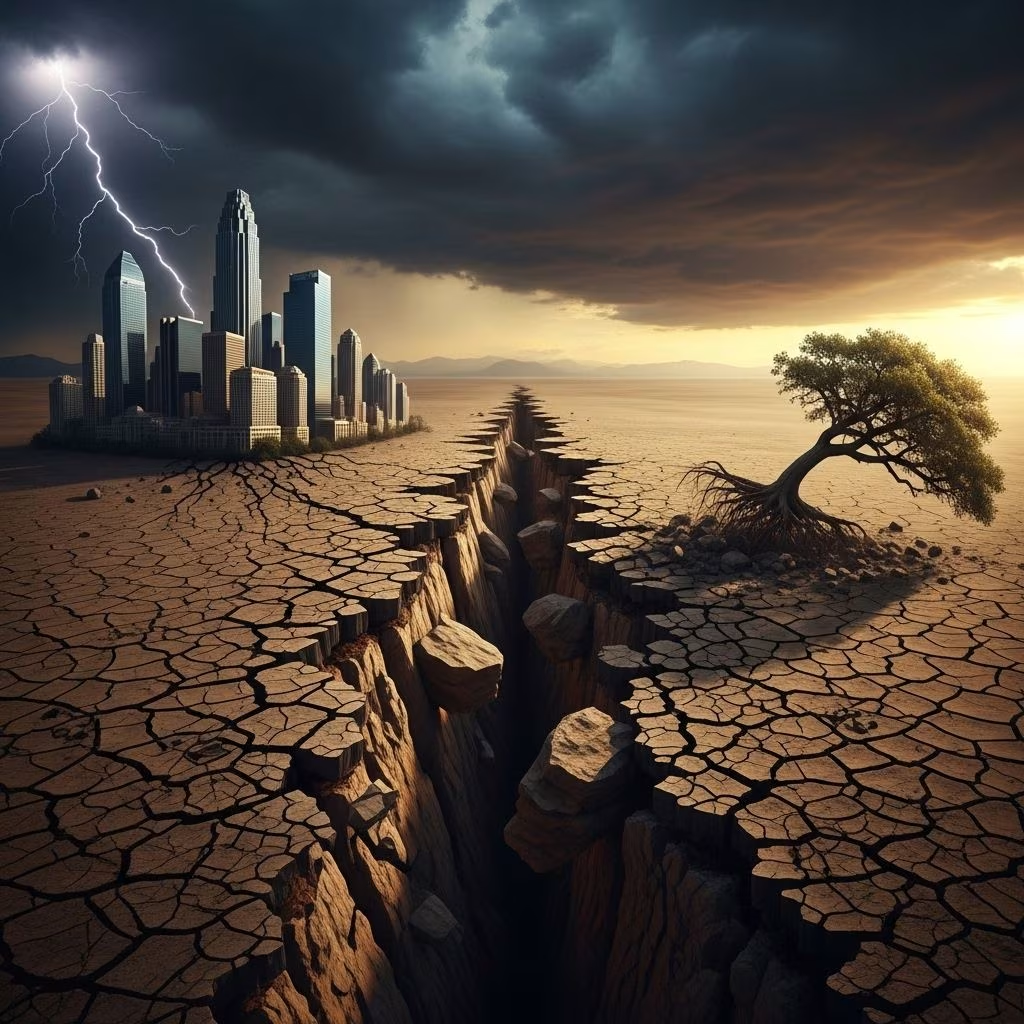
- Surface Rupture: The ground around the fault can crack, shift, or break open, damaging roads, pipes, and utilities.
- Landslides: Tremors can trigger landslides in mountainous or unstable areas, compounding destruction.
- Tsunamis: Earthquakes under the ocean floor often generate massive waves that devastate coastal communities.
- Liquefaction: Saturated soil may behave like liquid during shaking, undermining buildings and infrastructure.
- Fire: Earthquakes can destroy power lines and gas mains, sparking widespread fires.
Surprising Earthquake Facts
- About 500,000 earthquakes occur worldwide each year, but only about 100,000 are felt, and 100 cause damage.
- Earthquakes can trigger aftershocks—smaller quakes that follow the main event, sometimes continuing for weeks or months.
- Earthquakes happen on other planets and moons. For example, Mars experiences ‘marsquakes’ and the Moon experiences ‘moonquakes.’
- Animals are sometimes believed to sense earthquakes before humans, although scientific evidence remains inconclusive.
- Earthquakes don’t just happen in the Earth’s crust; events deep in the mantle have also been recorded.
- Most earthquakes occur at depths less than 50 miles (80 kilometers) from the surface.
How to Stay Safe During an Earthquake
Preparation and quick action are vital for safety during and after an earthquake:
- Know safe spots in your home: under sturdy tables or against interior walls away from glass.
- Practice “Drop, Cover, and Hold On” during drills and actual events.
- Secure heavy furniture and objects that could fall during shaking.
- Prepare an emergency kit with water, food, flashlight, and first aid supplies.
- Have a family communication plan for reunification after an earthquake.
- If outdoors, move to an open area away from buildings and power lines.
Earthquake Myths and Misconceptions
- Myth: California will fall into the ocean during the “Big One.”
Fact: The San Andreas Fault is a transform fault that causes horizontal movement—the state will not sink or break off. - Myth: Opening doorways offers protection.
Fact: Modern buildings no longer support this; seek shelter under furniture instead. - Myth: Small earthquakes prevent big ones.
Fact: Minor quakes do not relieve enough tension to prevent large, destructive earthquakes.
Earthquake Preparedness Around the World
Countries with frequent seismic activity have developed robust measures to protect people and property. Some common strategies include:
- Strict building codes that require earthquake-resistant construction.
- Public education programs and regular emergency drills.
- Early warning systems coupled with automatic shutdowns for utilities and transportation.
- Investment in rapid emergency response and disaster recovery resources.
Earthquakes and the Environment
Major earthquakes can reshape entire landscapes:
- Trigger landslides, avalanches, and rockfalls in affected areas.
- Alter river courses and create new lakes due to ground shifting.
- Impact habitats and disrupt ecosystems, sometimes leading to long-term changes in species populations.
Frequently Asked Questions (FAQs)
Q: Can you predict earthquakes?
A: No reliable method exists to predict earthquakes with precision. Scientists can estimate where earthquakes are likely but cannot forecast the exact time or magnitude.
Q: What should I do during an earthquake?
A: Drop, cover, and hold on. Stay away from glass, windows, and heavy furniture.
Q: Where do the most powerful earthquakes happen?
A: The most powerful earthquakes usually occur along subduction zones at plate boundaries, especially around the Pacific Ring of Fire.
Q: Can animals sense earthquakes before they happen?
A: There are anecdotal reports of animals behaving strangely before quakes, but scientific proof is limited.
Q: What causes aftershocks?
A: Aftershocks occur as the crust adjusts to changes in stress after the initial earthquake. These can continue for days, weeks, or even longer.
Q: Why do earthquakes happen more often in some regions?
A: Regions near tectonic plate boundaries experience more earthquakes due to intense geological activity.
Q: How can I prepare for an earthquake?
A: Create an emergency plan, secure heavy objects, store supplies, and know safe locations in your home.
Key Takeaways
- Earthquakes are a natural part of Earth’s geology, caused mainly by movements of the planet’s tectonic plates.
- Some quakes can cause immense destruction through shaking, tsunamis, landslides, and fires.
- Staying informed and prepared is critical for earthquake safety wherever you live.
- Despite modern technology, precise prediction of earthquakes remains out of reach.
- Worldwide, scientific research and safety preparation continue to evolve to protect lives and property from seismic risks.