Europe Rethinks Waste-to-Energy Amidst Green Ambitions
Across Europe, a growing debate is unfolding about the future of waste-to-energy (WtE) incineration facilities. Once championed as a pragmatic solution for managing non-recyclable waste while generating electricity and heat, WtE plants are increasingly under scrutiny as the European Union (EU) doubles down on its circular economy and greenhouse gas reduction goals. This article examines the complex landscape of waste management in Europe, the criticism and defense of the WtE sector, and the evolving policy frameworks shaping the continent’s waste future.
What Is Waste-to-Energy?
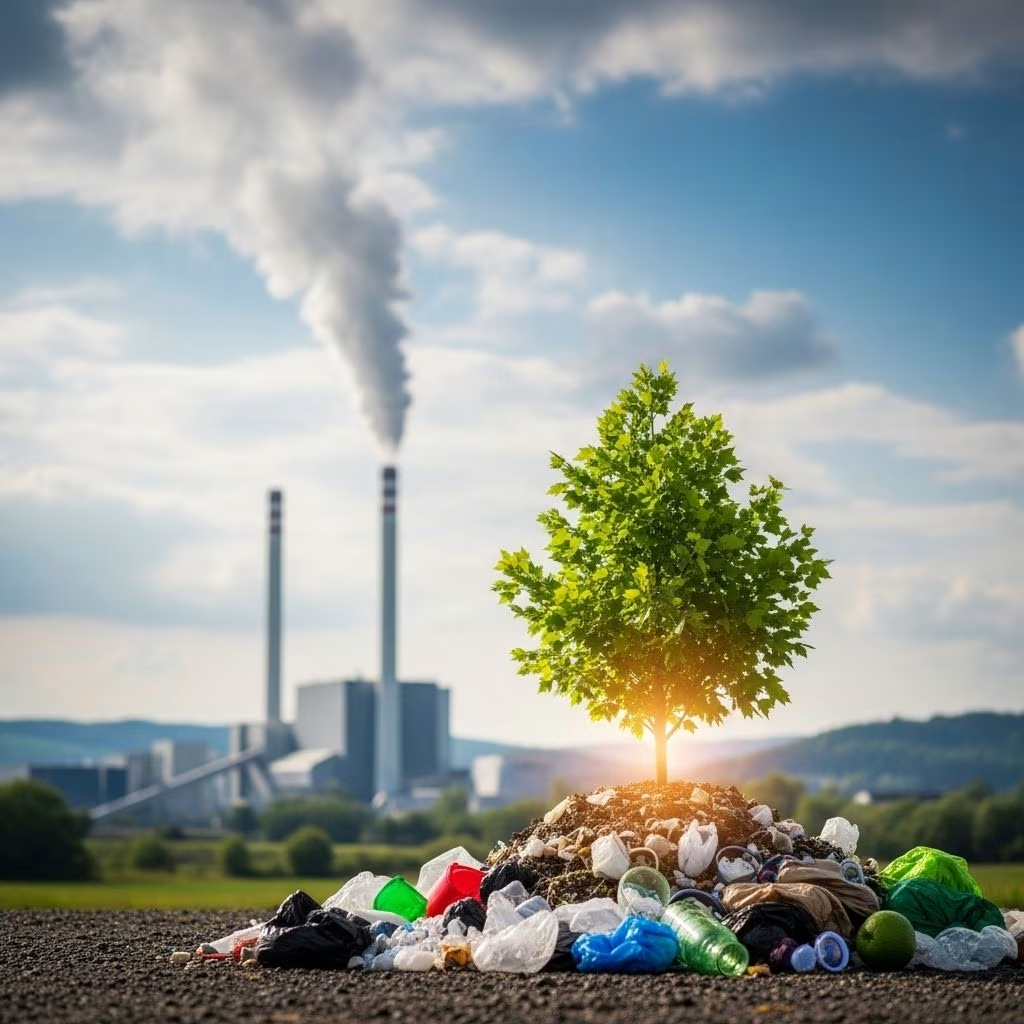
Waste-to-energy (WtE) refers to the incineration of municipal solid waste in purpose-built facilities that capture the energy released to produce electricity and often heat, particularly for district heating networks in European cities. These facilities are designed to handle “residual” waste—materials that remain after recycling and composting have taken place.
In 2019, European WtE plants generated an estimated 43 billion kWh of electricity and 99 billion kWh of heat, supplying approximately 20 million citizens with electricity and 17 million with heating. Alongside energy, WtE processes recover metals and minerals from incinerator ash, sending them back into the economy as secondary raw materials.
Europe’s Waste-to-Energy Dilemma
Waste-to-energy has, for decades, played a dual role in Europe’s waste strategy: reducing dependence on landfill and helping provide a steady supply of local energy. However, as Europe tightens its climate goals and promotes a regenerative circular economy, WtE finds itself caught in a policy and reputational crossfire.
- Past Importance: WtE was embraced as a solution for non-recyclable trash and as a source of secure, local energy—particularly important in countries like Sweden, Denmark, and Germany.
- Current Questioning: Policymakers and environmental advocates now question whether incineration aligns with climate-neutral and resource-circular ambitions.
- EU Shifts: Recent EU directives emphasize landfill reduction, higher recycling rates, and reductions in overall waste generation—narrowing the acceptable role for WtE.
Key EU Legislation and Waste Hierarchy
The backdrop for Europe’s re-evaluation of WtE is a shifting regulatory framework. Core to this are:
- European Green Deal: Launched in 2019, it sets out to make Europe the world’s first climate-neutral continent by 2050, with a 55% emissions cut by 2030.
- Circular Economy Action Plan (CEAP): Aims to decouple economic growth from resource consumption and promote waste prevention, reuse, and high-quality recycling. It commits to halving the amount of residual municipal waste by 2030.
- The Waste Framework Directive: Establishes the five-step waste hierarchy: prevention, reuse, recycling, energy recovery (including WtE), and disposal (landfill). Waste must be managed in ways that protect health, environment, water, soil, and air, and minimize nuisances like odor and noise.
- Landfill Directive: Sets targets to reduce landfilling of municipal waste and cut methane emissions.
| Rank | Step in Waste Hierarchy |
|---|---|
| 1 | Prevention |
| 2 | Reuse |
| 3 | Recycling |
| 4 | Energy Recovery (WtE) |
| 5 | Disposal (Landfill) |
Critiques and Concerns Over WtE
1. Climate Impact and Emissions
Critics argue that WtE facilities emit significant greenhouse gases, as burning mixed municipal waste releases both biogenic CO2 (from food and paper) and fossil-based CO2 (from plastics). Although emissions per ton are lower than landfilling (which releases methane), incinerators are still major point sources of CO2 in many cities.
- Climate Incompatibility: Environmental groups contend that the continued operation or expansion of WtE plants is incompatible with net-zero ambitions unless carbon capture technologies are rapidly deployed.
- Resource Lock-In: Building or upgrading WtE facilities entails long-term financial and materials commitments, potentially locking cities out of higher recycling rates or waste reduction once those become economically and politically feasible.
2. Undermining the Circular Economy
Opponents fear that WtE incentivizes producing waste to feed incinerators, undermining recycling, composting, and efforts to improve product design. Countries with high WtE capacity have sometimes lagged in recycling, although data are mixed on this point.
- Material Destruction: Burning waste destroys resources forever, reducing opportunities to recover valuable materials through recycling and reuse.
- Missed Recycling Potential: Contaminated and composite materials that end up in WtE facilities could potentially be recycled with new processing innovations.
3. Air Pollution and Public Health
Although modern WtE plants are equipped with stringent controls, historical and poorly managed incinerators have been linked to air pollution risks and toxic pollutant releases, including dioxins and heavy metals. These legacy issues have left a public trust deficit regarding such facilities, even where regulations have since tightened.
Alternatives to Waste-to-Energy
A key part of the debate is what happens to waste if WtE is phased out or curtailed. The main alternatives include:
- Enhanced Recycling and Composting: Stricter sorting, extended producer responsibility, and advanced recycling technologies are promoted as ways to capture more value from waste streams and reduce residual material volumes.
- Mechanical-Biological Treatment (MBT): MBT facilities pre-process mixed waste, extracting recyclables and preparing organic fractions for composting or anaerobic digestion, while minimizing incineration or landfill reliance.
- Landfilling: While considered least desirable due to methane emissions, groundwater risks, and long-term liabilities, for some waste streams it remains the default option if alternatives are not available or feasible.
- Waste Reduction at Source: Policies aimed at minimizing single-use plastics, closing product loops, and expanding reuse models are essential to shrinking the volume of non-recyclable waste.
How the WtE Industry Responds
The WtE sector and some policymakers defend the practice as a crucial transition tool in the waste hierarchy. Their main arguments include:
- Landfill Avoidance: WtE is portrayed as a safer, less polluting alternative to landfill, which is Europe’s largest source of waste-related methane emissions. Landfills also pose risks of groundwater and soil contamination and can harbor microplastics and hazardous pollutants.
- Energy Security: WtE plants help provide locally produced, reliable energy, supporting grid stability, especially during energy crises or supply interruptions.
- Material Recovery: Modern WtE facilities recover metals and minerals from ash, reducing the need for virgin resource extraction. Advances in technologies have improved recovery rates and reduced environmental harm.
- Complementarity to Recycling: Industry points to Eurostat data showing that the most circular economies in Europe—Germany, Sweden, the Netherlands—combine strong recycling with robust WtE sectors. WtE manages contaminated or complex materials that recycling cannot economically or safely process.
- Emission Controls and Innovation: Enhanced emissions controls and the integration of Carbon Capture, Utilization, and Storage (CCUS) are reducing WtE’s climate footprint and moving toward net-zero compatibility.
What’s Next for Waste-to-Energy in Europe?
With climate targets tightening and the circular economy rising in prominence, the EU faces several strategic choices regarding the future of WtE:
- Policy Shifts: The EU is narrowing financial support for WtE, making funding contingent on the highest environmental standards, material recovery, and alignment with the waste hierarchy. Direct funding is increasingly restricted to countries still heavily reliant on landfill and only for best-in-class facilities.
- Regulatory Uncertainty: Proposals to exclude WtE from green investment taxonomies and emission trading support frameworks are gaining ground. The waste import and export regime is also shifting, impacting WtE operators across Europe.
- Innovation Pressure: WtE plants are racing to integrate carbon capture and improve ash processing, hoping to future-proof their operations under stricter emission and resource requirements.
- System Integration: The future may see a smaller but more technologically advanced role for WtE, handling truly non-recyclable and hazardous waste, and integrated with material recovery, CCUS, and strict environmental controls.
Country Examples: Varied Approaches
- Germany, Sweden, Netherlands: High WtE capacity is paired with some of the highest recycling and landfill diversion rates in Europe.
- Eastern and Southern Europe: Still reliant on landfill; gradual WtE adoption could help bridge gaps but must be carefully balanced with new recycling infrastructure.
Frequently Asked Questions (FAQs)
Q: Are new waste-to-energy plants still being built in Europe?
A: Construction of new facilities has slowed, especially in Western Europe, due to policy restrictions and increased emphasis on recycling. However, new WtE projects may still proceed in regions with high landfill dependence or where integrated with advanced emission controls and material recovery.
Q: Does waste-to-energy compete with recycling?
A: Evidence suggests that advanced economies can successfully combine high recycling rates with robust WtE sectors. The key is to strictly segregate recyclable and compostable materials upstream, reserving WtE for materials that cannot be recycled or composted safely or economically.
Q: What role does carbon capture play in the sector?
A: Carbon Capture, Utilization, and Storage (CCUS) is seen as critical for reducing WtE’s net climate impact. Integration is expensive and technically challenging, but pilot projects are underway across Europe to demonstrate its feasibility at scale.
Q: What will happen to WtE as the circular economy develops?
A: The role of WtE is likely to shrink as waste generation falls and recycling and reuse rise. WtE will remain for certain hazardous or unrecyclable materials, but it will have to meet far stricter environmental and material recovery standards.
Key Takeaways for Europe’s Waste Future
- Europe’s approach to waste-to-energy reflects deeper questions about how to align environmental policy, energy security, and resource use in a climate-constrained world.
- The sector must innovate rapidly—deploying carbon capture, enhancing material recovery, and integrating upstream waste reduction—to retain a legitimate place in the future waste management system.
- Europe’s pursuit of its Green Deal goals will not eliminate residual waste overnight, but the pressure to ensure every tonne of waste is managed sustainably is now higher than ever.
References
- https://eswet.eu/waste-to-energy-crucial-to-clean-industrial-deal/
- https://eswet.eu/setting-the-record-straight-about-waste-to-energy/
- https://www.enhesa.com/resources/article/eu-green-deal-waste-management/
- https://www.cewep.eu/cewep-notebook-2025/
- https://joint-research-centre.ec.europa.eu/jrc-news-and-updates/proper-waste-management-can-significantly-reduce-greenhouse-gas-emissions-eu-2025-08-14_en
- https://europeanenergy.com/wp-content/uploads/2025/01/waste-management-policy.pdf
- https://environment.ec.europa.eu/news/new-rules-boost-recycling-efficiency-waste-batteries-2025-07-04_en
- https://envea.global/blog-post/2025-changes-to-environmental-rules-and-regulations/
- https://ebsummits.eu/our-summits/energy/2025/programme/