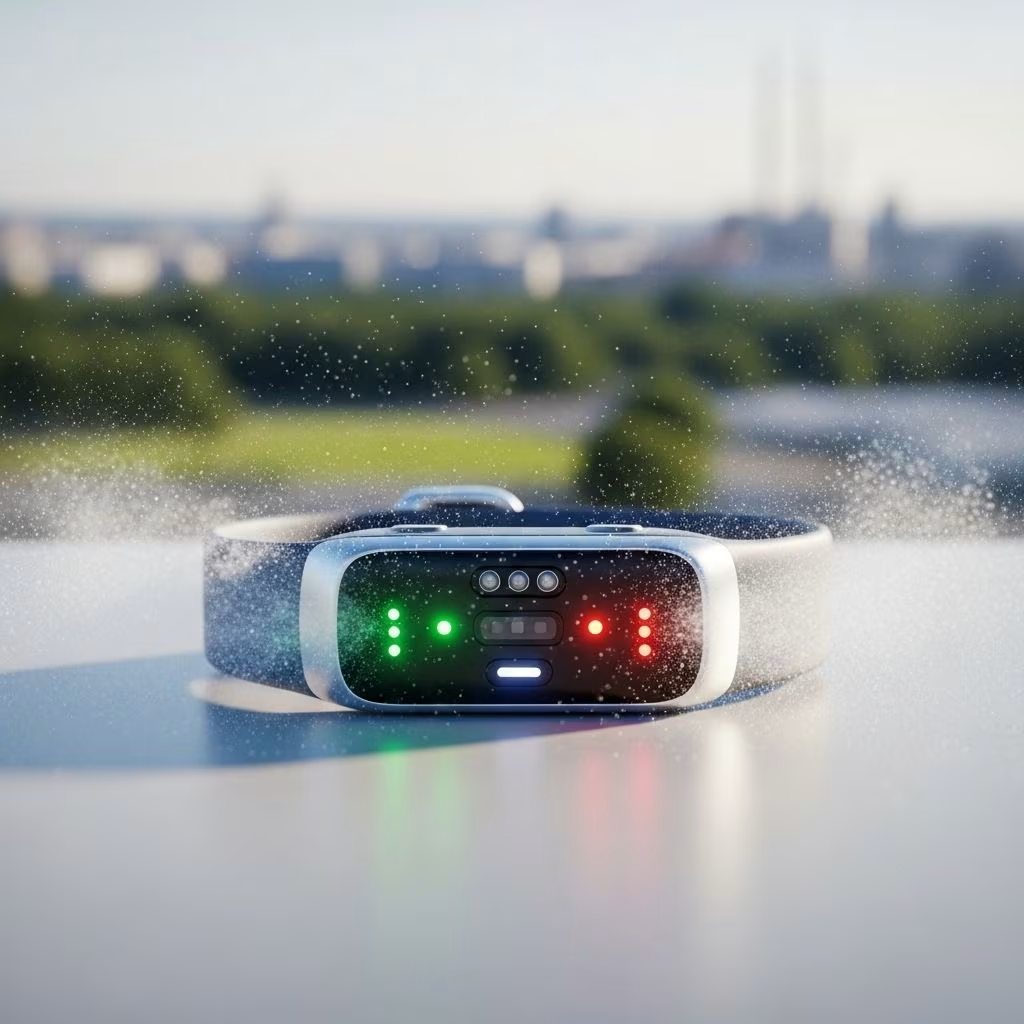
Latest Wearables: The Flow 2 Air Pollution Monitor
Concerns over urban air pollution and its effects on respiratory health have sparked a wave of innovation in wearable air quality monitors. Among these, the Flow 2 by Plume Labs stands out for its advanced particulate sensors, compact design, and user-centric features. This article explores how Flow 2 and similar wearables are enhancing our ability to track, understand, and react to air pollution in everyday life.
Why Personal Air Pollution Monitors Are Gaining Traction
- Localized data: Regional air quality data often overlooks micro-environments; wearable monitors reveal air quality on a street, in a park, or even inside a building as experienced by the individual wearer.
- Empowerment: Wearables help users avoid polluted areas, protect their health, and engage with environmental issues.
- Citizen science: The data collected by individual users can support community advocacy and research, increasing awareness and driving policy change.
Understanding Air Pollution: What Do We Measure?
Air pollution is a complex mix of particles and gases. Wearable devices focus on the most hazardous components:
| Pollutant | Description | Health Impact |
|---|---|---|
| PM1 | Ultra-fine particulate matter (<1µm) | Linked to cardiovascular, respiratory disease |
| PM2.5 | Fine particles (<2.5µm) | Penetrates lungs, damages tissue |
| PM10 | Coarse particles (<10µm) | Aggravates asthma, respiratory illness |
| NO₂ (Nitrogen Dioxide) | Produced by traffic & industry | Respiratory irritant, worsens asthma |
| VOCs (Volatile Organic Compounds) | Chemicals from vehicles, products | Can cause headaches, organ damage |
Flow 2: Features and Technology
The Flow 2 air pollution monitor embodies a leap forward in personal environmental sensing:
- Compact, wearable design makes it easy to carry on a bag or belt.
- PM1.0 sensor detects the smallest, most dangerous particles for improved health insights.
- Multi-pollutant detection: Measures PM1, PM2.5, PM10, NO₂, and VOCs.
- LED array gives instant air quality feedback via colored lights.
- Battery management extends battery life to up to 3 days by reducing sampling during periods of inactivity like sleep.
- Bluetooth connectivity for real-time data transfer to a smartphone app.
- Data export supports sharing with organizations and plotting trends on external software.
- Calibration algorithms ensure reliability and adjust for environmental drift.
- Charging base allows for easy overnight charging.
Technical Specifications (Flow 2)
- Custom-designed particulate matter sensor
- NO₂ and VOC sensors utilizing heated membrane and laser techniques
- Bluetooth Low Energy (BLE) connection
- Up to 72-hour battery life with smart idle mode
- USB-C charging with dedicated base
How Does Flow 2 Monitor Air Quality?
Flow 2 uses a combination of laser diffraction for particulate matter and heated membrane technology for gases. Air is drawn into the device by an internal fan, where:
- Laser diffraction detects particulate size and quantity by measuring light defraction.
- Heated membrane sensors gauge energy needed to break down gases like NO₂ and VOCs, correlating to their concentrations.
For optimal accuracy, the manufacturer recommends users expose the device to varied indoor and outdoor environments for a week, allowing auto-calibration algorithms to adapt its readings.
Accuracy and Validation: Can You Trust the Data?
Lab tests and user reviews have scrutinized the performance of Flow 2:
- Accuracy: Within 5% for NO₂, 1% for VOCs, and 10% for PM1 and PM2.5. PM10 readings correlate 83% to reference devices, placing overall accuracy within 10% for most pollutants.
- Manufacturer claims Flow 2 achieves 90-95% correlation with benchmark monitors for its covered pollutants.
- Academic comparisons show the Flow performs reliably, especially at higher pollution concentrations, matching well with validated sensors such as the Plantower A003.
- Auto-calibration adapts the individual devices over time based on environmental changes, improving accuracy for each user’s conditions.
Limitations
- PM10 readings, while usually within 10%, may be less accurate than PM1/PM2.5.
- Like all low-cost sensors, Flow 2 may show some deviation compared to laboratory-grade reference monitors, especially in extreme or highly variable conditions.
User Experience: Design, Usability, and App Integration
- Stylish and eye-catching design: Suitable for bags, belts, or on a desktop.
- Simple charging: Dedicated charging base for convenient overnight use.
- Instant feedback: RGB LED ring shows air quality status at a glance.
- Mobile app: Connects via Bluetooth for data visualization, mapping, and export functions.
- Export and trend analysis: Download collected data to visualize air pollution patterns in personal environments.
How Do Users Benefit?
- Greater awareness: Real-time alerts and feedback teach users when and where air is cleaner or more polluted.
- Protecting health: Avoid triggers for allergies, asthma, and other sensitivities by rerouting travel and activities.
- Community data: Contributing air quality data supports local advocacy and research.
- Device management: Battery management settings allow for tailored usage cycles.
Alternatives to Flow 2
Other wearable and portable air quality monitors available include:
- Atmotube Pro: A compact device focused on similar pollutants as Flow 2.
- Other low-cost sensors on the market, though many lack PM1 capability or advanced calibration algorithms.
Do You Need a Wearable Air Quality Monitor?
Whether a wearable air quality monitor is necessary depends on lifestyle, location, and personal sensitivity:
- Urban dwellers exposed to fluctuating pollution levels
- Those with respiratory conditions or allergies
- Active individuals (cyclists, runners, commuters)
- Citizens seeking data for advocacy or community improvement
While not strictly essential for everyone, these devices offer personalized, actionable insights that can’t be matched by fixed, regional monitoring stations.
Future Directions in Wearable Air Quality Sensing
- Nanoparticle detection: Ongoing advances aim to target even finer particles, further improving health relevance.
- Expanded connectivity: Integration with smart city systems, health trackers, and crowdsourced environmental platforms.
- Enhanced battery life and sensor accuracy as technology matures.
Frequently Asked Questions (FAQs)
Q: How does Flow 2 differ from the original Flow?
A: Flow 2 introduces a PM1.0 sensor, improved battery management, ability to export data, and enhanced accuracy compared to the original Flow.
Q: How accurate is Flow 2 in real-world conditions?
A: In laboratory tests, Flow 2 is generally accurate to within 10% for key pollutants, with strong correlation to benchmark devices.
Q: Can Flow 2 be used both indoors and outdoors?
A: Yes, it’s designed for use in a wide range of environments, and auto-calibration helps adapt to different air quality conditions.
Q: What other devices are comparable to Flow 2?
A: The Atmotube Pro is the most popular alternative, though features and accuracy may differ.
Q: Is a wearable air pollution monitor useful for everyone?
A: While especially helpful for those in polluted cities, those with health concerns, or active lifestyles, it can provide valuable information for anyone interested in local environmental conditions.
Conclusion: Empowering Users in a Polluted World
Wearable air pollution monitors like Flow 2 represent a new frontier for environmental awareness and personal health management. With compact, stylish designs and cutting-edge sensor technology, these devices put actionable data into the hands of everyday citizens—enabling informed decisions, improved well-being, and a deeper understanding of the air we breathe.
References
- https://breathesafeair.com/flow-2-review/
- https://seetheair.org/2019/12/23/review-flow-2-by-plume-labs/
- https://pmc.ncbi.nlm.nih.gov/articles/PMC9223593/
- https://plumelabs.zendesk.com/hc/en-us/articles/360009014973-How-does-Flow-work
- https://plumelabs.com/en/flow/
- https://apps.apple.com/us/app/flow-air-pollution-sensor/id1332618814
- https://www.youtube.com/watch?v=g2-xZ-I-va8
- https://www.epa.gov/indoor-air-quality-iaq/low-cost-air-pollution-monitors-and-indoor-air-quality