Introduction to the Osage Orange Tree
The Osage orange tree (Maclura pomifera) stands as one of North America’s most visually distinctive trees. Its unusual, brain-like fruit—globular and bumpy, sitting conspicuously beneath its branches in autumn—has perplexed and fascinated botanists, naturalists, and laypeople for centuries. Despite its misleading common names, this thorny tree offers a wealth of intrigue, from natural history and evolution to utility and folklore.
What Is the Osage Orange?
The Osage orange, also known by a variety of names such as hedge apple, bois d’arc, horse apple, bodark, and even monkey brains, is a small to medium deciduous tree or large shrub in the mulberry family (Moraceae). Native to the south-central United States, particularly the Red River region encompassing Texas, Oklahoma, and Arkansas, the tree has spread widely, largely due to human intervention.
- Scientific Name: Maclura pomifera
- Common Names: Osage orange, hedge apple, horse apple, bois d’arc, bodark, yellow-wood, monkey brain, mock orange, hedge ball
- Family: Mulberry (Moraceae)
- Native Range: Texas, Oklahoma, Arkansas, and the surrounding Ozark and south-central regions
Distinctive Appearance and Identification
The Osage orange tree is most easily recognized by its peculiar fruit and formidable, thorny branches. Standing up to 40-50 feet tall at maturity, this tree features a dense, rounded or irregular crown. Its short trunk and rough, furrowed bark with orange undercoloring lend it additional character, while the impressive thorns make it a natural barrier.
- Leaves: Simple, alternate, 3–6 inches long, shiny dark green above, paler and slightly hairy below, smooth margins, lack lobes or serrations.
- Bark: Brown to orange, deeply grooved, peeling into long, thin strips, with exposed roots and inner wood showing bright orange coloration.
- Twigs: Slender, light orange-brown in young specimens, milky sap, and prominent, sharp thorns up to half an inch long.
- Size: Matures at around 20–40 feet tall and wide, occasionally reaching 50 feet in optimal conditions.
The Brain-like Fruit
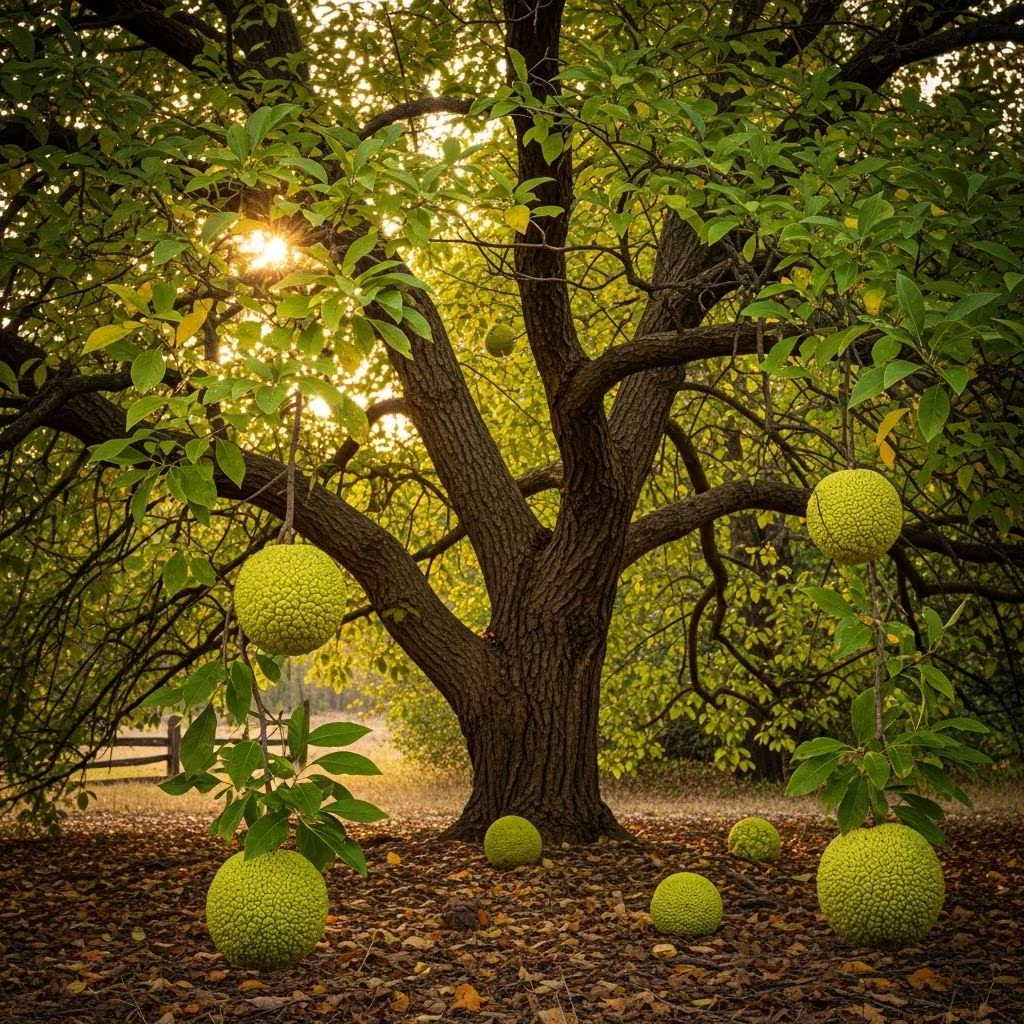
The most famous trait of the Osage orange is its large, spherical fruit. Produced by female trees, these fruit are 4–6 inches in diameter, chartreuse (yellow-green) in color, and covered in deep folds and crevices—a pattern that vividly evokes the convolutions of a brain. The surface is wrinkled and nubby, and the fruit exudes sticky, milky sap when cut or bruised. Each fruit contains dozens to hundreds of small, flat seeds distributed throughout its fleshy matrix. Often, these “brains” will litter the ground by autumn, obvious from a distance and unmistakable upon inspection.
| Trait | Description |
|---|---|
| Fruit size | 4–6 inches in diameter |
| Fruit surface | Highly wrinkled, bumpy; bright chartreuse color |
| Fruit contents | Milky, sticky sap and small, flat seeds |
| Tree height | 20–50 feet (typically 30–40 feet mature) |
| Thorns | Sharp, often more than half an inch in length |
Distribution and Habitat
The natural range of the Osage orange was once quite restricted, primarily found in the Red River drainage area of Texas, Oklahoma, and parts of Arkansas. However, since the 19th century, it has been planted extensively across the continental United States. Osage orange tolerates a wide variety of soil and climate conditions, thriving in moist, well-drained soils, alkaline or clay types, and even withstanding intermittent drought and flooding. This adaptability, combined with its use as a hedgerow plant, ensured its spread far beyond its original home.
- Growth Adaptability: Can be found in dry sites, wet sites, clay soil, alkaline soils, and withstands periodic drought and flooding.
- Zones: Hardy in USDA zones 4–9, from midwinter cold to summer heat.
- Landscape Uses: Commonly grown as windbreaks, living fences, and barriers in cities, parks, and rural settings.
A Tree with a Storied History
Long before European colonization, the Osage orange tree was a valued resource for indigenous peoples, especially the Osage Nation (for whom it was named). Its wood was prized for making bows, hence the French name bois d’arc—”wood of the bow.” Archaeological evidence and historical records indicate that Osage bows were traded across the continent, often fetching the value of a horse for a single well-crafted bow.
By the 19th century, settlers recognized the tree’s agricultural potential. The dense, thorny growth made the Osage orange ideal for “living fences” or hedgerows, a critical innovation before the advent of barbed wire. Entire farm boundaries were planted with lines of Osage orange, which, once established, became virtually impenetrable to livestock.
- Native American uses: Tools, bows, dye, and barter trade.
- Settler uses: Hedgerows for fencing, windbreaks, erosion prevention.
- Modern uses: Occasionally planted for ornamentals, windbreaks, or as a tough urban tree.
Fruit Mystery: Evolutionary Anachronism?
Despite the abundance and size of its fruit, the Osage orange has almost no modern animal dispersers. The fruit is unpalatable to livestock, rarely eaten by squirrels (which may seek seeds only), and ignored by most native wildlife. This disconnect led ecologists to propose the idea of the Osage orange as an evolutionary anachronism: a relic of a past ecological relationship now lost.
In this view, the huge, cumbersome fruit once relied upon massive animals now extinct—such as mastodons or giant ground sloths—to eat and disperse them. With the disappearance of these megafauna, the tree’s dispersal mechanism was rendered obsolete, a memory encoded in the persistent yet uneaten fruit dotting the landscape each fall.
Modern and Historical Uses of Osage Orange
The Osage orange’s extraordinary wood lies at the heart of its historical importance. Exceptionally strong, dense, and flexible, the golden-orange wood is resistant to rot and insect damage. Here are the most notable uses, past and present:
- Bows: Indigenous tribes fashioned bows renowned for their power and resilience.
- Fencing and Posts: Settlers exploited its rot-resistance for long-lasting fence posts and hedge plantings.
- Tool Handles: Wood used for tool handles, wheel rims, and other implements requiring strength and durability.
- Dye: The roots yield a yellow-orange dye, historically used in textiles.
- Ornamental Planting: Occasional usage in parks and large properties, valued for unique character.
Fruit Uses: Fact vs. Fiction
While rumors persist about the fruit as a natural insect repellent, scientific evidence for its effectiveness is minimal. Many believe that placing Osage oranges in basements or closets wards off spiders and insects, but controlled experiments reveal little actual benefit. Despite this, the “hedge apple” is still sometimes used for decor or as a folk remedy in household pest management.
Debunking Osage Orange Myths
- Is the fruit edible? Osage orange fruit is largely inedible for humans—unpalatably bitter and sticky. Some animals, such as squirrels, may eat the seeds, but most animals avoid the fruit itself.
- Is it poisonous? The fruit is not known to be poisonous, but its latex can irritate skin and mucous membranes in sensitive individuals.
- Does it repel insects? Scientific trials have found no significant insect-repelling properties from the fruit itself, though some extracts from its wood may deter certain pests.
Ecological Role and Growing Considerations
Today, the Osage orange tree fills several ecological and practical roles:
- Windbreaks and Erosion Control: The dense roots and vigorous suckering habit lend themselves to erosion mitigation and windbreak plantings.
- Wildlife Habitat: While little eats the fruit, the thick limbs and thorns provide nesting sites and protection for birds and small mammals.
- Urban and Park Use: Occasionally planted for its unique profile, strength, and tolerance of poor soils and urban conditions.
However, the tree’s aggressiveness—with vigorous suckering and dense, thorny thickets—means it is sometimes considered invasive or undesirable in some regions. The thorns also make it challenging for casual landscaping or use near pathways and high-traffic areas.
Frequently Asked Questions (FAQs)
Q: Why is it called the Osage orange?
A: The tree is named for the Osage Nation, native to the regions where the tree originated, and “orange” refers to the superficial resemblance of the fruit to citrus oranges, though the trees are unrelated.
Q: Are Osage orange trees related to real oranges?
A: No, despite its name, the Osage orange is not related to citrus oranges but is a member of the mulberry family.
Q: Can you eat Osage orange fruit?
A: The fruit is largely inedible for humans due to its bitter taste and sticky latex, though some wildlife, such as squirrels, may eat the seeds.
Q: How did Osage orange become widespread across the United States?
A: The tree was widely planted in the 19th century as living fences and windbreaks before barbed wire became widely available, leading to its spread beyond its original range.
Q: Does the Osage orange fruit repel insects?
A: Scientific research does not support the fruit’s reputation as an effective insect repellent; the belief is mostly folklore.
Conclusion: The Unending Fascination of the Brain Fruit
Few trees spark as much intrigue as the Osage orange. From its distinctive, brain-like fruit to its deep-rooted role in both indigenous and settler histories, this tree commands a unique place in North American nature and culture. While the mystery of its fruit’s evolutionary partner may never be fully solved, the Osage orange continues to offer utility, inspiration, and curiosity to all who wander beneath its boughs each autumn.
References
- https://mdc.mo.gov/discover-nature/field-guide/osage-orange
- https://www.purdue.edu/fnr/extension/intro-to-trees-of-indiana-osage-orange/
- https://www.columbiatribune.com/story/lifestyle/2021/10/27/strange-fruit-osage-orange/8506229002/
- https://en.wikipedia.org/wiki/Maclura_pomifera
- https://mortonarb.org/plant-and-protect/trees-and-plants/osage-orange/
- https://www.tulsagardencenter.org/news/2019/8/27/barry-fugatt-osage-orange-is-fragrant-fruit-with-brain-like-appearance
- https://extension.psu.edu/the-osage-orange-useless-or-useful/
- https://www.metroparks.net/blog/osage-orange/