A Plague on Both Their Passive Houses: The Battle over Passive House Standards
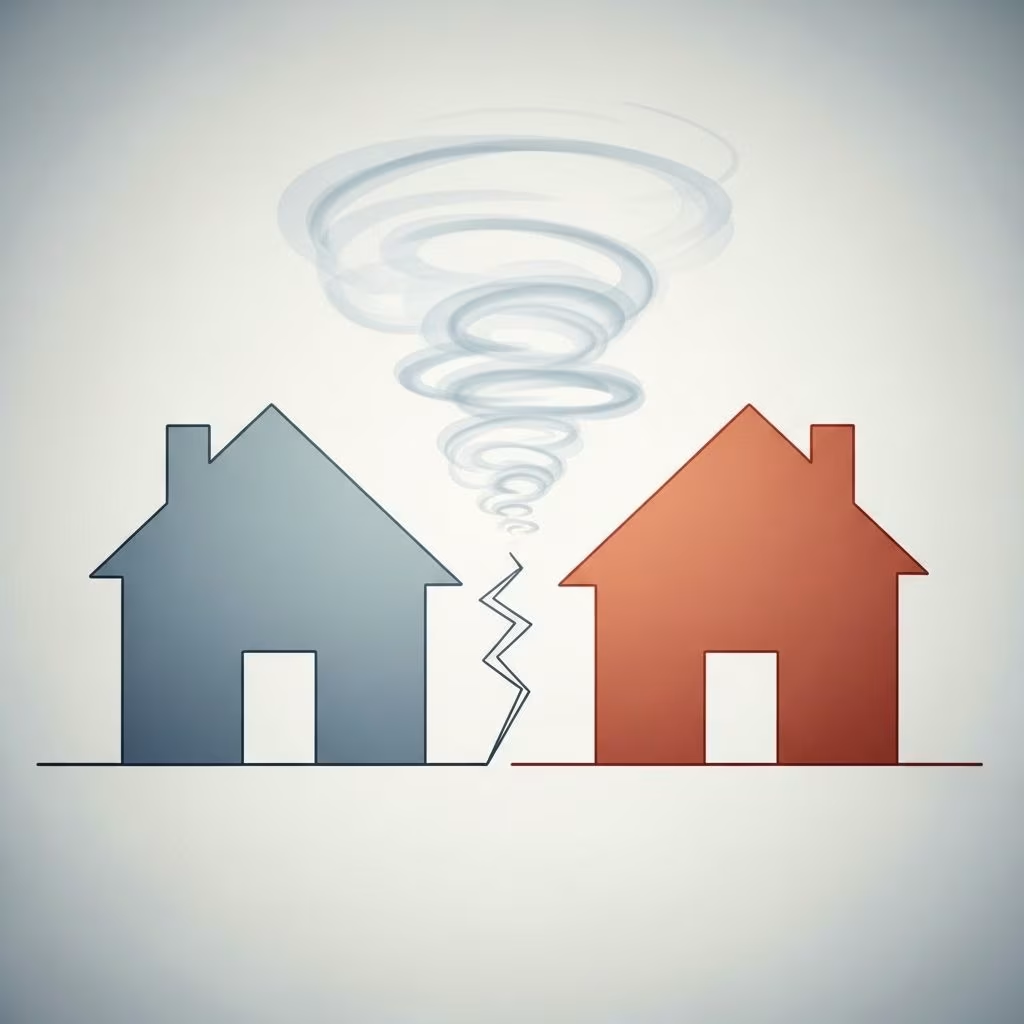
The Passive House movement, once unified in its quest to bring ultra-low energy standards to all corners of the globe, now stands embroiled in a meaningful and often fractious debate. The rift? How the internationally celebrated Passive House approach should apply—or be adapted—to North America’s dramatically diverse climates. As stakeholders argue over certification, terminology, and performance thresholds, the outcome will influence not just technical standards, but the pathway for green architecture in the decades ahead.
Background: What is Passive House?
Passive House is a rigorous, voluntary building certification standard that optimizes energy efficiency, comfort, and affordability. The concept centers on dramatically reduced energy consumption through measures such as superinsulation, airtight construction, high-performance windows, and heat recovery ventilation. The primary goal: minimize the need for traditional heating and cooling, relying as much as possible on passive sources like sunlight and occupant-produced heat.
Two main branches have developed:
- Passivhaus Institute (PHI): Based in Germany, the original Passive House standard, emphasizing strict and universal benchmarks for performance.
- Passive House Institute US (PHIUS): An independent organization in the United States, adapting standards for North American climates and construction practices.
Origins of the Controversy
Tensions escalated notably in 2012 with a petition launched by architect Hayden Robinson and other professionals in response to proposed changes by PHIUS. The core issue: Should the definition and standards of Passive House be made more flexible to accommodate diverse climates—particularly the harsher conditions unique to parts of North America?
This debate was amplified by influential bloggers and thought leaders such as Lloyd Alter of Treehugger, Mike Eliason, and Andrew Michler, all bringing attention to the possible implications of altering the Passive House definition and the movement’s underlying philosophy.
Timeline of Key Events
- PHIUS evaluates modifying the energy standard for certain regions.
- Petition launched to “defend” the original definition, urging PHIUS to adopt any changes under a different name.
- Stakeholder and public discussion spreads across blogs and building forums.
Key Players and Perspectives
| Stakeholder | Position | Main Arguments |
|---|---|---|
| PHI (Germany) | Strict adherence to original Passivhaus metrics | Consistency, scientific rigor, and comparability across projects worldwide |
| PHIUS (US) | Reform standard to fit US climate diversity | Cost-effectiveness and wider accessibility, especially for cold/different climates |
| Certified Passive House Consultants | Mixed; many support original, some back adaptation | Desire for clarity, reputation, market viability—plus technical feasibility |
| Bloggers/Media (Alter, Eliason, Michler) | Varied, mostly critical of confusion and in-fighting | Focus on professionalism, communication, and impact on movement’s reputation |
The Core Issues: Standards, Climate, and Costs
Should Standards Be Universal or Regional?
The central argument revolves around the uniformity versus adaptability of standards. Many in the US building science community argue that the German Passivhaus standard—optimized for central Europe—becomes cost-prohibitive or technically challenging in colder or more humid American climates. PHIUS, led by director Katrin Klingenberg, proposes climate-specific modifications to the standard for greater accessibility, without “watering down” the core values of comfort and envelope.
Key modification proposals include:
- Allowing looser energy targets in extremely cold regions (e.g., Duluth, MN)
- Possibility of tighter targets for milder, more temperate areas (e.g., San Francisco, CA)
- Substituting superinsulation with more use of solar thermal systems where appropriate
Arguments for Change
- Climate Diversity: North America encompasses a vast range of climates, each presenting unique challenges.
- Cost and Accessibility: Strict standards can make projects in severe climates cost-prohibitive, impeding broader market adoption.
- Innovation: Allowing adaptations can spur locally relevant solutions and technological advances.
Arguments Against Change
- Standard Dilution: Adapting the benchmark risks fracturing the movement’s core identity and brand.
- Confusion in the Marketplace: Multiple definitions can reduce trust and make it harder for clients to understand what a “Passive House” really means.
- International Comparability: Consistent standards enable clear, global comparisons and scientific analysis.
Community & Industry Reactions
The open letter and subsequent blogs generated a wave of commentary from architects, consultants, and industry observers:
- Many saw the proposal as necessary evolution, respectful of local realities and building science research from North American experts such as John Straube and Marc Rosenbaum.
- Others accused PHIUS of overstepping, risking a rift that could undermine the movement’s cohesion, credibility, and long-term impact.
- Several bloggers, including Lloyd Alter, called out personal jabs within the debate, urging civil discourse and focusing on shared goals.
- The discussion highlighted a significant divide between the practical needs of consultants and builders (who must make projects work) and the purist vision of theorists and original standard-bearers.
Stakeholder Representation
One mounting concern was whether the direction set by leadership truly reflected the interests and real-world experiences of the hundreds of Certified Passive House Consultants across the US. With only a small fraction of consultants having completed certified projects, many petition signers were motivated by a sense of ownership over the brand’s meaning—even if their own efforts had yet to materialize as built reality.
Impacts and the Future of Passive House
The outcome of this dispute will shape not only future Passive House certifications, but also policy, education, and the popular perception of high-performance green building across North America and potentially beyond. Several likely impacts include:
- Certification Clarity (or Confusion): Multiple standards could cause ongoing marketplace confusion, unless clarified by branding or additional consumer education.
- Technical Innovation: Flexible standards may unlock new methods and materials tailored to diverse climates, potentially making Passive House more widespread.
- Movement Cohesion: The degree of cooperation—or further split—between PHI and PHIUS will affect advocacy, lobbying, and the effectiveness of the Passive House community.
- Mainstream Adoption: If the movement can streamline adaptation without losing its core identity, Passive House may finally go mainstream, especially in demanding climates.
Regardless of the resolution, the controversy underscores an essential truth: sustainable building cannot afford to be static or monolithic. As design, science, and culture evolve, so too must its leading standards—albeit carefully, transparently, and with broad stakeholder engagement.
Frequently Asked Questions (FAQs)
Q: What is the core goal of Passive House standards?
A: To reduce a building’s energy consumption by optimizing its design for thermal performance, airtightness, and ventilation—leading to comfort, health, and low energy bills.
Q: Why is there a debate over Passive House definitions in North America?
A: Because North America includes climates for which the originally German standard can be unachievable or prohibitively expensive, prompting some to advocate for climate-specific modifications.
Q: Will changing the standards make Passive House less effective?
A: Proponents argue adaptation will increase accessibility while maintaining core performance values; critics fear it risks diluting the brand and confusing the market.
Q: Who certifies Passive Houses in the US?
A: Both PHIUS (Passive House Institute US) and the international Passivhaus Institute (PHI), but requirements and approaches may differ.
Q: How does the community interact in this debate?
A: Through petitions, blogs, social media, professional forums, and direct engagement with certification bodies and advocacy organizations.
Key Takeaways & Resources
- The Passive House movement is evolving, facing tough questions about adaptability and identity.
- Technical rigor, cost, and climate sensitivity are all at the heart of the current debate.
- Continued dialogue and mutual respect will be vital for the movement’s future influence and credibility.
- Both advocates and critics share a goal: buildings that are healthier, more sustainable, and accessible to more people and climates.
For further reading, seek out thought leaders in green building, authoritative blogs on Passive House developments, and the official statements from both PHI and PHIUS.