


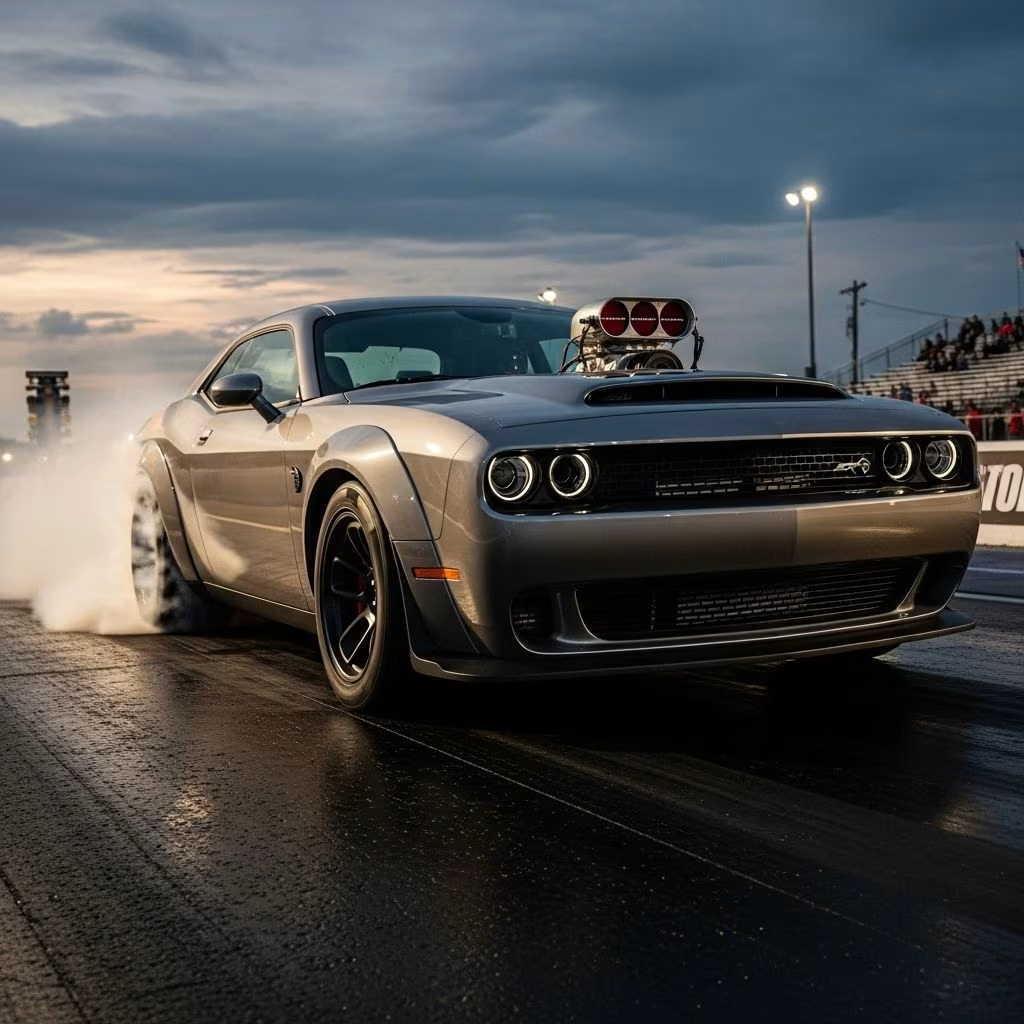
Should the 1,025-HP Dodge Demon Be Banned?
When Dodge unveiled the Challenger SRT Demon 170, car enthusiasts were left speechless by its staggering 1,025 horsepower. But this extraordinary achievement has reignited debates around the morality, safety, and environmental costs of building and selling ultra-high-horsepower muscle cars. Should there be legislative or ethical limits on what automakers can put on the road? Or does the Demon represent the crowning glory of American automotive innovation?
Background: Dodge Challenger SRT Demon 170
- Introduced: 2023, as a sendoff for the gasoline Challenger era.
- Power: 1,025 hp and 945 lb-ft of torque (on E85 ethanol blend).
- Performance: 0-60 mph in 1.66 seconds, quarter-mile in 8.91 seconds at 151 mph.
- Engine: 6.2L supercharged V8, flex-fuel (can run on E85 or regular gasoline).
- “Last Call” model: Celebrating the end of Dodge’s gas-powered muscle cars.
The Case for Banning Ultra-High Horsepower Vehicles
Some experts and advocates argue that cars like the Dodge Demon 170 pose outsized risks for public safety and contribute unnecessarily to environmental harm.
Safety Concerns
- Acceleration and speed: The Demon’s performance figures push the boundaries of what’s possible for street-legal cars. Such rapid acceleration leaves little margin for error in public settings. Highway speeds may be reached in seconds, outpacing even many supercars.
- Skill gap: The sheer power requires advanced driver skill to control; not all owners will possess this, increasing risk for themselves and others.
- Potential for misuse: High-profile accident cases involving powerful vehicles suggest greater temptation to drive recklessly or race on public roads.
- Unintended consequences: The faster and heavier a car, the greater the potential for severe crashes, putting pedestrians and other road users at risk.
Environmental Impact
- Carbon emissions: Both the Dodge Demon and similar muscle cars emit far higher levels of CO2 per mile than everyday vehicles. One source notes 546 grams per mile—many times the output of a sedan.
- Poor fuel economy: Despite technical improvements, the Demon only achieves 13 mpg city and 21 mpg highway. While superior to some hypercars, it’s still inefficient by most standards.
- Mixed sustainability claims: Dodge touts alcohol-based E85 fuel as having a “20% lower carbon footprint” than gasoline. However, the EPA and other authorities still rate the Demon poorly for smog and carbon output.
The Arguments Against a Ban: Why the Demon Matters
Enthusiasts and industry voices see cars like the Demon as vital to automotive heritage, technological progress, and personal freedom.
Automotive Innovation and Heritage
- Technological achievement: The Demon 170 is a showcase for what internal combustion (ICE) technology can achieve, using ethanol blends to push performance.
- Motorsport lineage: Muscle cars are a part of American culture; banning flagship models erases history.
- Drag strip focus: Dodge designed the Demon for sanctioned racing, not reckless street use. The vehicle itself includes safety instructions and recommendations for track use.
Personal Freedom
- Freedom of choice: Many argue adults should be able to buy and drive high-powered vehicles if they’re used responsibly.
- Ownership pride: “Bragging rights”—owning a unique high-performance car is tied to personal identity and achievement.
Performance Versus Reality
- Flex-fuel adaptability: The Demon can run on both E85 ethanol and standard gasoline, allowing drivers to choose fuel based on cost, availability, and emissions.
- Environmental offset: Some see ethanol’s lower carbon footprint as a partial answer to critics, though not all experts agree.
- Limited production: The high cost and scarce availability restricts ownership mostly to collectors and enthusiasts, arguably limiting widespread risk.
Ethical Questions: Should Extreme Muscle Cars Exist?
The debate isn’t just about speed or pollution; it’s about society’s responsibility to balance innovation with real-world consequences.
Regulation and Societal Responsibility
- Government ratings: Muscle cars receive poor ratings for emissions and smog, and stricter regulations could affect their future.
- Historical precedent: Past government crackdowns—such as the 1970s smog and safety rules—were direct responses to surging horsepower and related dangers.
- The slippery slope: If a 1,025-hp car is legal, where does the limit lie? At what point do society, lawmakers, or manufacturers need to step in?
Risk Versus Reward
| Pros | Cons |
|---|---|
| Showcases American engineering | High accident risk if misused |
| Advances performance technology | Poor emissions and fuel economy |
| A catalyst for motorsport enthusiasm | Temptation for reckless driving |
| Personal ownership pride and choice | Potential for societal harm |
| Limited production restricts impact | Regulatory challenge for lawmakers |
Environmental Claims: E85 Ethanol and the Demon
Dodge claims the Demon 170 is “environmentally-friendly” due to its ethanol fuel option. Here’s what that really means.
- E85 composition: Up to 85% ethanol, 15% gasoline.
- Renewable source: Ethanol primarily comes from corn, making it more sustainable than gas in theory.
- Performance: High-octane E85 enables the Demon’s top horsepower figures; on regular gas, power drops to 900 hp and 810 lb-ft.
- Real-world impact: Despite fuel choice, the Demon’s EPA ratings remain low for emissions compared to most passenger vehicles.
- Debated claims: While ethanol may lower the engine’s carbon footprint by 20%, critics argue it’s still wasteful for short, high-powered bursts rather than daily commuting.
Technical Innovations
- Advanced ECU: Real-time adjustment to fuel blend, empowering drivers to choose E85, gasoline, or a mix.
- Fuel sensors: The Demon’s technology detects ethanol content and optimizes boost and timing for max output.
- Drag-strip legality: Dodge emphasizes safe, sanctioned performance over street racing, suggesting responsible use.
Public Sentiment: Enthusiasm and Concern
Reactions to the Demon range from awe to concern, reflecting a split in public opinion about the role of extreme vehicles in modern society.
Enthusiast Perspective
- Pinnacle of muscle: The Demon 170 is seen as the ultimate street-legal muscle car, winning respect from longtime fans.
- Collector’s prize: Limited production means value as an investment and status for owners.
- A farewell: Many see the Demon’s release as the end of an era, making it culturally significant beyond its specs.
Critics’ Concerns
- Irresponsible excess: Some believe the match between ultra-power and public roads is fundamentally flawed.
- Negative role model: The image of “winning by horsepower” can encourage risky behavior, particularly among younger drivers.
- Environmental hypocrisy: Critics call out the contradiction in celebratory advertising for cars that defy emissions logic in a climate-conscious era.
Frequently Asked Questions (FAQs)
Q: What makes the Dodge Demon 170 unique compared to other muscle cars?
A: The Demon 170 offers 1,025 hp on E85 fuel, breaking dragstrip speed records and marking the end of Dodge’s gas-powered muscle era. Its ability to dynamically adjust power based on fuel blend makes it a technological pioneer among production cars.
Q: Is the Dodge Demon 170 environmentally friendly?
A: Dodge claims that using E85 reduces the car’s carbon footprint by 20% compared to gasoline. However, its overall emissions and fuel economy are still much worse than most passenger vehicles, which means it falls short of truly eco-friendly status.
Q: Can the Demon 170 be driven on ordinary roads?
A: The Demon is street legal, but its immense power is best suited for the drag strip. Owners are encouraged to adhere to safe driving practices and recognize the skills required to manage its capabilities safely.
Q: Why do some people want extreme cars like the Demon banned?
A: Critics cite safety risks from reckless driving, high accident potential, negative environmental impacts, and the message it sends about responsible transportation.
Q: Are there regulatory pressures against high-horsepower vehicles?
A: Yes. Government ratings for emissions and safety are increasingly strict; past trends suggest future regulations may further limit or even ban such vehicles if environmental or safety concerns aren’t addressed.
Conclusion: Fate of the Demon and the Future of Muscle Cars
The 1,025-horsepower Dodge Demon stands at a crossroads in automotive history. It captures hearts and headlines as a marvel of engineering, but also fuels fierce debate about the role of extreme vehicles in a society grappling with climate change and road safety. Whether bans or restrictions are justified remains a complex, value-laden question—one that will continue to shape car culture and legal frameworks for years to come.
References
- https://www.motorbiscuit.com/dodge-demon-170-eco-friendly-dodge-thinks-so/
- https://www.hellcat.org/threads/demon-hellcat-smog-rating-and-the-possible-doom-for-modern-muscle-cars.146113/
- https://eflexfuel.com/us/blog/the-quickest-fastest-most-powerful-mass-Produced-vehicle-in-the-world
- https://advancedbiofuelsusa.info/the-dodge-challenger-srt-demon-170-is-a-1025-hp-sendoff-dodge-is-celebrating-the-challenger-with-an-alcohol-fueled-farewell
- https://www.kellyjeep.com/is-the-dodge-demon-170-street-legal


