


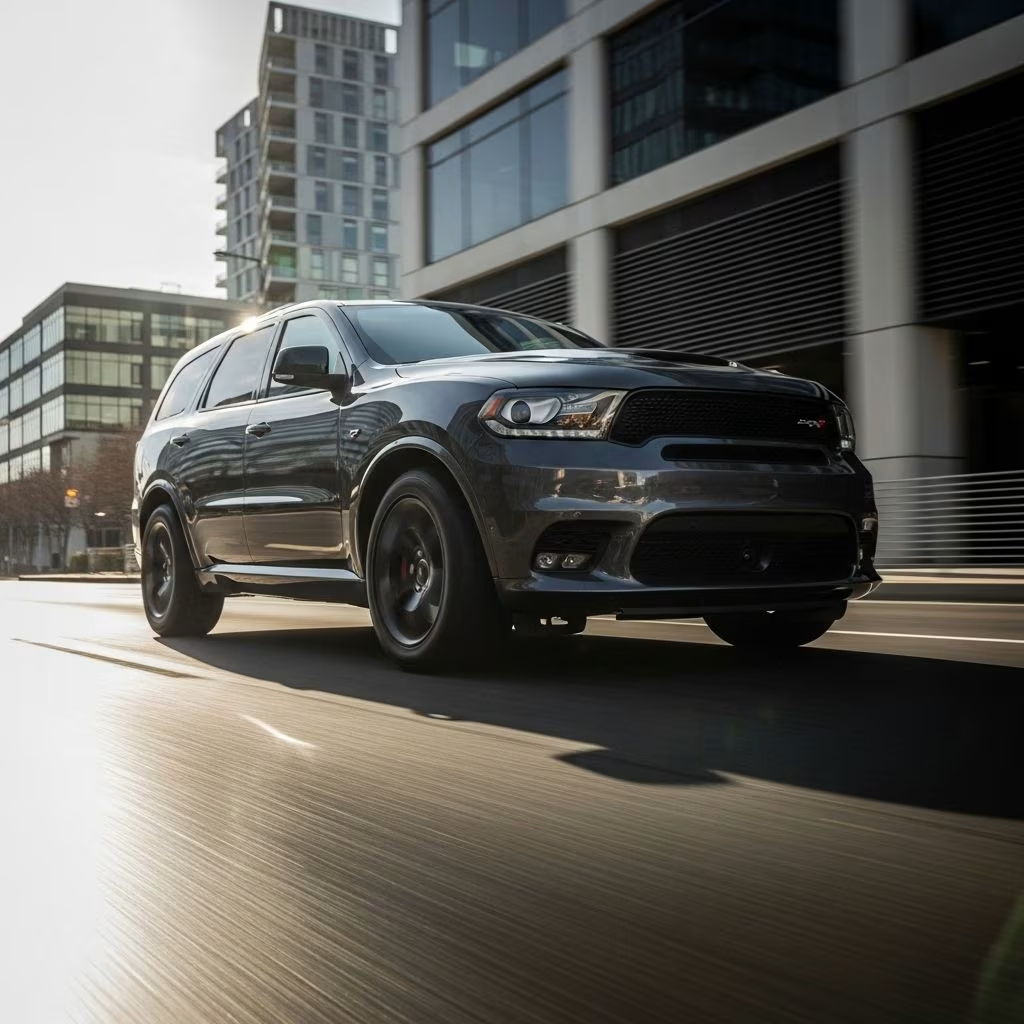
Should the Dodge Durango Hellcat Be Street Legal?
The Dodge Durango SRT Hellcat stands at the crossroads of power, engineering marvel, and controversy. With 710 horsepower and bold intentions, this American SUV is not just a high-powered family hauler—it’s a lightning rod for debates about performance cars, road safety, and the future of automaking. Here, we delve into the heart of the controversy: should a vehicle so potent be permitted on public streets?
The Rise of the Hellcat: What Is It?
The Dodge Durango SRT Hellcat is not just another large SUV. Underneath its muscular sheet metal lies a 6.2-liter supercharged HEMI V8 engine, delivering an eye-watering 710 horsepower and 645 lb-ft of torque. This makes it the most powerful gas-engine SUV ever produced. The Durango Hellcat is a three-row SUV that goes from 0 to 60 mph in just 3.6 seconds and handles the quarter-mile in about 12 seconds—performance figures that put it squarely in sports car territory.
- All-wheel drive for consistent power delivery
- 8-speed automatic transmission
- High-performance Pirelli tires standard
- 15.7-inch Brembo brakes for stopping power
- Capable of towing up to 8,700 pounds
With a base price approaching $90,000—often more with options—the Hellcat is not a mass-market family car. Instead, it exists as a kind of statement: an anti-ordinary flagship in Dodge’s portfolio, showcasing the limits of what a street legal American SUV can be.
Why Build an SUV With 710 Horsepower?
The rationale behind the Durango Hellcat isn’t just about raw acceleration. Dodge has a legacy of bold, unapologetically brawny vehicles—the Challenger and Charger Hellcats, the Demon, and now the three-row Durango Hellcat. For many fans, these vehicles are about pushing boundaries:
- Providing supercar-level performance in a practical (if expensive) package
- Borrowing performance parts and know-how from drag racing heritage
- Serving as halo cars that draw enthusiasts into the brand
- Giving buyers the thrill of acceleration with the usability of daily transportation
Yet, it also raises a fundamental question: Is there a point where too much power is simply too much?
The Arguments For Street-Legal Hellcats
Supporters of the Durango Hellcat and similar high-performance vehicles put forth several key arguments for why they should remain legal road vehicles:
- Freedom of Choice: In a free market, automakers should be able to sell, and drivers should be able to buy, road-legal vehicles as powerful as technology and regulation permit.
- Innovation and Progress: Pushing engineering boundaries often trickles down to mainstream models with better safety, efficiency, and handling.
- No Unique Safety Risk: The Durango Hellcat is as safe as any other modern SUV when driven responsibly. Its brakes and suspension are tuned for high speeds, and electronic safety nets (ABS, stability control, traction management) help keep it in check.
- Cultural Icon: The Hellcat badge and its muscular performance symbolize part of American car culture: boldness, excess, and a celebration of engineering achievement.
- Rare and Expensive: Given its price and limited production, the Durango Hellcat isn’t likely to be a widespread public safety menace; most owners are enthusiasts, not reckless drivers.
The Arguments Against Street-Legal Hellcats
But the existence of a 710-hp, three-row SUV raises plenty of objections, both practical and philosophical:
- Excessive for Public Roads: With much greater acceleration and top speeds than the posted speed limits, these vehicles are, some argue, overpowered for streets populated by ordinary commuters, bicyclists, and pedestrians.
- Potential for Misuse: The sheer speed available at a tap of the throttle could tempt irresponsible drivers to dangerously exceed speed limits.
- Environmental Impact: The Hellcat’s massive V8 is thirsty—rated at just 13 mpg combined—and its emissions dwarf those of even other large SUVs. In an age increasingly concerned with climate change, it feels out of step.
- Shifting Norms: With automakers investing in electric vehicles (EVs) and hybrids, critics see the Hellcat as a step backward in both technology and public safety priorities.
- Poor Urban Fit: At over 5,500 pounds and nearly 201 inches long, the Durango Hellcat takes up much more space than necessary for daily commuting or urban life.
How Does the Hellcat Stack Up Against Other Performance SUVs?
| Model | Horsepower | 0–60 mph (sec) | Top Speed (mph) | Base Price (USD) |
|---|---|---|---|---|
| Dodge Durango SRT Hellcat | 710 | 3.6 | 180* | ~$90,000 |
| Jeep Grand Cherokee Trackhawk | 707 | 3.5 | 180 | ~$90,000 |
| Lamborghini Urus | 657 | 3.3 | 190 | ~$230,000 |
| BMW X5 M Competition | 617 | 3.8 | 177 | ~$120,000 |
| Tesla Model X Plaid | 1020 (EV) | 2.5 | 163 (limited) | ~$108,490 |
*Estimated; actual top speeds may be electronically limited.
The Durango Hellcat outmuscles nearly every gas-powered rival at a fraction of the Lamborghini’s price, though it lags slightly behind on cutting-edge technology compared to the EV-based Plaid.
Expert Voices on the Hellcat’s Roads Legality
Automotive experts and industry observers remain divided:
- Performance journalists describe the Hellcat as a “dinosaur”—a thrilling throwback, but possibly a vehicle out of step with today’s environmental and road safety concerns.
- Safety advocates highlight physics: high-mass, high-speed vehicles amplify the risk in collisions and may reduce survivability for pedestrians and cyclists.
- Engineers point out that modern safety technologies—adaptive cruise control, automated braking, and stability control—make even powerful vehicles safer, but ultimately, driver behavior remains the wild card.
- Car enthusiasts see the Durango Hellcat as a symbol of freedom and choice—a rare breed in an increasingly regulated and electrified future.
The Environmental Dilemma
The environmental impact of the Durango Hellcat is significant:
- EPA-rated fuel economy of 13 mpg combined (12 mpg city, 17 mpg highway)
- Massive greenhouse gas emissions compared to most modern SUVs and all EVs
- Large, heavy footprint contributes to increased road wear and resource use
This stands in stark contrast to the automobile industry’s shift toward electrification and more stringent climate regulations. The Durango Hellcat’s very existence is, in some critics’ eyes, a challenge to these priorities—an emblem of the “old world” of internal combustion excess.
Why Does the Hellcat Still Exist?
With regulatory pressures and shifting consumer attitudes, why does Dodge still make the Hellcat? The answer comes down to branding, niche appeal, and demand:
- Dodge has long positioned itself as the bold, incendiary arm of the Chrysler family—a “last hurrah” for V8 muscle before electrification takes hold.
- Even a limited run of Hellcats can draw a halo effect, boosting excitement and sales across the Dodge brand.
- Hardcore fans and collectors—aware that these vehicles may soon disappear—are eager for one last taste of pure, old-school, supercharged V8 thunder.
The Legal Status: Can (or Should) Laws Change?
Currently, the Durango Hellcat is fully street legal in the United States and many other markets, having passed all federal requirements for crash safety, emissions (within the loopholes available to high-performance models), and pedestrian protection.
- No active legislation specifically targets the horsepower or acceleration potential of SUVs or passenger cars beyond general speed limits and safety protocols.
- Attempts to curtail the sale of high-horsepower vehicles face pushback on grounds of personal freedom and market choice.
- While some cities or municipalities have restricted or taxed high-emission vehicles, none have—so far—singled out models like the Hellcat for outright bans.
This leaves the debate as much a question of social and ethical values as one of law and physics.
What Does the Future Hold for Hyper-Powered SUVs?
The Durango Hellcat represents a high-water mark for factory-built, gas-powered muscle SUVs. However, several trends suggest vehicles like it are a dying breed:
- Automakers, including Dodge, are signaling shifts toward electrification, which will offer new forms of performance with fewer emissions but likely less visceral “old-school” appeal.
- Regulatory pressures to reduce fleet emissions may make similar future models impractical or illegal.
- As high-performance electric SUVs and crossovers (like the Tesla Model X Plaid) become more common, the traditional V8-powered performance SUV will become a rare niche product or collectors’ item.
For today, however, the Durango Hellcat remains legal, loud, and proud—an outlier in a changing automotive landscape.
Frequently Asked Questions (FAQs)
Q: Is the Dodge Durango Hellcat street legal everywhere?
A: Yes, the Durango Hellcat is legal to drive on public roads in the United States and most other jurisdictions, provided it complies with local emissions and safety regulations.
Q: How fast can the Durango Hellcat go?
A: The Durango Hellcat can reach 0–60 mph in 3.6 seconds and has a top speed estimated around 180 mph, depending on conditions and electronic limitations.
Q: Does owning a Hellcat mean you can drive at those high speeds legally?
A: No. Regardless of the vehicle’s capabilities, speed limits and traffic laws apply. Driving at excessive speed on public roads is both illegal and dangerous.
Q: Why does Dodge make such a powerful SUV?
A: To attract enthusiasts, uphold the brand’s muscle car legacy, and offer a performance flagship that draws attention—even at the risk of controversy.
Q: How bad is the Hellcat for the environment?
A: Its fuel economy is among the worst for modern SUVs, and it emits much higher levels of CO2 than nearly any vehicle in its segment, making it a poor choice from an ecological perspective.
Q: Will vehicles like the Hellcat be banned in the future?
A: While no bans are currently in place, intensifying emissions and fuel economy regulations could make future direct successors difficult or impossible to produce (at least with gasoline engines).
References
- https://www.caranddriver.com/dodge/durango-srt-hellcat
- https://www.youtube.com/watch?v=5NbGdeVRNwQ
- https://www.dodge.com/durango/performance.html
- https://www.caranddriver.com/dodge/durango-srt-hellcat/specs
- https://machineswithsouls.com/dodge-durango-srt-hellcat-review/
- https://www.hennesseyperformance.com/posts/h1000-dodge-durango-hellcat/
- https://www.dodge.com/durango-hellcat-jailbreak.html
- https://www.autonationdodgeramarapahoe.com/research/dodge-durango.htm


