


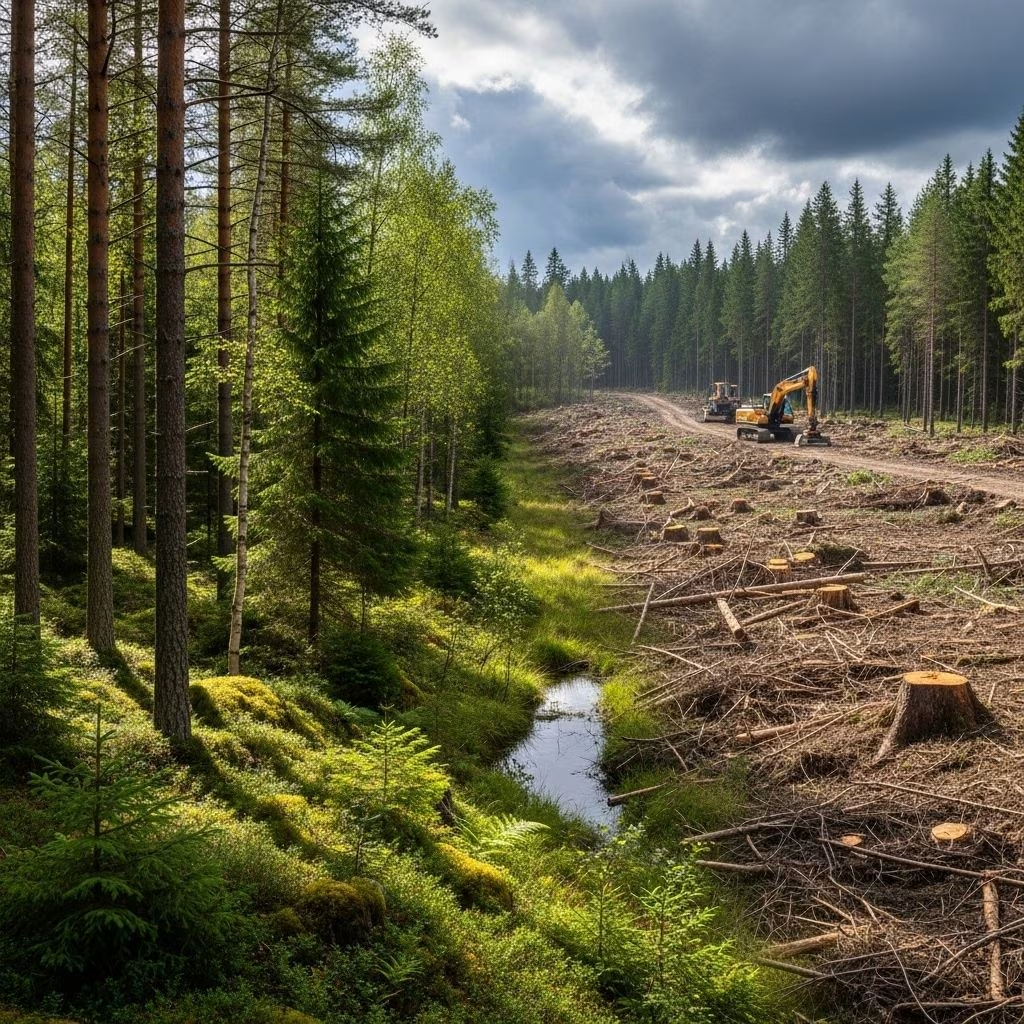
How Sweden’s Logging Practices Affect the Environment
Sweden is often celebrated globally as a champion of green innovation and sustainable forestry. Boasting vast boreal forests and robust timber industries, the country’s official forestry model is widely promoted as a gold standard. Yet, the environmental consequences of these logging practices remain subject to intense debate and scrutiny.
The Swedish Forestry Model: Claims and Realities
The so-called Swedish Forestry Model is built on balancing timber production with environmental objectives. Swedish authorities and the timber industry tout their operations as paragons of sustainability, urging other countries to adopt similar frameworks. According to official figures, about 45% of Sweden’s forested area—almost 10 million hectares—is internationally certified as being managed sustainably, largely under programs like FSC (Forest Stewardship Council). But what does sustainability look like on the ground?
- Clearcutting remains the dominant harvesting technique, accounting for up to 95% of all logging on tracts.
- Harvested areas are immediately replanted, usually as monocultures of spruce or pine, and increasingly with fast-growing, non-native species such as lodgepole pine from North America.
- The regulation of logging under the current Forestry Act follows a principle called “freedom with responsibility,” relying heavily on industry self-policing with light governmental oversight.
Sweden, as the third-largest country in the European Union, heavily depends on its forests. Timber is central to the national economy, supporting large-scale industries that convert wood into paper, lumber, and bioenergy.
Key Statistics
| Area of Commercial Forests | ~23 million hectares |
|---|---|
| Certified as ‘Sustainable’ | ~10 million hectares (45%) |
| Clearcutting Share | ~95% of logged areas |
| Protected Forest Land | ~25% excluded from forestry |
| Forestry Sector Jobs | ~140,000 |
The Legacy and Mechanisms of Clearcutting
Clearcutting replaced selective logging and other traditional methods in the post-World War II era, with a focus on maximizing timber yield. During a typical clearcut, up to 95% of trees in an area are felled, leaving only minor buffer zones around sensitive sites like rivers or protected nesting grounds, sometimes as narrow as two meters.
- Clearcutting is justified by replacing harvested trees with new plantations, but most of these are monocultures, with little resemblance to the original, diverse ecosystems.
- This method is particularly problematic in the northern regions, where regrowth is slow due to harsh climates.
- The average age of Sweden’s forests continues to drop, as old forests are disproportionately targeted for harvest.
Certification and Green Image: FSC and Beyond
While Sweden is lauded for its high rate of FSC (Forest Stewardship Council) certification, watchdog groups and ecologists raise alarm at persistent gaps:
- The largest forestry companies in Sweden—including state-owned Sveaskog and SCA—are FSC-certified.
- Yet, investigations reveal that even these certified companies log in areas of high conservation value, including habitats crucial for threatened species.
- Environmental groups allege “greenwashing”—using certification more as a marketing strategy than a true guarantee of sustainability.
Even the Swedish Society for Nature Conservation (SSNC) has reported FSC rule violations, with companies cutting old forests that FSC guidelines are supposed to protect. This exposes weaknesses in enforcement and transparency of certification processes.
Environmental Impacts: Biodiversity and Climate
Sweden’s approach to forestry, particularly the scale of clearcutting and monoculture replanting, has triggered negative impacts on both biodiversity and the broader climate.
Impact on Biodiversity
- Every year, thousands of hectares of primary and old-growth forests—areas of high conservation value—are lost to logging, undermining the survival of rare and threatened species.
- Once diverse woodlands are replaced by single-species plantations, reducing the complexity of forest habitats and making them more susceptible to pests and disease.
- Approximately 37% of logging between 2017–2020 prioritized timber output over conservation requirements, in direct contravention of Sweden’s Forestry Act.
- As forests are fragmented and simplified, populations of lichen, mosses, and birds such as the capercaillie face steep decline.
Impact on Climate Change
- Older, undisturbed forests store vastly more carbon than young plantations due to massive, intertwined root systems and forest floor biomass.
- Clearcutting leads to an immediate release of stored carbon, turning Swedish forestry into one of the country’s largest industrial greenhouse gas emitters.
- The official claim that replanting trees makes the process “carbon neutral” is challenged by ecologists: newly planted saplings take decades to match the carbon absorbing capacity of old forests.
- In reality, Sweden’s actual carbon sequestration now almost exclusively comes from protected areas, as intensive forestry cycles keep most logged lands too young to build significant stores of carbon.
The Debate: Balancing Industry and Conservation
Sweden’s forest products sector is a core pillar of the economy, supporting about 140,000 jobs and producing goods from paper pulp and timber to bioenergy fuels. This economic importance creates a tension between the need to “safeguard” forests and the desire to meet industry and energy needs.
- Forest owners and industry groups argue that using wood products helps displace more carbon-intensive fossil fuels.
- Yet, environmental advocates—such as the World Wildlife Fund (WWF)—insist that exploiting loopholes to log in high conservation value forests undermines both biodiversity and climate commitments.
- The debate persists around where the true balance lies between economic benefit, climate mitigation, and the preservation of irreplaceable natural ecosystems.
Sweden’s Forestry Law and Its Challenges
The current legal regime was shaped primarily by the 1993 Forestry Act, which requires all logging to balance production and conservation. However, critics argue the legislation is too weakly enforced:
- The Swedish Forest Agency is tasked with monitoring, but suffers from underfunding and limited staffing, leaving most oversight to private companies.
- This self-policing structure leads to inconsistent environmental standards and frequent rule violations.
- Buffer zones around waterways—critical for preventing runoff and habitat loss—may be as little as two meters wide on logged sites, far below ecological recommendations.
- Despite a requirement to protect areas of high biodiversity, the overall age and diversity of Sweden’s forest landscape continues to decrease.
Sweden’s system thus exemplifies the clash between “freedom with responsibility” and the need for stringent, transparent oversight.
International Criticism and the European Union’s Response
The global demand for sustainable wood products means Swedish forestry comes under international scrutiny. Recently, the European Commission has proposed policies to block the import of goods (including timber) linked to deforestation. These measures aim to push producing countries toward greater transparency and genuine sustainability.
- The EU’s stance reflects growing alarm over the loss of Europe’s ancient forests and the responsibility of member states—like Sweden—to uphold biodiversity and emissions targets.
- WWF and other NGOs maintain that Sweden and similarly situated countries are not doing enough to protect primary forests or prevent loophole-driven exploitation.
Looking Forward: Paths to True Sustainability
Genuine sustainable forestry in Sweden would require addressing several critical issues:
- Strengthening protection for old-growth and high-biodiversity forests, including stricter legal definitions and larger no-logging buffer zones.
- Shifting from monoculture plantations toward mixed-species reforestation, prioritizing native biodiversity, ecological resilience, and carbon storage.
- Applying best-available science to verify the actual carbon balance of forestry operations, not relying on generalized national data.
- Improving independent monitoring and enforcing certification standards to prevent “greenwashing.”
- Expanding public and indigenous input on land use decisions, particularly where forests intersect with traditional Sami reindeer herding lands and community rights.
Ultimately, Sweden’s forestry debate mirrors global challenges—how to reconcile economic reliance on forest products with the urgent imperatives of climate change mitigation and ecological integrity.
Frequently Asked Questions (FAQs)
Q: What is the Swedish Forestry Model, and why is it controversial?
A: The Swedish Forestry Model is a policy framework that claims to balance timber production with environmental conservation. In practice, it has been criticized for prioritizing large-scale clearcutting and self-policing by industry, leading to concerns about biodiversity loss, carbon emissions, and inadequate protection of old forests.
Q: How does clearcutting impact Sweden’s ecosystems?
A: Clearcutting removes almost all trees from logged sites, fragments wildlife habitat, reduces biodiversity, and exposes forest soils to erosion and nutrient runoff. When replanted as monocultures, these areas rarely regain their historical ecological complexity.
Q: Are Sweden’s forests really being managed sustainably?
A: While almost half of Sweden’s forests are certified under programs like FSC, watchdogs and NGOs have documented ongoing logging in areas of high conservation value, raising serious doubts about the integrity of these programs and the true definition of sustainability.
Q: What role do Swedish forests play in climate mitigation?
A: Mature forests store large amounts of carbon. Replacing them with young plantations releases carbon, and it takes decades for new growth to absorb the same amount. Claims that Swedish forestry is carbon neutral or negative are contested by independent scientists.
Q: What are key recommendations for improving Sweden’s forestry practices?
A: Independent experts recommend strengthening legal protections for old-growth forests, enforcing wider no-logging zones, restoring and maintaining ecological diversity in replanted areas, and increasing oversight of both industry practices and certification schemes.
References
- https://e360.yale.edu/features/swedens_green_veneer_hides_unsustainable_logging_practices
- https://news.mongabay.com/2022/06/how-unsustainable-is-swedens-forestry-very-qa-with-marcus-westberg-and-staffan-widstrand/
- https://phys.org/news/2025-01-wwf-blasts-sweden-finland.html
- https://www.swedishwood.com/wood-facts/about-wood/wood-and-sustainability/the-forest-and-sustainable-forestry/
- https://pmc.ncbi.nlm.nih.gov/articles/PMC3906476/
- https://www.tandfonline.com/doi/full/10.1080/14942119.2023.2229707
- https://www.ieabioenergy.com/wp-content/uploads/2014/06/Consequences-of-an-increased-extraction-of-forest-biofuel-in-Sweden-IEA-BIOENERGY-TR2014-1.pdf
- https://www.forestindustries.se/forest-industry/forest-management/forestry/


