


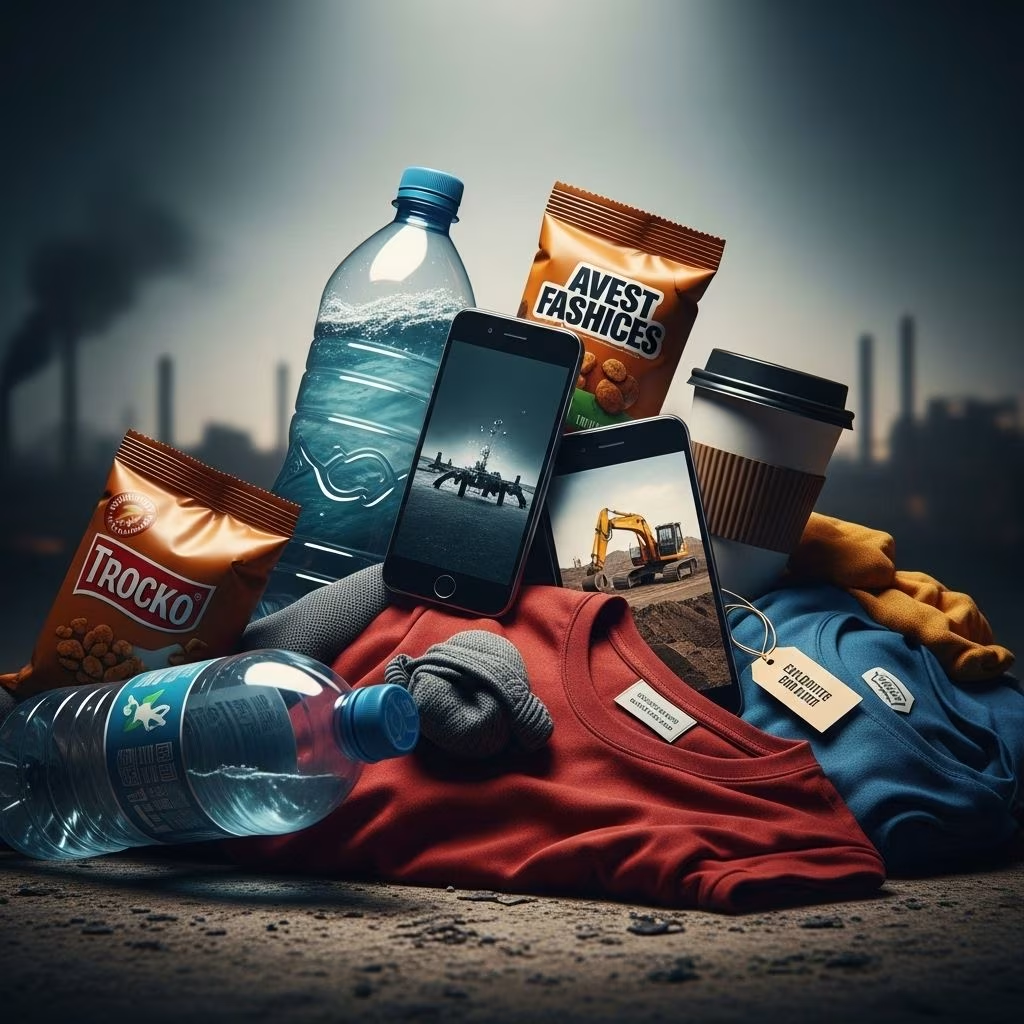
Unpacking the Environmental and Social Costs of Everyday Consumer Goods
In an era where consumption drives economies and defines lifestyles, the hidden environmental and social costs associated with everyday products remain largely invisible. While consumers make choices across endless product aisles, questions about where, how, and by whom these goods are produced often take a backseat. A new generation of podcasts is exploring what it truly means to be a responsible consumer—challenging us to address the externalities embedded in every transaction.
The Podcast Revolution: Bringing Product Costs to Light
With the rise of podcasting, storytellers have found new ways to deepen public understanding of complex issues. Among the growing ranks of sustainability-focused podcasts, investigative series are shining light on the real-world impacts of seemingly innocuous purchases. Through compelling interviews, field reporting, and expert commentary, these podcasts ask us to reconsider our relationship with the goods we buy and the systems we sustain.
- Podcasts dissect the lifecycle of consumer goods, tracing products from raw material extraction to disposal.
- Stories highlight the human and ecological costs of production, including pollution, labor rights violations, and community disruption.
- Experts and activists discuss potential solutions, spanning from policy to personal action.
Beyond the Price Tag: What Are the True Costs?
The price a consumer pays at checkout rarely reflects the full cost of a product’s journey. Below the surface, there are persistent and destructive impacts that extend across:
- Environmental degradation—including habitat destruction, greenhouse gas emissions, and pollution from manufacturing and disposal.
- Social exploitation—ranging from unfair labor practices and health hazards faced by workers to displacement of communities.
- Resource depletion—from overuse of water and minerals to loss of biodiversity.
These hidden costs are often borne by people and ecosystems that have little influence on consumer demand. As podcasts give voice to these stories, listeners are challenged to confront questions of accountability and justice.
Tracing the Journey: From Raw Materials to Retail Shelves
Every consumer item has a complex supply chain with its own tapestry of environmental and social impacts. A single T-shirt, for example, may comprise cotton grown with intensive pesticide use, processed in factories with lax labor standards, and colored with dyes that contaminate water systems. The journey is long, and the consequences span continents.
| Life Cycle Stage | Environmental Costs | Social Costs |
|---|---|---|
| Raw Material Extraction | Deforestation, land degradation, pollution | Land conflicts, displacement, crop loss |
| Manufacturing | Water and air pollution, energy use | Labor rights violations, unsafe conditions |
| Distribution & Retail | Transport emissions, packaging waste | Low wages in retail, job precarity |
| Consumer Use & Disposal | Resource consumption, landfill burden | Waste exported overseas, worker exposures |
The Human Story: Workers, Communities, and the Price of Progress
Many podcasts delve into the voices and experiences of people at the frontlines of extraction, manufacturing, and waste management. These human stories reveal staggering disparities in who reaps the benefits—and who bears the costs—of global consumption.
- Factory workers in developing countries may endure hazardous conditions for low pay, making electronics or sewing garments.
- Farmers are often squeezed by market prices, exposing themselves to toxic chemicals to produce commodities for distant markets.
- Local communities grapple with polluted air, water, and soil, often with little recourse or representation.
Some investigative podcasts give these individuals a platform to share their perspectives, offering audiences a rare direct connection to far-reaching consequences of their choices.
The Environmental Toll: Pollution, Waste, and Loss of Biodiversity
Few consumers witness the landfills filled with discarded goods or the rivers choked with factory runoff. Podcasts use powerful storytelling and reporting to map these impacts, emphasizing just how far a product’s shadow can reach:
- Textile manufacturing remains a leading source of industrial water pollution worldwide.
- Plastic packaging, ubiquitous in global retail, often ends up as persistent ocean debris threatening marine life.
- The appetite for minerals powering electronics has driven deforestation and toxic mining in sensitive ecosystems.
Case Study: Electronics and E-Waste
The global demand for smartphones, laptops, and other electronics has fostered rapid technological advancement—but at significant environmental and health costs:
- E-waste, the fastest-growing solid waste stream globally, is often shipped to countries ill-equipped for safe recycling, resulting in toxic pollution and community health risks.
- The mining of rare earths and metals contaminates soil and waterways, impacting biodiversity and local agriculture.
Podcasting for Accountability: Making Change Possible
One of the most significant roles podcasts play is in initiating public conversations around accountability. By revealing the links between consumption and global impacts, they catalyze action on multiple fronts:
- Raising consumer awareness about hidden product costs and subtle marketing tactics.
- Highlighting activist campaigns and policy proposals aiming to enforce corporate responsibility and protect vulnerable populations.
- Encouraging business innovation—from closed-loop recycling to ethical sourcing certifications.
Interview segments often feature leaders from NGOs, sustainability-focused businesses, and grassroots groups, allowing listeners to learn about solutions already in play and how they might support or advocate for change directly.
From Awareness to Action: What Can Consumers and Companies Do?
Although the problems are systemic, solutions can arise at every level of the supply chain, as well as in individual consumer choices.
Consumer-Level Strategies
- Buy less, buy better: Prioritize quality and longevity, backed by ethical certifications and transparent supply chains.
- Support companies with clear sustainability commitments and responsible sourcing policies.
- Reduce, reuse, and recycle: Engage in repair, sharing economies, and proper recycling practices to extend product lives and curb waste.
- Ask questions: Challenge brands on their sourcing, labor conditions, and end-of-life product management policies.
Corporate and Policy-Level Interventions
- Adopt circular economy models to minimize waste and maximize resource recovery.
- Enforce transparency in supply chains, from farm or mine to factory to end user.
- Implement producer responsibility schemes for proper disposal and recycling.
- Support living wages, safe working conditions, and community investment at source locations.
Challenges in Measuring and Communicating True Costs
Select podcasts go behind the scenes with journalists, researchers, and policy advocates struggling to quantify and communicate these complex cost structures. Barriers include:
- Data opacity: Multinational supply chains are often shrouded in secrecy, impeding access to reliable data.
- Lack of standardized metrics for social and environmental costs.
- Greenwashing: Companies sometimes exaggerate or misrepresent sustainability achievements.
Despite these hurdles, new tools—from blockchain traceability to lifecycle analysis—are improving transparency and accountability.
How Podcasts Influence Wider Change
By personalizing the costs of consumption and amplifying underreported stories, podcasts serve as catalysts for transformation. They bridge the gap between academic research, grassroots movements, and everyday listeners.
- Increase political engagement by encouraging listeners to advocate for stronger regulations.
- Expand awareness of the intersection between environmental justice and consumer behavior.
- Promote innovative business models responding to new consumer expectations.
Resources: Podcasts and More That Expose Product Costs
- This Week in Sustainability—Dissects the pros and cons of consumer products and materials.
- For a Better World by Fair World Project—Explores the environmental and social fallout from the production of everyday items.
- CGF Sustainability Podcast—Interviews industry leaders combating issues from deforestation to food waste.
- Treehugger Podcast—Delivers dynamic reporting and outside-the-box thinking on sustainable living.
Frequently Asked Questions (FAQs)
Q: Why aren’t consumers more aware of the hidden costs attached to products?
A: Many supply chains are nontransparent, and the marketing of products often obscures their environmental and social impacts. Podcasts, journalism, and advocacy are crucial in holding brands accountable and educating the public.
Q: What is a “circular economy,” and how does it help?
A: A circular economy is an economic system aimed at eliminating waste and the continual use of resources by keeping products and materials in use through reuse, repair, remanufacturing, and recycling.
Q: How can I evaluate if a brand is truly committed to sustainability?
A: Look for third-party certifications (like Fair Trade or B Corp), transparency about sourcing and labor, concrete emissions targets, and regular, verified sustainability reporting—not just marketing claims.
Q: What role do governments play in addressing these hidden costs?
A: Governments can enforce regulations on pollution, worker protections, and product standards, as well as incentivize sustainable business practices through policies and public funding.
Q: Can individual actions make a difference given global supply chains?
A: Yes, especially when combined with collective efforts: choosing better products, supporting activism, and advocating for policy reforms all contribute to systemic change.
References
- https://podcast.feedspot.com/sustainability_podcasts/
- https://shortyawards.com/5th-socialgood/treehugger
- https://www.youtube.com/watch?v=0DsuU8oHnHw
- https://www.treehuggerpod.com/episodes/urban-nature
- https://open.spotify.com/show/1C1K2d5fZdqQDolXYo5iLP
- https://www.treehuggerpod.com
- https://www.youtube.com/@treehuggerpodcast


