


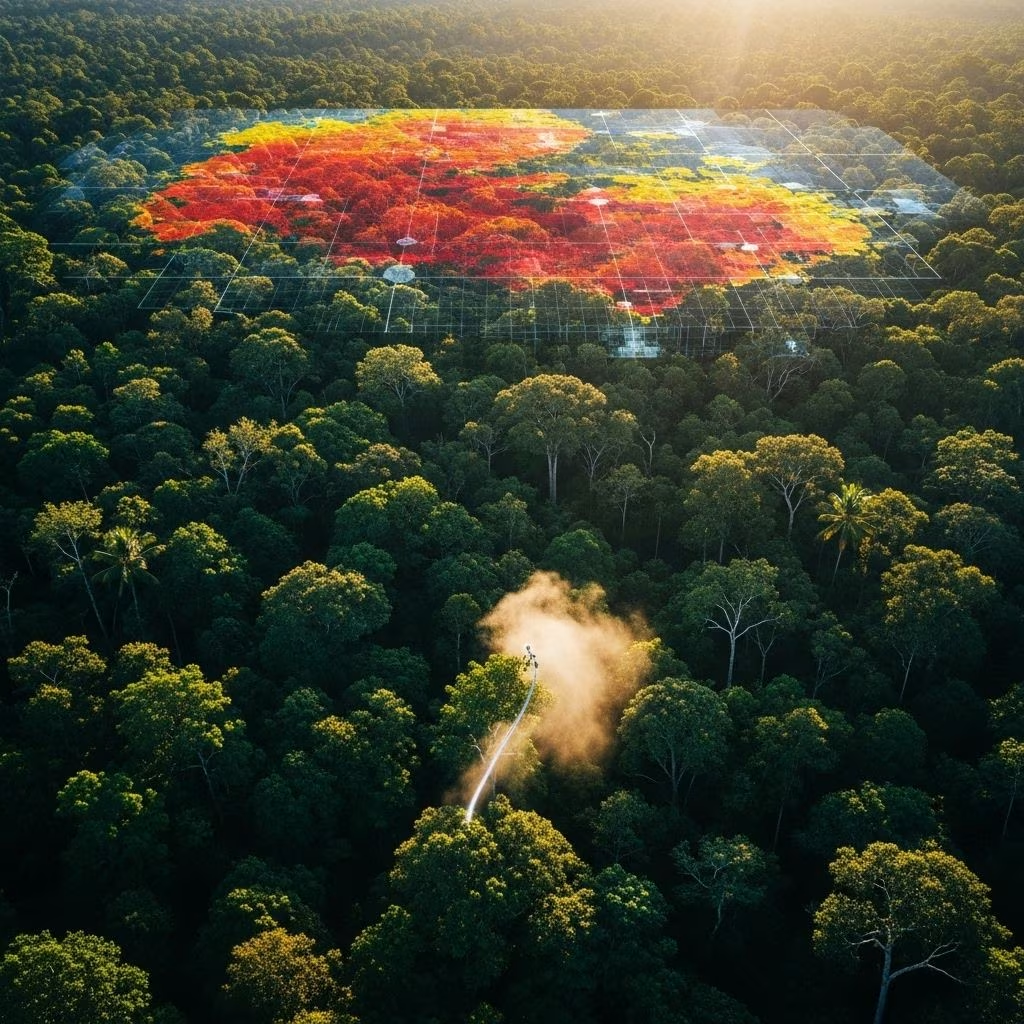
Tropical Rainforest Vulnerability Index: A Modern Tool for Forest Conservation
The world’s tropical rainforests are not only natural wonders brimming with biodiversity, but also critical climate regulators. Yet these vibrant ecosystems are under growing threat from climate change, deforestation, and other human pressures. Addressing these threats requires actionable knowledge—an urgent call answered by the recent creation of the Tropical Rainforest Vulnerability Index (TFVI), a groundbreaking framework that tracks and predicts the resilience and risk for rainforests across the globe.
Why Track Rainforest Vulnerability?
Tropical rainforests play a vital role in stabilizing the global climate, filtering water, providing habitat for untold species, and offering resilience against natural disasters. Their well-being influences the planet’s carbon cycle, regional rainfall patterns, and vast webs of biodiversity.
- Climate Regulation: Rainforests absorb immense quantities of atmospheric carbon dioxide, helping curb global warming.
- Water & Soil Management: They maintain healthy waterways and fertile soils crucial for local and regional agriculture.
- Biodiversity: The majority of Earth’s terrestrial species are found within tropical rainforests, making their protection essential for life’s diversity.
Yet these benefits are threatened by logging, land conversion, fragmentation, and now, the more unpredictable impacts of a warming climate. Measuring and monitoring rainforest health, especially vulnerability to stressors, has historically been a fragmented and often local effort, limiting global-scale action.
The Need for a Global Early Warning System
Traditional methods for assessing rainforest vulnerability mainly relied on local observations or isolated studies, which, while valuable, lacked the scope and consistency necessary to guide international policies or prompt coordinated action. Without a cohesive global system, comparisons between regions were difficult and early warnings about tipping points—abrupt and possibly irreversible ecosystem shifts—often came too late.
The Tropical Rainforest Vulnerability Index (TFVI) was conceived to address this critical gap, enabling direct, continual, and comparative assessment of rainforest vulnerability at a planetary scale.
Introducing the Tropical Rainforest Vulnerability Index
The TFVI is a composite indicator that combines a variety of ecological functions and climate-related measurements, distilled from decades of satellite data, to offer a practical, up-to-date baseline for scientists, conservationists, and policy makers alike.
- Data Sources: Combines global satellite data sets, ground observations, and climate models.
- Scope: Covers primary tropical rainforests in South America, Africa, and Southeast Asia.
- Frequency: Updated monthly, it provides near-real-time information for decision makers.
What the TFVI Measures
The index assesses vulnerability and resilience by analyzing factors including:
- Carbon cycling and storage
- Water fluxes and hydrology
- Biodiversity—species richness, habitat connectivity
- Land use changes—deforestation, fragmentation
- Climate variables—drought, heatwaves
This approach enables simultaneous tracking of multiple stressors and their combined effects on rainforest ecosystems.
How Was the Index Developed?
The TFVI was the result of a collaborative global effort, spearheaded by the National Geographic Society with support from Rolex and involving leading ecologists, climate scientists, and conservationists from around the world. Their mission: build a reliable metric to diagnose, compare, and anticipate shifts in rainforest health across continents.
They drew upon:
- Advanced satellite remote sensing technologies—to collect high-resolution climate and vegetation data.
- Statistical models—to integrate complex and varied datasets into a single, interpretable score.
- Automated updates—so the index reflects the latest field and satellite observations.
Key Steps in TFVI Creation
- Data Collection: Satellite and climate data recorded over several decades provided a robust baseline of forest health.
- Regional Calibration: The model was adjusted for each continental region to account for inherent differences in forest ecology and climate.
- Cross-Validation: Field studies and local observations were used to test and refine the model’s accuracy.
What Has the TFVI Revealed So Far?
Initial findings from the index have already transformed understanding of rainforest vulnerability. Major insights include:
- Regional Differences Matter: Rainforests on different continents—such as those in South America (the Amazon), Africa (the Congo), and Southeast Asia—respond in markedly different ways to similar climate shocks and land use changes.
- Uneven Resilience: Certain rainforests show impressive natural resilience, while others are fragile and quick to degrade under stress.
- Fragmented Forests Are at Greatest Risk: Areas already disturbed or broken apart by human activity exhibit “almost no resilience” to climate warming or extended droughts.
Continental Comparison Table: Rainforest Vulnerability
| Region | Main Threats | Observed Resilience | TFVI Insights |
|---|---|---|---|
| Amazon Basin (South America) | Drought, deforestation, fire | Low to moderate (especially in fragmented areas) | Highly sensitive to climate & land use; rapid decline possible |
| Congo Basin (Africa) | Land conversion, selective logging, shifting rainfall | Moderate (historically more resilient to drought) | Regionally variable; some zones remain resistant, others show stress |
| Southeast Asia | Palm oil plantations, fragmentation, fire, drought | Variable (often stressed due to long land use history) | Some forests show resilience; others are highly vulnerable due to fragmentation |
Scientific Insights
- Interactions between climate, land use, and biodiversity fundamentally define a forest’s ability to withstand stressors.
- Areas undergoing “critical transitions” (approaching a tipping point) can now be flagged early via the index.
- Some rainforests are already showing reduced capacity to store carbon and regulate water flows—a warning of diminishing ecosystem services overall.
The Significance for Conservation
By providing an up-to-date, scientific assessment of rainforest health, the TFVI enables conservationists to:
- Identify High-Risk Regions: Direct resources to forests on the brink before irreversible loss occurs.
- Monitor Changes Over Time: Observe the effects of conservation strategies and policy interventions.
- Guide Policy: Inform lawmakers and land managers about urgent environmental risks, guiding commitments under agreements like the Paris Agreement.
- Encourage Global Collaboration: Help unify data, priorities, and initiatives across countries and sectors for maximum impact.
Examples of TFVI in Action
- Early Detection: The index can provide timely warnings for regions at risk of crossing ecological tipping points, allowing for swift conservation action.
- Measuring Recovery: The TFVI helps track how well a rainforest rebounds following restoration efforts or natural disasters.
- Educational Outreach: Publicly available updates can raise awareness and foster stewardship among citizens, NGOs, and governments.
Frequently Asked Questions (FAQs)
Q: How is the TFVI different from previous rainforest monitoring tools?
A: Traditional methods relied on local or regional indicators, often missing global context and the interplay of multiple stressors. The TFVI is global, continuous, and incorporates real-time satellite and field data for an integrated perspective.
Q: What are “tipping points” in the context of rainforests?
A: Tipping points are thresholds beyond which rapid, and sometimes irreversible, ecosystem changes occur. Crossing them could lead to large-scale dieback, loss of biodiversity, or failure in ecosystem services.
Q: Can the TFVI help forecast future changes?
A: Yes. The index not only measures current vulnerability but also tracks trends, providing early warnings and helping forecast areas likely to face mounting stress or ecosystem collapse.
Q: How does the index handle regional differences across continents?
A: The TFVI is calibrated for different regions, taking into account ecological and climatic nuances of each major rainforest system, such as those in the Amazon, Congo, and Southeast Asia.
Q: Does the TFVI have a role in climate policy?
A: Absolutely. As a science-backed, transparent metric, it equips policymakers with crucial data for natural resource management, helping nations meet international sustainability goals.
Challenges and Future Directions
While the TFVI marks a significant leap forward in global rainforest monitoring, challenges remain:
- Data Gaps: Some regions have limited ground-truthing, making satellite calibration more difficult.
- Complex Interactions: Fully disentangling the roles of human and natural drivers requires ongoing research.
- Keeping Pace with Change: Rapid shifts in land use and climate demand that the index and its models remain adaptive and current.
To meet these challenges, the TFVI is designed for automatic, continual updates, with researchers actively integrating new scientific and technological advancements. Expanding integration with local studies and citizen science can further sharpen predictions and conservation outcomes.
Why the TFVI Matters for Everyone
Protecting rainforests is not just a matter for scientists or conservationists—it is central to safeguarding the planet’s future. The TFVI translates a wealth of complex data into actionable intelligence, empowering global society to take informed steps for preserving these irreplaceable ecosystems for generations to come.
- Forests buffer climate extremes, protecting communities globally.
- Biodiversity is a bulwark against future ecological and health crises.
- Conservation guided by robust data is the best hope for halting tropical deforestation and the cascade of losses that may follow.
By systematically diagnosing and tracking the “health” of rainforests around the world, the TFVI stands as an essential tool in the renewed global movement to conserve nature and address the twin crises of climate change and biodiversity loss.
References
- https://arkansasresearch.uark.edu/climate-science-researcher-contributes-to-tropical-forest-vulnerability-index/
- https://www.bgc-jena.mpg.de/en/pm-tropical-forest-stress
- https://news.uark.edu/articles/57441/climate-science-researcher-contributes-to-tropical-forest-vulnerability-index
- https://www.scimex.org/newsfeed/new-index-to-track-tropical-forest-vulnerability-to-help-avoid-tipping-points
- https://pmc.ncbi.nlm.nih.gov/articles/PMC9477241/
- https://www.jpl.nasa.gov/news/index-ranks-rainforests-vulnerability-to-climate-and-human-impacts/


