


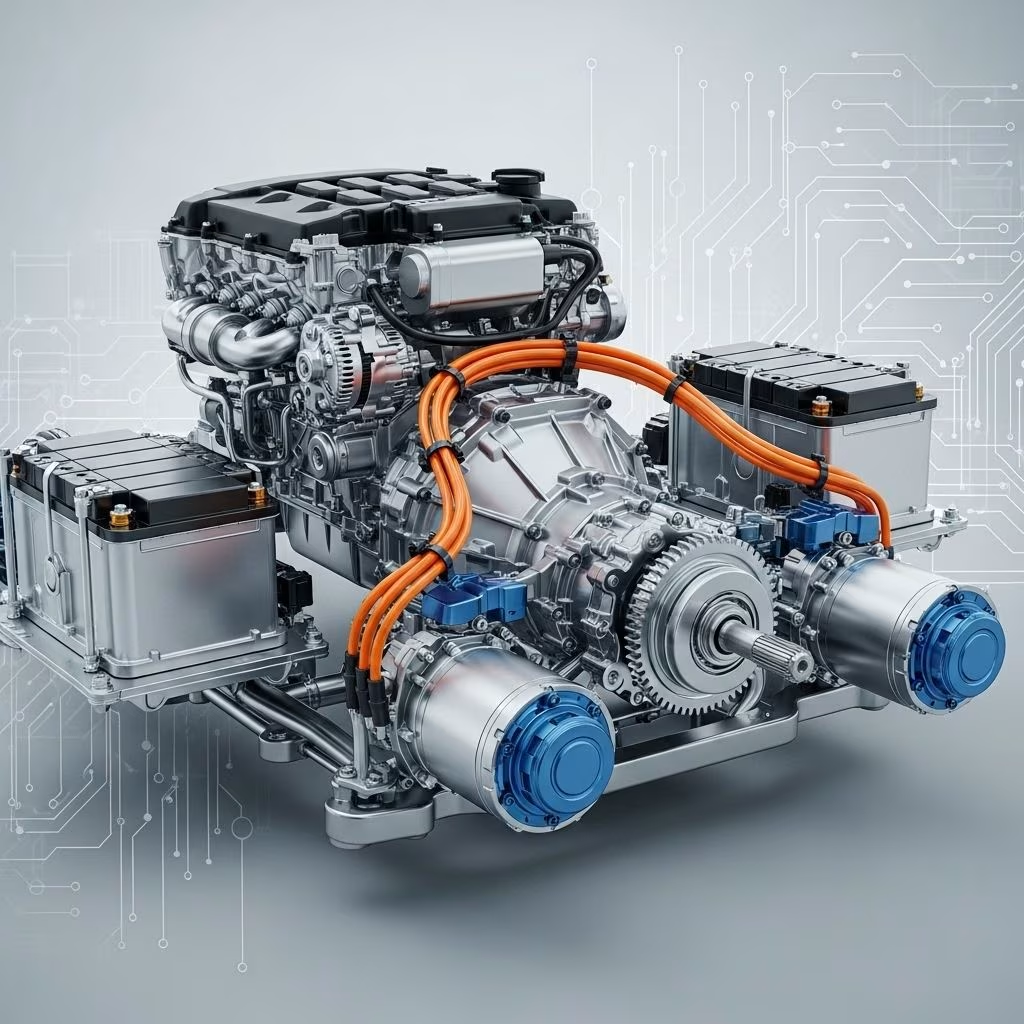
What Is a Two-Mode Hybrid Vehicle?
A two-mode hybrid vehicle is a highly sophisticated hybrid drive system that uses both a gasoline engine and one or more electric motors to propel a vehicle, intelligently switching between or combining two distinct operational modes to optimize efficiency and performance. Unlike traditional hybrids, two-mode systems seamlessly blend parallel and series hybrid configurations, maximizing fuel economy in a wide range of driving scenarios. This technology, initially developed for heavy-duty vehicles like buses, has been adapted for mainstream applications, such as large SUVs by major automakers.
Technical Overview: How Does the Two-Mode Hybrid System Work?
The two-mode hybrid system is engineered around a unique transmission that incorporates multiple electric motors and planetary gearsets, enabling it to operate in two primary driving modes:
- Mode 1 (Low-Speed/Light Load or City Mode): Focuses on urban and stop-and-go traffic. The vehicle can operate using electric motors only, gasoline engine only, or a blend of both. At low speeds, the gasoline engine can switch off entirely, allowing electric propulsion for zero-emission travel. This mode prioritizes fuel savings and reduced emissions in typical city driving scenarios, with the electric motors taking the lead.
- Mode 2 (High-Speed/Heavy Load or Highway Mode): Optimized for acceleration, towing, and highway cruising. In this mode, both the gasoline engine and the electric motors can work together to provide additional power during high-load situations, such as merging onto a highway or climbing a hill. Here, the efficient blending of engine and electric motor outputs ensures enhanced performance and reduced overall fuel consumption.
Switching between these modes is seamless, managed automatically by an onboard control system that assesses speed, throttle input, load, and battery charge. The two-mode system integrates the advantages of both parallel (where engine and motors can drive the wheels together) and series (engine generates electricity for the motors) hybrid systems.
The Evolution of Two-Mode Hybrid Technology
Development of the two-mode hybrid system began in the early 2000s through a collaborative effort between General Motors, Allison Transmission, and the U.S. Department of Energy. The initial focus was on heavy-duty applications such as transit buses, where significant gains in fuel efficiency and emission reductions could be rapidly demonstrated. Following successful large-scale deployments—such as transit fleets in Seattle, Houston, Chicago, Washington D.C., and Istanbul—the technology was refined for use in light-duty vehicles, notably large SUVs including Chevrolet Tahoe, GMC Yukon, Dodge Durango, and Chrysler Aspen. As of today, adaptations and evolutions of two-mode hybrid concepts exist in various passenger vehicles by different manufacturers.
Key Components of Two-Mode Hybrid Systems
- Hybrid-Specific Transmission: A specialized multi-speed automatic transmission housing multiple electric motor/generators and several planetary gearsets.
- Gasoline Engine: Often a V6 or V8 engine with advanced fuel-saving features, such as cylinder deactivation and variable valve timing.
- Electric Motors/Generators: Typically two compact electric motor units inside the transmission housing that enable both propulsion and regenerative braking.
- Battery Pack: High-voltage lithium-ion or nickel-metal hydride batteries that store and provide electric energy for propulsion and accessory systems.
- Power Electronics Module: Control units that regulate power flow between the battery, engine, and motors, as well as coordinate mode transitions.
- Auxiliary Electrical Systems: The two-mode system sometimes incorporates multiple electrical systems—300V for the hybrid drive, 42V, and traditional 12V—enabling different vehicle functions.
Detailed Operation Modes Explained
| Driving Situation | How Power is Delivered | Main Benefit |
|---|---|---|
| Stop-and-Go City Traffic | Primarily electric motors, with engine disengaged or supporting as needed | Zero-emission driving, maximum fuel savings |
| Acceleration and Merging | Engine and electric motors combine for extra power | Boosted performance, smooth acceleration |
| Cruising at Highway Speeds | Engine with possible motor assist; optimized gearsets | Efficient cruising, minimized fuel use |
| High Load Situations (Towing/Climbing) | Full combined outputs from engine and electric motors | High torque, capability without excessive engine strain |
| Deceleration/Braking | Regenerative braking via electric motors recharging battery | Energy recovery, improved efficiency |
Advantages of Two-Mode Hybrid Systems
- Superior Fuel Economy: Real-world tests on transit buses have shown fuel economy improvements ranging from 20–54% compared to traditional diesel buses, with significant savings observed in city driving.
- Reduced Emissions: Notably lower nitrogen oxide (NOx) and greenhouse gas emissions compared to conventional engines. Up to 50% reduction in NOx has been reported in transit applications.
- Seamless Mode Transitions: The system’s electronics provide nearly imperceptible changes between engine and electric drive, resulting in smooth acceleration and a refined driving experience.
- Enhanced Performance and Versatility: Vehicles retain strong towing and hauling capabilities thanks to combined engine and motor torque, with engine shutdown at idle for improved efficiency.
- Urban and Highway Efficiency: Unlike early hybrids that are optimized for city driving, two-mode designs improve fuel usage across both urban and highway environments by leveraging their dual operational modes.
- Scalability for Different Applications: Systems were successfully scaled from heavy-duty buses to light-duty SUVs and even planned for midsize crossovers.
Major Applications of Two-Mode Hybrid Technology
Heavy-Duty Transit Buses:
Two-mode hybrid transmissions were initially deployed in city transit buses. Fleet deployments in major North American and international cities demonstrated real-world savings in fuel and emissions.
Full-Size SUVs and Trucks:
Automakers such as General Motors and Chrysler introduced two-mode hybrid versions of large SUVs, including:
- Chevrolet Tahoe Hybrid
- GMC Yukon Hybrid
- Cadillac Escalade Hybrid
- Chrysler Aspen Hybrid
- Dodge Durango Hybrid
These vehicles offered significant improvements in urban fuel efficiency without sacrificing passenger or towing capacity.
Emerging Passenger Car Applications:
Manufacturers like Honda and Toyota have advanced related hybrid systems (e.g., Honda’s two-motor e:HEV system, the Toyota Hybrid Synergy Drive) that use similar principles of seamlessly blending electric and engine power and switching between multiple modes, further demonstrating scalability and versatility.
Comparison: Two-Mode, Series, and Parallel Hybrid Systems
| Type | How it Works | Key Advantages | Common Vehicles |
|---|---|---|---|
| Series Hybrid | Engine powers a generator; electric motor drives wheels | Simplified drivetrain, useful for city driving | Early hybrid buses, BMW i3 (with range extender) |
| Parallel Hybrid | Engine and/or electric motor can drive wheels directly | Improved highway efficiency, direct engine power | Honda Insight, many Toyota hybrids |
| Two-Mode Hybrid | Switches between or combines series and parallel modes | Optimized city and highway efficiency, high flexibility, seamless transitions | GM Tahoe/Yukon Hybrid, city buses |
Industry Impact and Environmental Benefits
Deployment of two-mode hybrid technology has led to the following benefits:
- Reduced Fossil Fuel Dependence: By optimizing fuel usage and aggressively leveraging electric power, vehicles consume less gasoline or diesel overall.
- Improved Urban Air Quality: Major cities with hybrid transit buses have reported measurable reductions in emissions and particulate matter, benefiting community health.
- Real-World Durability: Thousands of hybrid buses operated reliably in harsh, stop-and-go urban conditions—paving the way for broader adoption in the consumer market.
- Expanded Consumer Choice: Hybrid technology in large SUVs and trucks demonstrates that efficiency can go hand-in-hand with utility and comfort.
Challenges and Limitations
- Complexity and Cost: The two-mode hybrid system features advanced engineering, making it more expensive to produce and potentially more complex to repair compared to conventional vehicles.
- Market Niche: While pioneering, the technology’s benefits are most pronounced in vehicles where high towing capacity and versatility are required, rather than in compact cars.
- Battery Constraints: Early models utilized battery chemistries (such as nickel–metal hydride) that limited electric-only driving range and added weight. As battery technology advances, these constraints are decreasing.
Latest Innovations: The Path Forward
Present-day hybrid vehicles, such as the Honda e:HEV system, expand on the principles of two-mode design by integrating multiple electric motors, even more efficient power electronics, and improved regenerative braking. Additionally, the distinction between hybrid, plug-in hybrid, and pure electric vehicles is narrowing as all these vehicles increasingly use smart power management and multi-mode drive principles.
Key trends shaping the future:
- High-capacity lithium-ion batteries, enabling extended electric-only driving
- Smarter electronic management to optimize mode transitions and power output
- Integration with plug-in capability for reduced fuel use and increased all-electric range
- Declining costs and mass-market designs, broadening the appeal of hybridization
Frequently Asked Questions (FAQs)
Q: What makes a two-mode hybrid different from a traditional hybrid?
A two-mode system can intelligently switch between operating as a series or parallel hybrid, maximizing efficiency in both city and highway driving—something most traditional hybrids cannot do.
Q: Are two-mode hybrids more expensive to maintain?
They may have higher upfront costs due to complexity, but many systems were engineered for heavy-duty applications and tend to be robust. However, specialized components and batteries could increase long-term service costs compared to standard vehicles.
Q: Do two-mode hybrids need to be plugged in?
No, traditional two-mode hybrids are not plug-in vehicles; they recharge their batteries via the engine, regenerative braking, and onboard systems. Some concepts in the future may integrate plug-in capability.
Q: How long do the batteries last?
Battery life depends on usage and environment. Modern hybrid batteries often last over 8–10 years and are designed for reliability in tough operating conditions.
Q: Is there a performance sacrifice with two-mode hybrid vehicles?
On the contrary, two-mode hybrids often provide equal or better acceleration and towing performance compared to their non-hybrid counterparts, especially at low speeds, due to the immediate torque provided by electric motors.
Conclusion: The Significance of Two-Mode Hybrid Technology
The two-mode hybrid system represents a pivotal step in the evolution of automotive technology, blending the flexibility of electric and combustion propulsion to deliver efficiency, performance, and lower emissions across a variety of vehicle types. Proven in demanding real-world scenarios and adapted for consumer needs, the legacy of two-mode hybrid technology continues to inform the next generation of cleaner, smarter vehicles.
References
- https://www1.eere.energy.gov/vehiclesandfuels/pdfs/success/dual-mode_hybrid.pdf
- https://www.utc.edu/engineering-and-computer-science/research-and-laboratories/cete/hybrid-vehicles
- https://global.honda/en/tech/two_motor_hybrid_system_honda_eHEV/
- https://www.firehouse.com/rescue/article/10492819/two-mode-hybrid-vehicles
- https://www.youtube.com/watch?v=-P_VChtMGK8


