


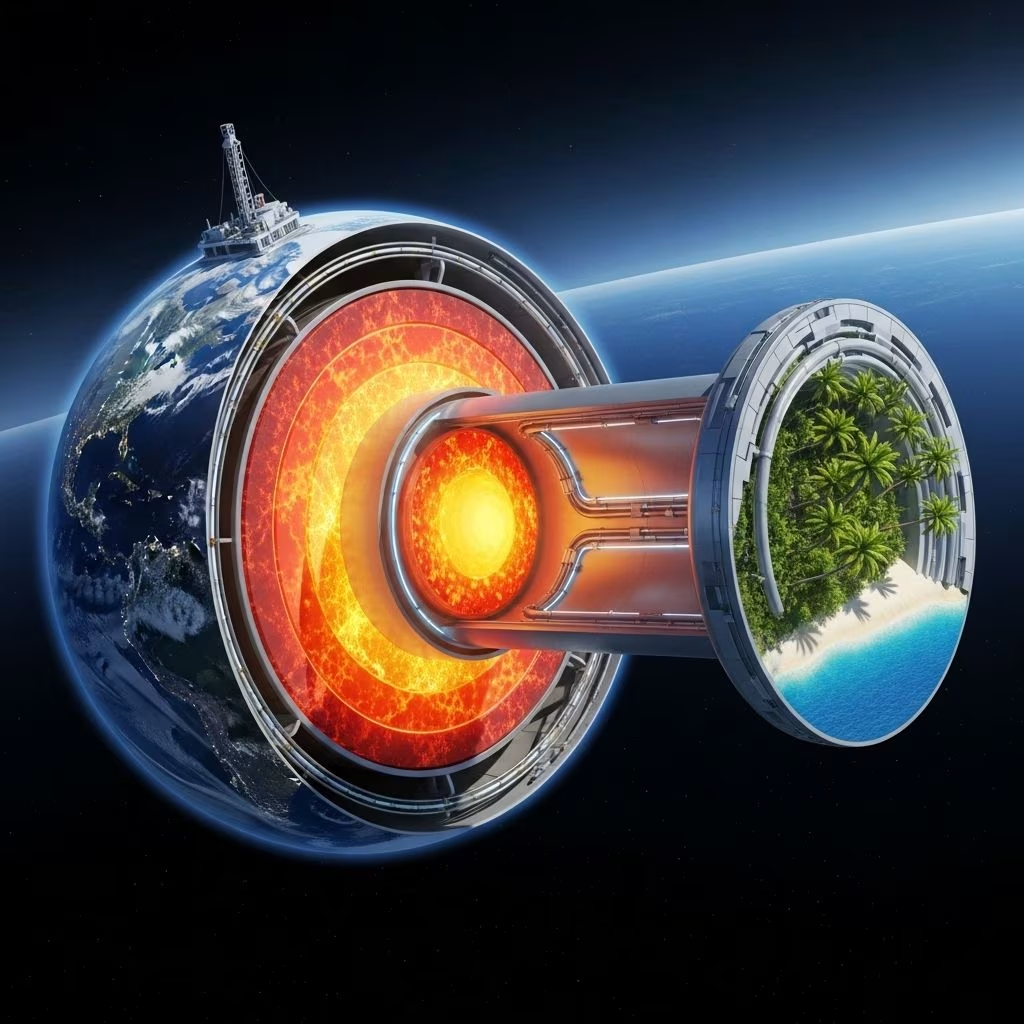
What Happens If You Dig a Hole Straight Through the Earth?
Humans have long imagined what would happen if you could dig a hole straight through the planet. Would you tumble out in China, the ocean, or some exotic locale? The idea pops up in children’s cartoons, science fiction, and idle daydreams. Beneath this playful question lies a fascinating world of geography, physics, and fun global trivia. This article explores where you would actually end up if you dug directly through the center of the Earth, what’s possible, and what’s fanciful myth.
Understanding the Antipodes: The Science of Earth’s Opposite Points
The word antipode refers to the point on the Earth that is diametrically opposite another. In other words, if you drew a line from your location, passing straight through the center of the planet, the place where it emerges on the other side is your true antipode.
Determining antipodes can be done with basic arithmetic:
- Latitude: Invert the north/south direction. For example, 40°N becomes 40°S.
- Longitude: Subtract your longitude from 180°, and switch east to west (or vice versa). For example, 73°W becomes 107°E.
This simple math reveals a surprising truth: most people would not emerge in another country—but deep underwater.
Why Digging Through to China Is a Myth
“Dig to China!” is a classic joke in North America and Europe, but the math uncovers the reality. The United States, for instance, is not antipodal to China. In fact, the vast majority of land-based locations around the world have antipodes in the ocean. Here’s why:
- Earth’s surface is about 71% water, leaving relatively little land for antipodal matches.
- Continents are not symmetrically arranged, so most terrestrial locations correspond to points in the sea, often in remote regions far from any landmass.
This is why, if you dig from almost anywhere in North America, Europe, or Africa, your journey to the other side would plunge you into a surprising part of the world’s oceans.
Mapping the Other Side: Global Antipodes Revealed
Global antipode maps are a striking way to visualize this reality. These maps pair each point on the surface with its antipodal twin, revealing the scarce places where land lines up with land. Let’s look at some notable examples:
- Spain and New Zealand: Parts of Spain’s east coast are antipodal to regions near New Zealand’s North Island, one of the rare land-to-land correspondences.
- Argentina and China: Central and western Argentina’s antipodes fall within China’s landmass, though with a mismatch in population density.
- Hawaii and Botswana: Hawaii’s antipodes land in southern Africa, though off by a few degrees to hit Botswana directly.
The table below highlights a few famous locations and where you’d theoretically surface if you dug straight through from there:
| Start Location | Antipode (Opposite Point) | Land/Water |
|---|---|---|
| New York City (USA) | Indian Ocean (off Australia’s western coast) | Water |
| Madrid (Spain) | Near Wellington (New Zealand) | Land |
| Beijing (China) | Argentina (near Santa Fe) | Land |
| Cape Town (South Africa) | North Pacific Ocean (off Hawaii) | Water |
| Honolulu (Hawaii) | Botswana (Southern Africa) | Land |
| London (UK) | South Pacific Ocean (east of New Zealand) | Water |
Why Most People Would End Up in the Ocean
The stark reality is that about 80% of the world’s population has an oceanic antipode. This owes both to the distribution of human settlement—largely concentrated north of the equator on broad landmasses—and the sheer preponderance of water covering the southern and eastern hemispheres. Some quirks emerge from this fact:
- Those digging from North America and Europe would plunge into the Indian or Pacific Ocean.
- Australians and New Zealanders are more likely than most to have antipodes on land, thanks to their isolated positions.
- Most of Africa, Russia, and Greenland are opposed by vast stretches of water.
The Fascination of Antipode Pairs: Unusual Examples
Despite the overwhelming odds of a watery exit, some rare land-to-land antipodes spark curiosity. These pairs have captivated armchair geographers for generations:
- Waihi, New Zealand & Ronda, Spain: Only a narrow corridor in Spain matches up with part of the North Island in New Zealand.
- Paeroa, New Zealand & Linares, Spain: Again, matching towns across continents and oceans—an outlier on the global map.
- Puerto Madryn, Argentina & Zhengzhou, China: Urban centers in vastly different landscapes, but precisely opposite the world from each other.
These unusual pairs underscore just how rare—and how geographically lucky—a true terrestrial antipode match can be.
How Far Down Would You Have to Dig?
The next question is: how deep is straight through? The Earth’s average radius is about 6,371 kilometers (3,959 miles), which means you’d have to dig at least that far—through layer upon layer of bedrock, mantle, and core. For comparison:
- Deepest human-made hole: The Kola Superdeep Borehole in Russia descends 12.3 kilometers (about 7.6 miles)—just a tiny fraction of the way through.
- Depth to Earth’s center: 6,371 kilometers (nearly 4,000 miles) of rock and molten metal lie between you and the antipode.
- Thickness of the crust: Only about 30-50 kilometers (19-31 miles) thick on average before hitting the mantle.
After the crust, you’d enter the mantle, then the outer core (liquid iron and nickel), and then the blazing hot solid inner core. No human has ever come remotely close to tunneling through the planet’s depths.
What Would Digging Straight Down Be Like?
Suppose technology were no object and you could burrow through every barrier—what would the journey entail? Science fiction aside, here’s a quick thought experiment:
- Pressure: Increases rapidly as you go deeper, overwhelming any materials or suits.
- Temperature: Rises at about 25°C per kilometer—reaching 6000°C at the core, hotter than the sun’s surface.
- Gravity: Would decrease the farther down you go, until reaching zero at the exact center, then accelerate again as you emerge at the other side.
- Lava: Both mantle and outer core are partly or entirely liquid—no tunnel could remain open.
In summary: digging straight through the Earth is impossible with our current understanding of physics, geology, and materials science. It remains a delightful hypothetical, best left for maps and musings.
Common Myths and Misconceptions
- China is directly opposite North America: As shown above, this is largely a myth—nearly all North American points have antipodes in the Indian Ocean.
- A tunnel to the other side would let you fall through: In reality, temperatures and pressures would crush and incinerate anything long before reaching the core.
- Digging straight down is merely a geology problem: It’s vastly more complex, involving impossible physics, extreme temperatures, and the need to displace trillions of tons of matter.
Antipode Mapping: Tools and Fun for the Curious
If you want to locate your own antipode, you can use various online antipode calculators and interactive maps. By entering your city or coordinates, you can instantly see the point on Earth that lies directly opposite. These tools visualize:
- How rare land-based antipodes are
- Where in the ocean your location points to
- Fun connections between distant cities and continents
This simple exercise reveals global geography in a new light and gives context to faraway places.
Beyond Maps: The Playful Legacy of Digging Down
The idea of digging through the Earth persists in culture, folklore, and children’s books. It inspires everything from:
- Cartoons featuring instant tunnels to the other side
- Adventure stories about lost worlds beneath our feet
- Science projects and geography games in classrooms
Ultimately, it’s a prompt for curiosity and wonder about the size, shape, and mystery of our planet.
Frequently Asked Questions (FAQs)
Q: Is it possible to dig a hole straight through the Earth?
A: No. The extreme pressure, temperature, and changing state of materials from crust to core make it physically impossible with current technology or materials.
Q: Are there places you can actually dig to the other side and reach land?
A: Only a few land-based locations have antipodes that are also on land, such as parts of Spain and New Zealand, or Argentina and China. Most points lead to the ocean.
Q: Why are most antipodes found in the ocean?
A: The distribution of land and sea on Earth is not symmetrical. Since water covers more than 70% of the planet’s surface, most points have oceanic antipodes.
Q: What is the farthest anyone has actually dug into the Earth?
A: The Kola Superdeep Borehole in Russia is the deepest manmade hole at about 12.3 kilometers (7.6 miles), a tiny fraction of the way to the other side.
Q: Do any famous cities have land-based antipodes?
A: A few do—such as Madrid and Wellington; Beijing and regions in Argentina—but far more have antipodes in the oceans.
Final Thoughts: The Magic Under Our Feet
Whether as a childhood game or a feat of imagination, digging straight through the Earth offers a playful insight into the true complexity, scale, and diversity of our planet. Next time you’re tempted to wonder, “where would I end up?”—remember: it’s a lot farther, deeper, and wetter than most of us ever imagined!


