Why the Earth—and So Many Things—Break Into Cubes
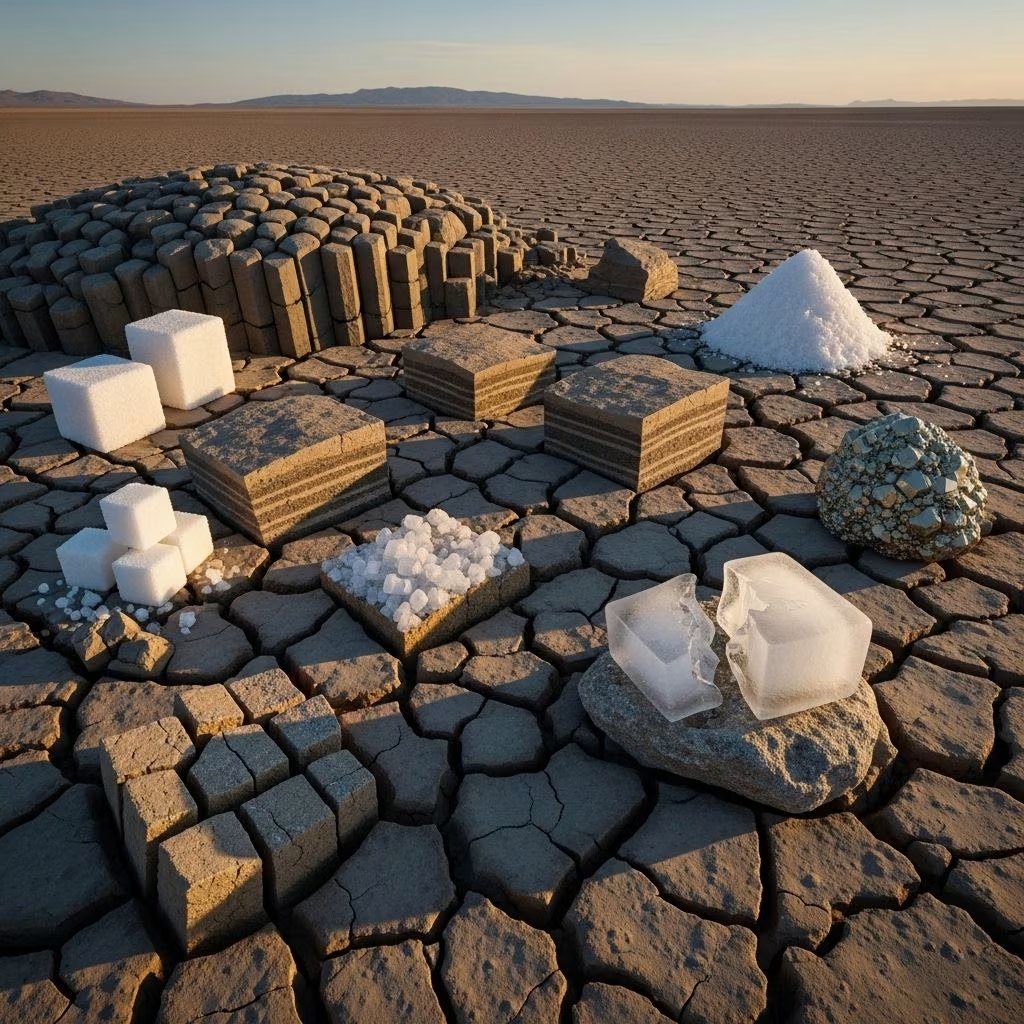
Cubes aren’t just artifacts of human design or the Rubik’s Cube puzzle—they are fundamental patterns that frequently emerge throughout the natural world. When icebergs calve, rocks fracture, or salt crystals grow, the resulting shapes often display a striking cubic regularity. Recent research in geology, physics, and material science offers new insights into why cubes, not random shards or spheres, dominate the outcomes when materials crack or grow. Surprisingly, these findings may even reshape our understanding of the Earth’s deepest inner structures.
Not a World of Spheres: Rethinking the Shapes in Nature
Spheres might seem like the ultimate natural form—planets, bubbles, and droplets often round themselves out courtesy of gravity and surface tension. Yet beneath the surface, much of the material world fractures and forms along hard edges and flat faces. The prevalence of cubes across disparate environments suggests that universal forces—not just chance—shape this geometric tendency.
The cube, with its six square faces and eight vertices, pops up from the micro to the macro scale:
- Rocks splitting from towering cliffs.
- Salt and pyrite forming iconic cubic crystals.
- Icebergs breaking away from glaciers.
- Theorized atomic structures deep inside the Earth’s core.
Do Rocks and Minerals Really Tend to Form Cubes?
In the field, geologists and mineralogists have long noticed cubes in unexpected places. When rocks fracture naturally or by human intervention, their pieces seldom resemble jagged shards. Instead, blocks frequently show squarish or cubic outlines—something scientists used to attribute to the materials’ crystalline arrangement or gravity-driven settling.
However, a 2021 study brought new empirical reinforcement to this intuition. Researchers surveyed dolomite outcrops—both naturally weathered and artificially blasted—and found that cracks formed predominantly square shapes when viewed head-on. The three-dimensional pieces that fell away were, more often than not, close to cubes. But why?
The Physics of Fracture: Why Cubes Emerge
The tendency for fractured objects to break into cubes is a matter of simple, universal mechanics. When stress builds up in a solid material, cracks propagate in patterns that seek the path of least resistance. If all directions of stress are roughly equal—a situation known as isotropic stress—then the cracks spread out perpendicularly. This process naturally segments the material along planes, intersecting at right angles and ultimately producing a cube-like distribution of fragments.
- Stress directionality: When forces pull or press from multiple axes, the resulting fractures form three sets of parallel planes, creating blocky (cuboid) pieces.
- Minimum energy: Cracking at right angles minimizes the energy needed to break the material—a principle echoed in other physics domains.
- Material uniformity: Uniform materials (like many crystalline minerals) are especially prone to this kind of neat, regular breakage.
Supercomputer Simulations: Modeling Fracture in 3D
To rigorously test these ideas, researchers built supercomputer models simulating the break-up of cubic materials under uniform stress. When the simulated blocks were “broken,” they most often split into small cubes, not spheres or shards. This held true for a variety of substances, from rock types to ice and artificial crystals. The findings pointed to a clear law behind nature’s fondness for cubes: fractures grow perpendicular to the applied stress fields, channeling break lines into mutually orthogonal (90-degree) planes.
Cubes Beyond the Surface: From Icebergs to Mountain Faces
Some of the world’s most dramatic natural landscapes provide real-world confirmations of the cube law of fracture. Whether it’s the massive tabular icebergs calved from Antarctica or the squared-off cliffs visible in deserts and mountains, massive blocks formed by natural breakage bear the geometric stamp of cubes. In Antarctica, for instance, icebergs often break away in flat-topped, blocky slabs rather than irregular chunks. Similarly, after rock falls or quarry blasting, the resulting rubble piles frequently display block-shaped pieces.
- Natural dolomite faces show vertical and horizontal cracks forming squares and cubes.
- Engineered dynamiting tends to enhance, not erase, this natural blockiness.
Cubic Crystals: Nature’s Smallest Building Blocks
Cubic shapes are not just a result of how materials fracture but also how they grow. At the atomic scale, some minerals naturally crystallize into perfect cubes. Common table salt (sodium chloride) is a classic example—its atoms form a regular lattice that makes each grain a tiny, nearly-perfect cube under a microscope. Pyrite (“fool’s gold”) and galena (lead sulfide) are two other minerals famed for their blocky crystal faces.
Crystalline cubes occur because atoms prefer arrangements that minimize their potential energy, which often results in symmetrical, repeating three-dimensional forms. The cube, one of the highly symmetrical Platonic solids, is a natural solution to this problem for a variety of elements and compounds.
- Table Salt: Sodium and chloride ions alternate in a cubic lattice, leading to visible cubic grains.
- Pyrite: Iron and sulfur arrange in a cube-forming structure, creating distinct cubic crystals.
- Galena: Lead and sulfur produce robust, visible cube crystals.
Deep Inside the Earth: Cubic Iron in the Core?
The most startling consequences of nature’s cube-forming preferences may exist unimaginably far beneath our feet—at the very center of the planet. The Earth’s inner core, long thought to be a solid sphere of iron and nickel, is now believed to have properties potentially explained by cubic atomic arrangements.
Intriguingly, seismic observations show that shockwaves move faster through the core along the axis of the planet’s spin compared to the equator. This “anisotropy” puzzled geophysicists for decades, since at the ultra-high pressures and temperatures expected in the core, most iron structures should be nearly isotropic—showing the same behavior in all directions.
In the early 2000s, Swedish researchers used theoretical models and computer simulations to propose that the inner core’s iron takes on a body-centered cubic (bcc) structure, rather than the previously assumed hexagonal close-packed (hcp) one. The bcc form, despite its symmetry, exhibits surprising anisotropy in its physical properties, matching seismic data. Later simulations confirmed that as iron settles into these cubic arrangements, elastic properties become direction-dependent, explaining why seismic waves propagate as observed.
- Cubic iron (bcc) matches seismic ‘fast axes’ in the core.
- Simulated iron atoms in bcc conform to real-core conditions.
Unexpected Fluidity: The Inner Core Isn’t Static
Adding a twist to the story, new seismic data reveal that the Earth’s inner core is not as perfectly solid or unchanging as once thought. Advanced studies show that the layer closest to the core-mantle boundary appears to be deforming—a form of slow, viscous shifting—possibly as a result of interactions between the solid inner core and the turbulent, fluid outer core. These changes could influence:
- Earth’s rotation speed and day length.
- The generation and stability of Earth’s magnetic field.
- The long-term cooling and evolution of the planet’s interior.
While the deep core’s rearrangements unfold over long geological timescales, they echo the same fundamental physics involved in tiny cubes popping out of a fractured rock on a hillside: the interplay of stress, structure, and energy minimization.
Why Not Spheres or Shards? The Geometry of Natural Breakage
Why do cubes win out over sharper, more chaotic fragments or smooth spheres? The answer lies in the basic mathematics of fracture:
- Spheres form in processes where fluidity and surface tension dominate—bubbles, droplets, and planets are all molded into spheres by these rules.
- Cubes or cuboids emerge when materials under stress break along three directions. The perpendicular (orthogonal) cracks divide the material into regular blocks, which efficiently dissipates stress with minimal extra cracking.
- Irregular shards tend to form in glass and some tough, heterogeneous materials. But wherever uniform stress and structure exist, cubes are likely outcomes.
The Universal Cube Law: Applications Beyond Earth
Is the dominance of cubes a quirk of terrestrial geology, or does it arise all across the cosmos? Wherever the universal laws of stress, strain, and energetic stability hold sway, cubes—and their less-regular cousins, cuboids—are likely to emerge. This includes:
- Solidification of ices and rocks on other planets and moons.
- Fracture patterns in crystalline materials synthesized in laboratories.
- Potential atomic arrangements in dense planetary interiors.
Frequently Asked Questions (FAQs)
Q: Are cubes the most common shape in nature?
A: While spheres dominate many processes (such as planetary formation and droplets), cubes frequently appear where cracking, crystallization, and stress-driven growth occur—especially in minerals and fractured solids.
Q: Why does salt always form cubic crystals?
A: Table salt (NaCl) uniquely arranges its sodium and chloride ions into a simple cubic lattice at the atomic level, expressed clearly in the visible shape of its grains.
Q: Could the Earth’s inner core really be made of cubes?
A: Not literal cubes, but at atomic scales, models suggest iron in the core forms a body-centered cubic crystal structure. This helps explain seismic wave patterns seen deep within the Earth.
Q: What determines if rocks break into cubes or other shapes?
A: The uniformity of the material and the equal distribution of stress favor perpendicular fractures and blocky, cubic pieces. Highly variable or layered materials may break into different forms.
Q: Do these findings about cubes matter to everyday life?
A: Understanding the geometries of cracking helps engineers predict how buildings, dams, and landscapes change over time, and informs mineral extraction and material science.
Key Takeaways: The Cubic Signature of Stress in Nature
- Cubes form where uniform stress causes materials to crack along three perpendicular axes.
- Crystalline minerals and rocks often favor regular, blocky fracture and growth patterns.
- Deep inside the Earth, cubic atomic structures may explain mysterious behaviors of the core.
- The cube law isn’t limited to Earth—it’s a universal result of natural laws applied to solids.
From fractured cliffs to the atomic lattice of salt, and possibly the core of the Earth itself, cubes reveal a hidden order in nature—a geometry written by stress, encoded in the very fabric of materials, and repeated across scales great and small.
References
- https://www.openaccessgovernment.org/the-earths-inner-core-is-changing-shape-study-reveals/188481/
- https://www.sciencedaily.com/releases/2008/02/080208091314.htm
- https://www.nature.com/articles/d41586-025-03007-6
- https://www.science.org/content/article/rocks-icebergs-natural-world-tends-break-cubes
- https://www.popularmechanics.com/science/a33372667/earth-cubes-plato-theory/
- http://ui.adsabs.harvard.edu/abs/2017EGUGA..19.5884K/abstract
- https://www.sciencealert.com/scientists-detected-signs-of-a-hidden-structure-inside-earths-core
- https://nsf-gov-resources.nsf.gov/pubs/2011/nsf11085/nsf11085.pdf