


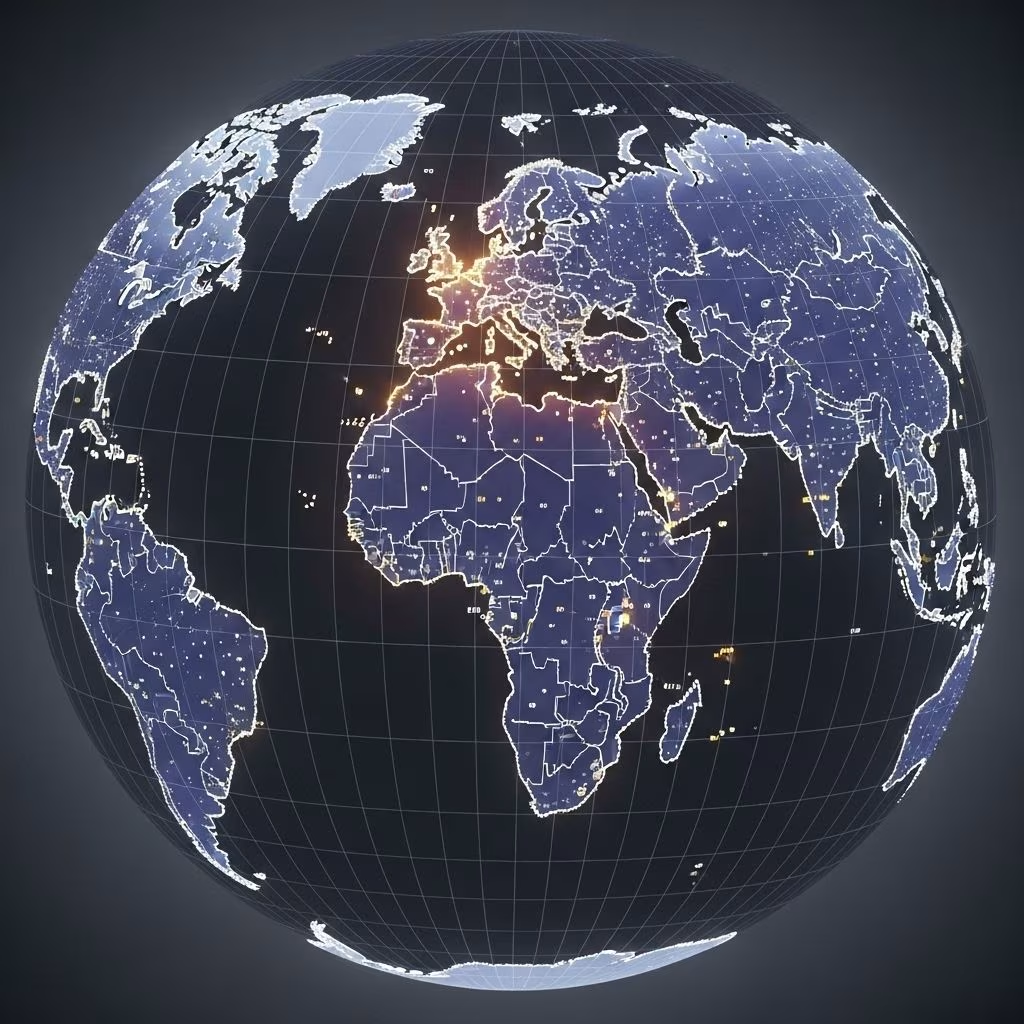
Most people expect time zones to follow tidy one-hour increments, but look closely at a world clock or global time zone map, and it quickly becomes clear that reality is far messier. From half-hour and even quarter-hour differences to political boundaries that ignore longitude, the world’s clock is shaped by history, economics, and the deliberate decisions of governments. This article explores why some countries don’t fit the one-hour mold, the unique cases behind those choices, and the surprising global stories behind the world’s temporal borders.
Understanding the Time Zone Concept
Time zones were created to standardize time, especially as global communication and transportation expanded. Ideally, each zone is set in one-hour increments based on a theoretical longitudinal grid, but human activity, geography, and history can warp their boundaries. The international time zone system divides the world into 24 basic zones, each roughly 15 degrees of longitude apart. Yet, many countries and regions use local variations, resulting in time zones that differ by 30, 45, or even 15 minutes instead of only full hours.
Key Points:
- The globe is divided into 24 main time zones, each one hour apart by longitude.
- Standard time zones often don’t match country borders or local sunlight patterns.
- Minute-based offsets (like 30 or 45 minutes) enable countries to adjust to local solar time and often reflect social or political choices.
The Origins of Non-Standard Time Zones
The decision to adopt a particular time zone, or to use a variation not aligned with the international grid, usually reflects a blend of factors:
- Geography: Wide or uniquely positioned countries need to synchronize time with solar noon to align daily rhythms to sunlight.
- Politics: National pride, economic relationships, and geopolitical statements often shape a country’s time zone.
- History: Colonial legacies, wars, and influential leaders can cement odd time boundaries long after their original reasons have faded.
According to time zone researchers, “geographic location is the primary factor, but a combination of economic ties, political alliances, and historical traditions can also play a significant role in choosing a time zone.”
Some of the World’s Strangest Time Zone Choices
India and Its 30-Minute Offset (UTC+5:30)
India is the most populated country in the world that uses a 30-minute offset: UTC+5:30. Rather than following a full-hour increment, India chose this system to better match the average solar time across its vast longitude. The eastern and western extremes of India see sunrise and sunset times that can differ by over an hour, so the compromise ensures neither side is excessively out of sync with local daylight. This approach also reinforces a national identity by using a single official time for the whole country, despite geographic challenges.
Nepal’s Unique 45-Minute Offset (UTC+5:45)
Just to the north, Nepal has perhaps the strangest officially recognized time zone on Earth: UTC+5:45. Nepal’s time is precisely 15 minutes ahead of India. This reflects both its particular longitude and a desire to stand apart from its populous neighbor. The choice “brought Nepal’s official time closer to the International System, while still retaining a uniquely Nepali identity,” reflects an effort to balance practical solar alignment with cultural and political individuality.
Other 30- and 45-Minute Offsets: Global Oddities
India and Nepal are far from alone. Consider these unusual time zones:
- Iran: UTC+3:30. Chosen for better solar alignment.
- Afghanistan: UTC+4:30. Split between the standard zones of UTC+4 and UTC+5 for the same reason.
- Myanmar (Burma): UTC+6:30. Its location between neighboring zones led to this offset.
- Venezuela (historically): Switched in 2007 to UTC−4:30, but reverted in 2016 to UTC−4, citing energy savings.
- Australia (Central West): Unofficial use of UTC+8:45 in a small region.
Minute-based offsets can also serve as a national branding tool, helping countries differentiate themselves or reflect complex identities.
Political Power and Time: Time Zones as a Tool
Time zone boundaries can be highly political. Sometimes, governments use time to reinforce unity, assert sovereignty, or signal separation from unwanted associations.
China: One Time, Five Geographical Zones
Geographically, China spans nearly five time zones. Nevertheless, since the late 1940s, the nation has observed a single official time, Beijing Time (UTC+8), across the entire country. In China’s far west, this means sunrise can happen as late as 10 a.m. in winter. The policy, designed to reinforce national unity and central control, occasionally leads to unusual local living patterns and even the use of unofficial time zones for regional coordination.
North Korea’s Brief Experiment With Pyongyang Time
In 2015, North Korea created a new time zone, Pyongyang Time (UTC+8:30), moving 30 minutes behind South Korea and Japan. According to state media, the move was intended to distance the nation from Japanese colonial rule, referring to the change as defying the “wicked Japanese imperialists.” This lasted until 2018, when Pyongyang Time was abolished to promote inter-Korean unity.
Spain’s Shift to Central European Time
In 1940, Spain shifted from its natural place in Western European Time (GMT/UTC+0) to Central European Time (UTC+1), following a directive from Francisco Franco to put Spain in the same time zone as Nazi Germany. Unlike other countries that later reverted, Spain never changed back. This results in a national schedule where meals and daily routines run much later than in neighboring Portugal or the UK.
How Time Zones Affect Local Life
Odd time offsets and unusual boundaries have genuine effects on people’s lives:
- Sunrise and sunset: Out-of-step clocks can shift daylight hours, influencing work, school, and social patterns.
- Business and trade: Minute offsets and mismatched time zones can complicate cross-border commerce and communication.
- National identity: Maintaining a unique time standard often becomes a form of asserting independence or unity.
For instance, India’s time system means sunrise in the eastern city of Kolkata can be more than an hour earlier than in western Jamnagar. In China’s far west, the sun rises so late that some regions use an unofficial “Xinjiang Time” for practical purposes, though it is not officially recognized.
The International Date Line: Time’s Zigzag Border
The International Date Line (IDL) provides a clear example of how time boundaries can bend for practical reasons. It is supposed to be a straight line roughly following the 180° longitude, but it zigs and zags to accommodate political and economic realities:
- Kiribati: In 1994, the Pacific island nation of Kiribati shifted the Date Line eastward to align all its islands in the same calendar day, making Kiribati the first country to enter the new millennium.
- Samoa: In 2011, Samoa skipped an entire day to move west of the Date Line, facilitating easier trade with Australia and New Zealand.
These changes were strategic, helping local economies and distinguishing countries on the world stage, and show how “time is as much about human relationships as seconds and minutes.”
Why Change Time Zones or Minute Offsets?
Governments modify time zones and minute offsets for several reasons:
- Economic integration: Greenland shifted from UTC−3 to UTC−2 to narrow the time zone gap between itself and Europe.
- Cultural solidarity: Samoa’s shift to align better with major trade partners.
- Political statements: North Korea’s brief adoption of Pyongyang Time.
- Practical solar timing: India, Nepal, and parts of Australia choosing minute-based offsets to suit daily schedules and geography.
Fascinating Examples of Minute-Based Time Zones
| Country/Region | UTC Offset | Rationale |
|---|---|---|
| India | +5:30 | Compromise for wide east-west distance, reinforces national unity |
| Nepal | +5:45 | Aligns to longitude, asserts independence from India |
| Afghanistan | +4:30 | Better fits geographical solar noon |
| Iran | +3:30 | Solar alignment choice |
| Myanmar (Burma) | +6:30 | Practical east-west compromise |
| Central West Australia (unofficial) | +8:45 | Local coordination in remote area |
| Venezuela (2007-2016) | -4:30 | Energy and daylight management |
Frequently Asked Questions (FAQs)
Why don’t all countries use full one-hour time zones?
Using full one-hour increments would make practical life difficult in some countries, especially those with wide east-west spans. Half-hour or even quarter-hour offsets provide a better fit for local solar time and daily routines, and sometimes reflect political identity.
How are time zones decided for a country?
Time zones are chosen based on a mix of longitude, national borders, historic precedent, political priorities, and economic ties. Political decisions can override geography, as seen in China and Spain.
What is the most unusual official time zone?
Nepal’s UTC+5:45 is often cited as the most unusual, being the only country with a 45-minute offset from Coordinated Universal Time.
Why did Spain stay on a wartime time zone?
Spain shifted to align with Nazi Germany in 1940 and never reverted, resulting in late sunsets and distinctive daily routines.
What does the International Date Line represent?
The International Date Line separates calendar days, but its path bends to accommodate political and economic realities, so some countries can organize themselves for trade or national identity.
Conclusion: Time Zones—A Blend of Science, Society, and Sovereignty
Minute-based offsets and unusual time zone boundaries capture how our global clock is shaped by far more than math. From colonial decisions to declarations of independence, from sunrise to sovereignty, the way a country sets its watches is a living record of its history, priorities, and identity. Even in an age of atomic timekeeping and digital calendars, the world’s clock remains gloriously, and revealingly, imperfect.
References
- https://www.timeanddate.com/time/time-zones-decided.html
- https://24timezones.com/world-time-zones
- https://www.youtube.com/watch?v=WivK_ccYaws
- https://www.citymonitor.ai/analysis/the-worlds-weirdest-time-zones/
- https://en.wikipedia.org/wiki/Time_zone
- https://remote.com/blog/global-expansion/whats-wrong-time-zones


