Woods vs. Forest: Understanding the Distinction
The terms woods and forest are often used interchangeably, yet their meanings and implications diverge in significant ways. The language we use to describe tree-dominated landscapes shapes not only our understanding but also how we value, manage, and conserve these vital ecosystems. This article unpacks their core differences, explores their ecological impact, and considers how our relationship with trees is reflected in our words and actions.
Defining Woods and Forests
Both woods and forests are areas dominated by trees, but there are key distinctions based on size, density, and ecological function.
Historical and Linguistic Origins
- Forest – Originates from the Latin forestis meaning “outside” (originally lands outside royal domains, later lands preserved for hunting by royalty in Norman Britain).
- Woods – Derives from Old English wudu, generally referring to smaller, local areas of trees.
Scientific and Modern Definitions
| Criteria | Forest | Woods/Woodland |
|---|---|---|
| Size | Large, often hundreds or thousands of acres | Smaller, usually less than a forest, variable size |
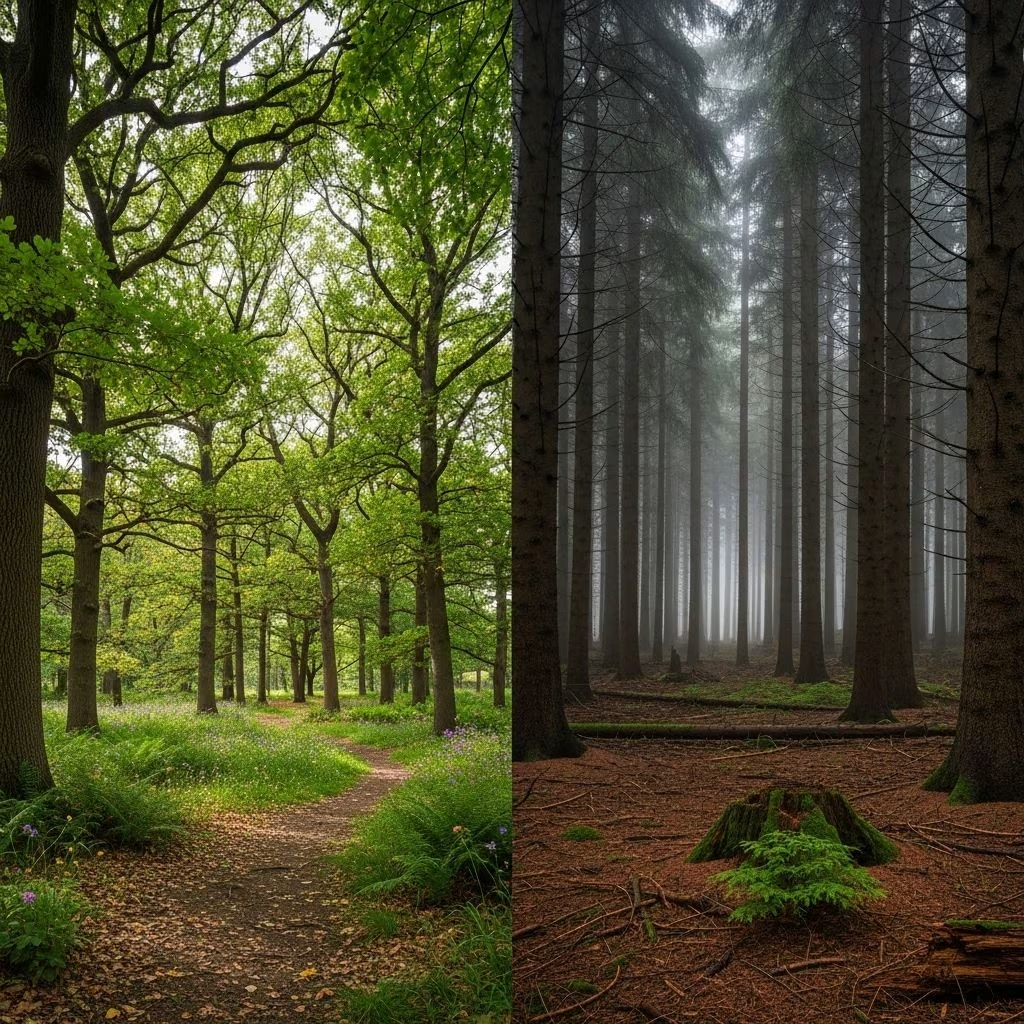
| Tree Density | Higher canopy cover (often >30%) | Lower canopy cover (5–30%); more open |
| Understory | Shade-tolerant plants, ferns, mosses | More sunlight, shrubby undergrowth, grasses |
| Ecological Function | Complex, functioning ecosystem; high biodiversity | Supports biodiversity, but not as robust as forests |
Key Takeaway: While both feature trees, forests are generally larger and denser, supporting more complex ecological communities than woods.
The Role of Canopy Cover and Scale
Modern classifications increasingly focus on canopy cover (the percentage of ground shaded by tree crowns when viewed from above) rather than just raw size:
- Forest: Canopy cover typically exceeds 30%. The United Nations Food and Agriculture Organization (FAO) defines a forest as an area larger than 1.24 acres with more than 10% canopy cover.
- Woods (or woodland): Canopy cover falls between 5% and 30%. The area may be comparable in size to a forest, but with a more open, park-like appearance.
Australian ecologists further separate the two: any tree-dominated land with less than 30% canopy cover is classified as woodland; anything denser counts as forest.
Ecological Importance: More Than Just Trees
It is tempting to assume that a stand of trees — however large or small — is ecologically equivalent. However, forests and woods differ dramatically in their ecological complexity and the roles they play in sustaining life.
The Functional Forest
- Supports Biodiversity: Forests provide habitat for myriad species, from large mammals and birds to fungi, insects, and microorganisms.
- Regulates Climate: Dense forests sequester vast amounts of carbon dioxide, producing oxygen and moderating local climates.
- Maintains Soil and Water: Forests stabilize soil, reduce erosion, purify water, and maintain watershed health.
- Promotes Resilience: The ecological interactions in forests (pollination, predation, decomposition) result in systems better able to recover from disturbances.
Value of Woods and Woodlands
- Edge Habitat: Woods often have more sunlight reaching the ground, supporting species that thrive at forest edges or in open woodlands.
- Human Access: Woods are often more accessible for recreation, foraging, and small-scale wood gathering.
- Ecological Corridors: Woodland areas can link larger forest tracts, ensuring wildlife movement and gene flow.
Trees Alone Don’t Make a Forest
Understanding the difference between a group of trees and a functional forest is vital for conservation policy and land management. A tree farm or plantation may have the same density of trees as a natural forest, but lacks the intricate web of species and interactions crucial for a healthy ecosystem.
For instance:
- Tree farms often feature single species, planted in rows, with little understory and limited wildlife value.
- Mature forests display complex vertical structure, deadwood, decomposing logs, regeneration gaps, and a rich mosaic of life.
- Effective conservation measures, such as REDD+ (Reducing Emissions from Deforestation and Degradation), must distinguish between real forests and mere tree cover.
Why Do the Differences Matter?
The distinction between woods and forests affects everything from scientific research and conservation funding to how we emotionally connect with the land. When policies track “tree cover” alone, they risk overlooking vital aspects of forest health — biodiversity, resilience, and ecosystem services — that are absent in monocultures or sparsely treed areas.
- Conservation Policy: Accurate classification ensures efforts are directed where they yield the greatest ecological return.
- Climate Change: Functional forests are far more effective at carbon sequestration and climate regulation than plantations or simple groves.
- Habitat Protection: True forests harbor endangered species and specialized communities that cannot thrive elsewhere.
How Our Language Reflects Our Relationship with Trees
The words we use for forests and woods mirror our cultural attitudes toward nature. Historically, vast forests symbolized the wild and unknown, inspiring awe and even fear. Woods, being closer and more familiar, were sites of gathering, community, and daily interaction.
Culturally significant trees and groves often receive names and become focal points for community narratives and conservation efforts, reflecting a human need to connect personally with nature. Many tree-lovers, sometimes affectionately called “tree huggers,” find deep meaning in favorite old trees, advocating for their preservation even when economic pressures promote logging.
Common Misconceptions: Forest, Woods, Jungle
A related confusion arises between woods, forests, and jungles:
- Woods: Typically smaller, less dense, often characterized by open undergrowth and lower tree canopy.
- Forest: Larger, denser, supporting closed canopies and richer undergrowth of shade-tolerant plants.
- Jungle: Not a scientific term — often denotes the dense, tangled vegetation (usually tropical forests) where the undergrowth is thick and difficult to traverse.
For example, New England’s fall foliage is seen in woods and forests, not jungles, as the term “jungle” typically applies only to tropical regions.
Living With and Among Trees: Personal Connections
Our affinity with trees is personal and often passionate. Some people develop lifelong attachments to particular trees, from towering oaks to ancient hemlocks. These monumental “forest monarchs” inspire reverence not just for their beauty, but for the history and ecological wisdom they embody.
Conserving large, old trees often transcends economics. The value of a majestic red oak standing for generations, shading a hillside and supporting wildlife, cannot be measured solely in timber dollars. As forest enthusiasts (and professional foresters) note, careful stewardship can allow these giants to enrich landscapes and lives for centuries. Even declining or dead trees (snags) are vital, providing habitat and contributing to forest regeneration through decomposition and nutrient cycling.
The Impact of Classification on Policy and Conservation
The way we define and classify woods and forests directly impacts land management and conservation policy:
- Carbon Accounting: Global policies like REDD+ risk confusion when tree cover alone is used as a proxy for intact forest. Only true, functioning forests provide maximum biodiversity and ecosystem services.
- Mapping & Monitoring: Modern satellite imagery can measure tree cover, but fails to capture the complexity beyond the canopy—species richness, age diversity, understory health, etc.
- Urban vs. Rural Trees: In cities, urban forests play a valuable role in mitigating heat, filtering air, and offering recreation. However, a cluster of street trees is not equivalent ecologically to a contiguous wild forest or even a well-connected woodland park.
Key Takeaways
- Forests are generally larger and denser than woods, with a more complex ecological structure.
- Woods provide important biodiversity and function, but their openness and scale set them apart.
- Effective conservation requires distinguishing true forests from plantations or simple tree cover.
- Our words and attitudes about woods and forests profoundly shape our approach to their care and preservation.
Frequently Asked Questions (FAQs)
Q: Can a woods become a forest?
A: Yes, over time and with natural succession (expansion of canopy, increased tree density, and minimal human disturbance), a wooded area may mature into a forest as its ecological complexity grows.
Q: Are woods less valuable than forests?
A: Not necessarily. While forests support greater biodiversity and carbon sequestration, woods offer essential habitat, recreational opportunities, and ecological connectivity between larger forest patches.
Q: What is the main difference between a tree plantation and a forest?
A: Plantations are typically monocultures of even-aged trees, aimed at production. Natural forests feature multiple layers, ages, species, and support far greater ecological function.
Q: Do definitions of woods and forests vary worldwide?
A: Yes. Canopy cover, area, and species composition are measured differently in different regions. The general distinction—forests are denser and more ecologically complex than woods—remains constant.
Q: How can individuals help protect woods and forests?
A: Support conservation groups, plant native trees, advocate for protecting large tracts of wild land, and engage in responsible recreation that respects living ecosystems.
References
- https://www.mentalfloss.com/article/604599/forests-vs-woods-vs-jungles-what-is-difference
- https://www.forestsociety.org/blog-post/forest-journal-tree-hugging-everyone-should-have-favorite-tree
- https://www.worldwildlife.org/magazine/articles/should-we-care-about-the-difference-between-the-forest-and-the-trees
- https://www.youtube.com/watch?v=iVgUASgRQcc
- https://www.parksproject.us/blogs/in-park/10-ways-to-be-a-tree-hugger
- https://survivalsherpa.wordpress.com/2014/08/04/why-being-a-tree-hugger-builds-self-reliance/
- https://nationalcenter.org/ncppr/2002/08/01/tree-huggers-or-fire-huggers-the-environmental-movements-confused-forest-policy-by-thomas-m-bonnicksen-ph-d/
- https://underthebanyan.blog/2010/09/05/a-challenge-to-anyone-who-ever-used-the-phrase-tree-hugger/