Push-Ups: The Muscles Worked, Expert Form, and Variations for Every Level
Push-ups are a foundational bodyweight exercise used worldwide to build strength, improve endurance, and support functional fitness goals. Whether youre new to exercise or an athlete trying to level up, understanding precisely how push-ups affect your body can help you train smarter. This comprehensive guide details the main muscles used, tips for perfect form, the top benefits, and push-up variations for every level.
What Muscles Do Push-Ups Work?
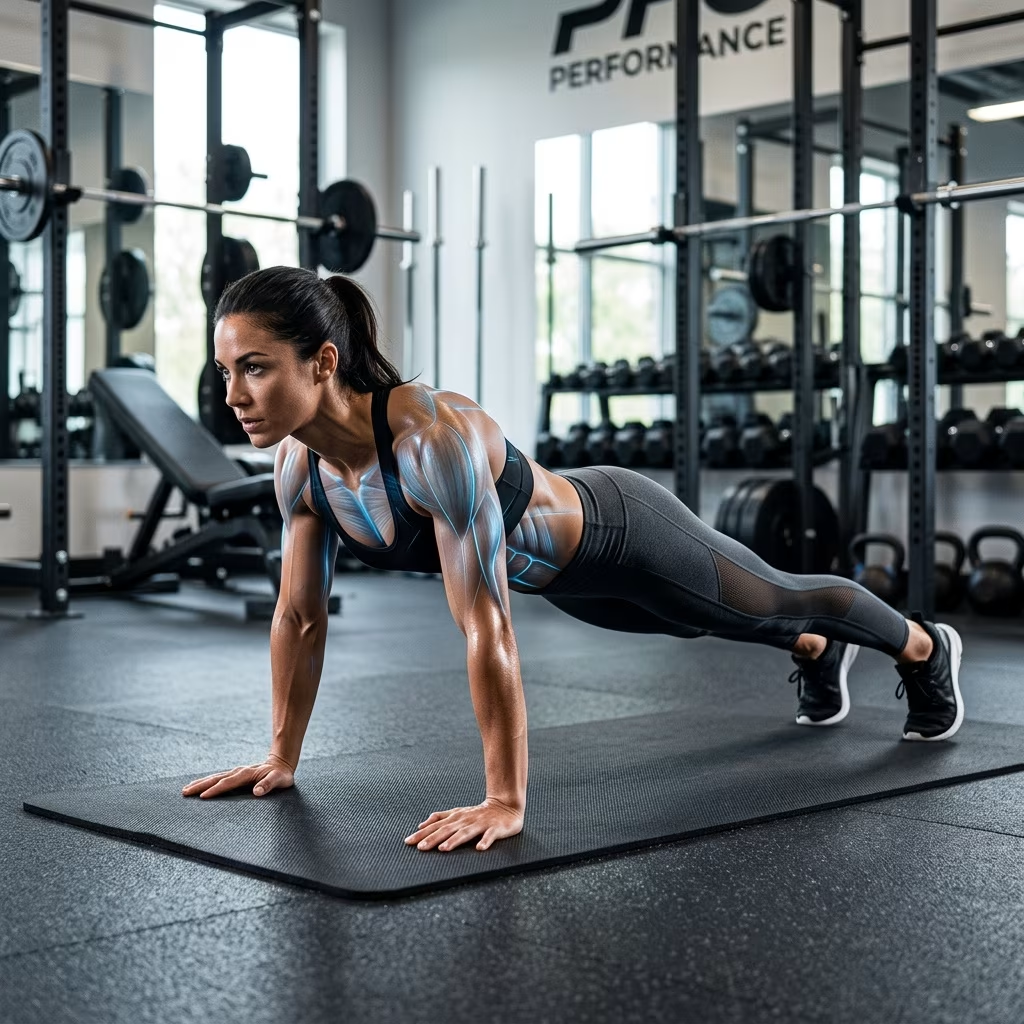
While often associated with the chest, push-ups are a compound exercise—meaning they activate several muscle groups at once. Here’s what’s working hard during a standard push-up:
| Muscle Group | Role in Push-Ups |
|---|---|
| Pectoralis Major (chest) | The prime mover, responsible for moving your upper arms as you press up and control the descent. |
| Pectoralis Minor (chest, under pectoralis major) | Stabilizes your shoulder blades, ensuring proper shoulder and upper back posture. |
| Anterior Deltoids (front of shoulders) | Assist in pushing your arms forward and stabilizing the shoulder joint. |
| Triceps Brachii (back of upper arms) | Responsible for extending your elbows as you straighten your arms. |
| Core Muscles (rectus abdominis, obliques, transverse abdominis) | Keep your midsection stable and prevent your back from sagging during the movement. |
| Serratus Anterior (muscles beside the ribcage) | Helps move the shoulder blades and maintain scapular stability. |
| Latissimus Dorsi (sides of the back) | Aids with shoulder movement and upper body stability. |
| Gluteal Muscles (buttocks) | Engage to maintain a straight line from head to heels during the push-up. |
| Quadriceps (front of thighs) | Activated to keep the legs rigid and stable. |
| Erector Spinae (lower back) | Contributes to maintaining spinal alignment and core stability. |
With so many muscles involved, push-ups provide a full-body challenge—making them a time-efficient and highly functional movement.
Key Benefits of Push-Ups
Push-ups are more than just an upper-body toner. Here are the science-backed advantages of practicing them regularly:
- Build Upper-Body Strength. Push-ups primarily strengthen the chest, shoulders, and triceps, which translates to easier daily tasks and better performance in sports.
- Enhance Core Stability. By requiring you to maintain a plank position, push-ups train all core muscles, supporting better posture and reducing the risk of lower back issues.
- Promote Heart Health. Muscle-strengthening routines (including push-ups) have been linked to a reduced risk of cardiac events.
- Improve Body Composition. Push-ups build lean muscle, increasing metabolism and boosting physical appearance.
- Enhance Bone Health. Weight-bearing moves help stimulate bone density and joint resilience.
- Support Shoulder Function. Activation of the shoulder stabilizers can help prevent and rehabilitate shoulder injuries.
- Accessible & Adaptable. No equipment is needed; push-ups can be performed almost anywhere and modified to suit all fitness levels.
- Boost Mental Focus & Discipline. Regularly challenging yourself with push-ups enhances body awareness, mental fortitude, and discipline.
How to Do a Push-Up with Perfect Form
Mastering your form is crucial to activating the right muscles, maximizing benefits, and reducing injury risk. Here’s a step-by-step guide:
- Start in a high plank position. Place your hands slightly wider than shoulder-width apart, fingers splayed and gripping the floor. Feet are together or slightly apart; your body should form a straight line from head to heels.
- Brace your core. Imagine pulling your belly button to your spine. Engage your glutes and quads to help maintain a flat, rigid back.
- Lower with control. Keeping elbows at about a 45-degree angle to your body, bend your arms and lower your chest toward the floor. Stop once your upper arms are in line with your back, chest hovering just above the ground.
- Press up strongly. Exhale as you push through your palms, straightening your arms and returning to the starting plank. Focus on moving your body as a single unit—avoid letting your hips sag or pike upward.
- Repeat. Perform as many quality reps as your fitness allows, aiming for good technique over quantity.
Push-Up Positioning Tips
- Keep a neutral neck by looking down, not forward or up.
- Don’t lock out your elbows at the top or flare them wide at the sides.
- Keep your body in one straight line—avoid letting your butt lift or back arch.
Push-Up Variations for Every Level
The basic push-up is an excellent foundation, but modifying the exercise can make it accessible for beginners or challenge advanced practitioners. Consider these popular variations:
| Variation | How to Do It | Who it’s For | Challenge |
|---|---|---|---|
| Knee Push-Ups | From a plank, lower knees to the ground. Perform push-ups as usual from this modified position. | Beginners, those building strength | Reduces body weight load and difficulty |
| Incline Push-Ups | Place hands on an elevated surface (bench, table); keep body straight and perform regular push-ups. | Beginners, those easing into push-ups | Uses gravity to make exercise easier |
| Standard Push-Ups | Traditional version on toes and hands, body plank-straight. | Most exercisers | Full challenge, classic movement |
| Decline Push-Ups | Place feet on an elevated surface (bench, step), hands on the floor. Perform push-ups as usual. | Intermediate to advanced | Increases load on the shoulders and upper chest |
| Diamond Push-Ups | Put hands close together under your chest with thumbs and index fingers forming a diamond. Perform push-ups, targeting triceps more intensely. | Advanced lifters | Greater triceps and inner chest activation |
| Plyometric (Clap) Push-Ups | From standard push-up, explode up with enough power that hands leave the ground (option to clap in midair), land softly and continue. | Advanced, power trainers | Adds explosive power and cardio |
| One-Arm Push-Ups | Perform push-up on only one arm; feet wider for balance. | Elite strength | Maximal challenge to strength and stability |
How to Choose Your Push-Up Variation
- Start with easier variations (knee or incline) if you’re building strength or returning from injury.
- Progress to harder versions (decline, diamond, plyometric) to push muscle development.
- Mix variants to avoid plateaus and target different muscle groups dynamically.
Common Push-Up Mistakes to Avoid
Correcting your push-up technique not only reduces injury risk but ensures you target the right muscles. Watch out for these frequent errors:
- Letting your hips sag. Indicates a weak core or improper bracing, stressing the lower back.
- Piking your butt upward. Prevents full activation of core and upper body muscles; strive for a straight line.
- Flared elbows. Keep elbows closer to your sides (not directly out at 90 degrees) to protect shoulder joints.
- Incomplete range of motion. Lower until the chest nearly touches the ground to work muscles completely.
- Improper hand position. Hands too far forward or behind shoulder line can stress wrists or reduce muscle engagement.
- Using momentum. Fast, uncontrolled reps reduce effectiveness—aim for slow, steady movement.
Frequently Asked Questions (FAQs)
Q: How often should I do push-ups?
A: Most trainers recommend 2–3 times per week for best results, allowing rest days for muscle recovery.
Q: Can push-ups help build muscle mass?
A: Yes, especially if you push close to muscle fatigue with good form and progress to challenging variations.
Q: Are push-ups enough for a full upper-body workout?
A: Push-ups target many upper body muscles but are best paired with pulling exercises (like rows or pull-ups) for a well-rounded routine.
Q: How can I modify push-ups for sore wrists?
A: Try doing push-ups on dumbbells, push-up bars, or fists to keep wrists in a neutral position, or perform incline push-ups for reduced pressure.
Q: Why do I feel push-ups in my lower back?
A: Sagging hips or arching the back often indicate core weakness. Focus on bracing your abs and glutes throughout every rep; consider building core strength separately if pain persists.
Final Thoughts
Push-ups are one of the most effective, accessible, and versatile exercises for building functional strength and muscle definition. By understanding their mechanics, benefits, and variations, anyone can make push-ups a safe and powerful part of their fitness journey. Always prioritize technique and listen to your body—if you maintain consistency, you’ll see progress in both strength and confidence.
References
- https://www.goodrx.com/well-being/movement-exercise/benefits-of-push-ups
- https://www.healthline.com/health/fitness-exercise/muscles-worked-push-ups
- https://pmc.ncbi.nlm.nih.gov/articles/PMC4616144/
- https://www.prevention.com/fitness/a20494914/5-moves-to-help-you-master-a-push-up-in-8-weeks/
- https://www.prevention.com/fitness/a63238499/strength-training-adds-years-to-your-life-study/
- https://www.prevention.com/fitness/fitness-tips/a61161933/building-muscle-after-50/
- https://learn.athleanx.com/articles/pushups-are-killing-your-gains