Five Enduring Lessons from Allan Benton, Country Ham King
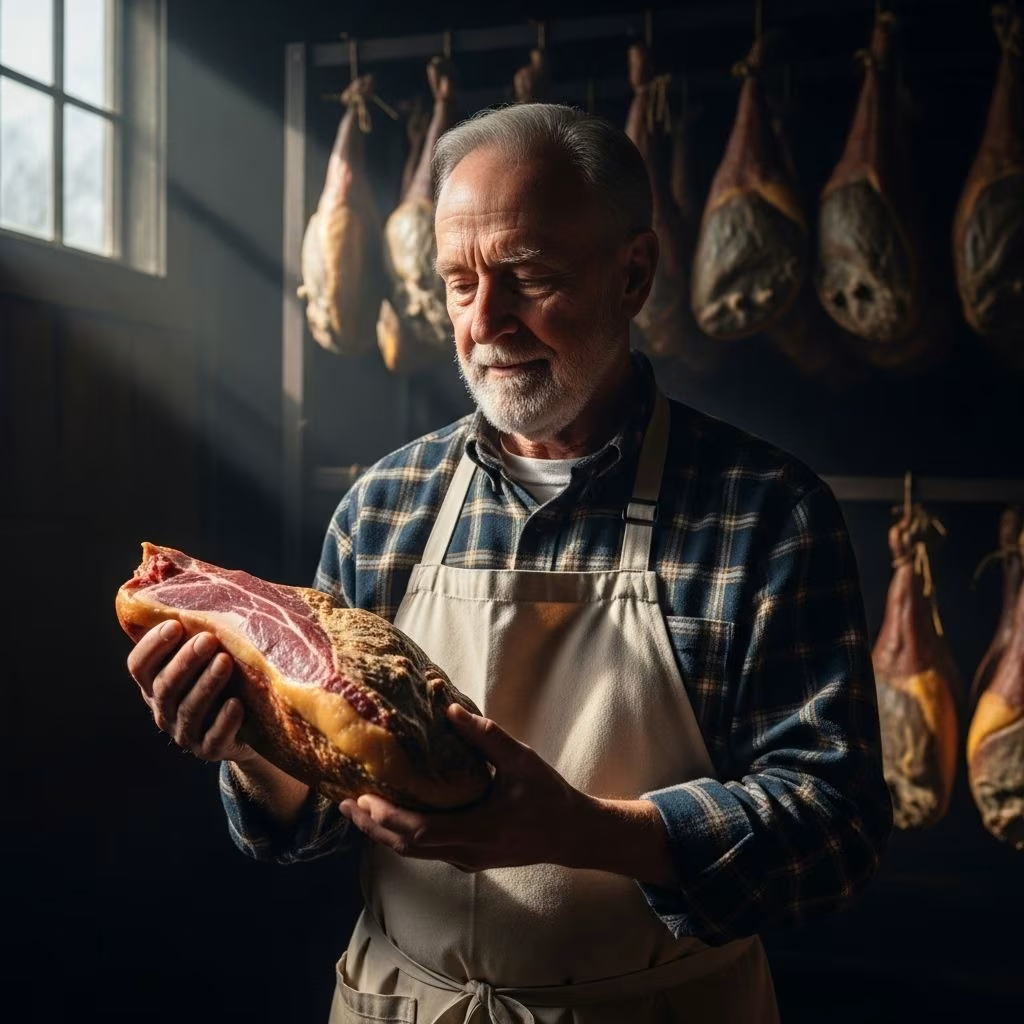
Allan Benton stands as a humble titan in the world of American cured meats, especially country ham and smoky bacon. From his smokehouse in Madisonville, Tennessee, Benton transformed a simple operation into a legendary name recognized by chefs and food lovers worldwide. His story is a compelling testament to the virtues of patience, tradition, and integrity — qualities that underpin every slice of his cured meats. The following five lessons drawn from Benton’s journey resonate far beyond the boundaries of his Appalachian smokehouse, offering timeless guidance for artisans, entrepreneurs, and anyone drawn to the pursuit of excellence.
1. The Value of Doing Things the Hard Way
At the heart of Benton’s operation is an unwavering respect for tradition. Benton’s approach – slow, deliberate, and deeply rooted in Appalachian heritage – stands in sharp contrast to today’s rapidly mechanized food landscape. For Benton, there are no shortcuts:
- Hams are dry-cured with salt, brown sugar, and pepper, eschewing industrial additives or brines entirely.
- The meats are aged in naturally fluctuating conditions for 14 to 24 months, sometimes up to 36 in rare cases, allowing flavors to develop with exceptional complexity.
- Appalachian hickory smoke finishes the process, imparting a deep, robust flavor unattainable by artificial means.
“It’s a hillbilly operation, meant as sustenance for poor Appalachian hillbillies,” Benton says with trademark modesty. This humility masks a deliberate choice: to resist efficiency when it comes at the expense of flavor and authenticity. “There are no processed ingredients in their ham or bacon—just a simple cure of salt, brown sugar, and pepper. The meats are then aged in carefully controlled environments, mimicking the natural cycles of seasons and temperatures that Appalachians have relied on for generations, long before refrigeration.”
Benton’s lesson: Endurance and patience may not yield the highest quantity, but they almost always yield the highest quality.
2. Let the Ingredients and Environment Speak
One could argue that most of the work in Benton’s hams is done by nature itself. Drawing inspiration from European traditions, Benton’s aging rooms are not sterile laboratories. Instead:
- Time, temperature, local humidity, and even the microflora unique to Madisonville play crucial roles in flavor development.
- Just like “aged cheeses, these hams are acquiring mold strains specific to this spot in Tennessee,” explains Darrell Benton, Allan’s son and now his business partner.
- Pasture-raised pork is chosen with an eye toward fat quality and flavor – every detail matters.
This process cannot be rushed or replicated by automation; it is inherently, proudly place-based.
Benton’s lesson: Let your ingredients and environment shine. Allow what is special about your place and process to take center stage.
3. Mastery Is a Lifelong Process
After more than five decades, Allan Benton remains a dedicated student of his craft. “Even after five decades, I’m still learning, and there are surprises,” he admits. Benton’s curiosity is undiminished by years, awards, or fame — instead, it deepens his commitment to improvement:
- He continues to experiment with aging times, smoke intensity, and subtle tweaks to curing mixtures.
- Benton never hesitates to credit his mentors and acknowledge the influence of European pâtés, prosciutti, and country-style hams on his work.
- The operation is a living laboratory, where each batch is tasted, evaluated, and refined.
This humility and willingness to learn have contributed to the enduring excellence of Benton’s products — and his reputation for integrity.
Benton’s lesson: Expertise is not a destination but a journey; remain open to learning, and never let success dull your curiosity.
4. Cherish the Community and Tradition
Benton emphasizes the broader purpose behind his work. The smokehouse is not only a business but also a pillar of Appalachian community life:
- He prioritizes customer service and community hospitality — every visitor is greeted with a warm smile, a welcoming handshake, and sometimes even a sample of bacon.
- Benton’s generosity extends to those in need, offering extra food not as charity but as a neighborly gesture.
- The legacy is maintained by family: After a long and successful medical career, Darrell Benton returned home, joining his father to nurture the business and uphold its traditions.
“For the first few decades, Dad struggled to keep the lights on,” recalls Darrell. “I remember sitting on an old church pew out front praying someone would come and buy a ham.”
This loyalty to tradition and loyalty to people go hand in hand — sustaining both the craft and the community.
Benton’s lesson: Honor your roots, foster connections, and use your work to strengthen the fabric of your community.
5. Integrity and Attention to Detail Set You Apart
While the meat is what draws food lovers from far and wide, it’s Benton’s unswerving integrity and attention to detail that sustain his legend. As demand has grown and challenges have arisen — from scaling production to managing a larger team — Benton has refused to compromise:
- Quality always takes precedence over quantity; automation is adopted only when it does not threaten the artisan touch.
- Each employee is trained in Benton’s careful, hands-on methods — every ham handled as a labor of love, not a commodity.
- Curing and aging space has grown, but the standards remain unchanged: slow, deliberate, and hands-on.
“Each piece of bacon and ham requires the expertise and dedication of skilled hands, and that’s something no machine can replicate.”
In a landscape dominated by mass production, Benton’s approach is a powerful reminder of the value of craftsmanship and unwavering standards.
Benton’s lesson: Integrity is the foundation of a lasting reputation; let your attention to detail define your work.
The Journey: From Humble Beginnings to Legendary Status
Benton’s story is as much about perseverance as it is about food. Initially, the business was a modest operation — just a young man with Appalachian roots and ambitions to do something meaningful. Rising from a family of self-sufficient farmers where “bragging rights” existed over who made the best ham, Benton took local traditions and elevated them:
- Started in 1973, leasing a smokehouse from a retired dairy farmer in Tennessee.
- At first, sales were so sparse that Darrell, as a child, would pray for a single customer.
- Over time, praise arrived not just from the mountains but from chefs at celebrated restaurants like Blackberry Farm, who became fervent supporters.
- Benton’s hams have now appeared on menus from the South’s finest restaurants to international food festivals.
Yet, despite this acclaim, the soul of Benton’s has never shifted. “I call it country ham, but I’m lying through my teeth. It’s just a curing process they’ve been doing for a thousand years in Europe. The way I see it, just because they live in Parma, or in Germany, or anywhere else, doesn’t mean that they can produce a better ham than a bunch of farm boys from Tennessee can.”
Comparing Benton’s Methods with Commercial Producers
| Aspect | Benton’s Country Ham | Commercial Producers |
|---|---|---|
| Ingredients | Salt, brown sugar, pepper only | Curing salts, brines, additives |
| Aging Process | 14-36 months, slow, natural | 8-12 months, often accelerated by technology |
| Smoking | Appalachian hickory, natural wood only | Standardized or liquid smoke; less flavor depth |
| Scale | 18,000 hams annually, artisan scale | Mass production, automated |
| Quality Control | Manual inspection, craftsmanship | Automated systems and batch testing |
Frequently Asked Questions (FAQs)
Q: Why does Benton’s country ham take so long to make?
A: The lengthy aging (14 to 24, sometimes up to 36 months) allows the flavors to deepen and mellow naturally, resulting in a nuanced, complex taste unattainable with rapid-curing methods.
Q: What makes Benton’s products different from other country hams or bacons?
A: Benton uses only salt, sugar, pepper, and hickory smoke with no artificial additives. Every piece is hand-crafted, aged for flavor, and deeply influenced by the unique environment of his Appalachian smokehouse.
Q: Is the operation still family run?
A: Yes. After pursuing a successful medical career, Allan’s son Darrell returned to co-run the business with his father, ensuring that its traditions and standards are upheld for a new generation.
Q: Can I visit and buy directly from the smokehouse?
A: Yes, visitors are welcomed warmly in Madisonville, Tennessee, where the Bentons often share samples and stories along with their legendary hams.
Conclusion: Benton’s Lessons for All
The story and methods of Allan Benton transcend the boundaries of regional cuisine. They teach us to value patience, embrace tradition, and honor both our communities and our crafts. In today’s fast-paced world, Benton’s legendary hams are a savory reminder that doing things the hard way, with care and respect, is often the best way—no matter your calling.