How to Properly Display the American Flag: Etiquette and Traditions
The American flag stands as a powerful symbol of the nation’s ideals, freedoms, and history. Whether displayed on patriotic holidays, flown daily, or featured in special ceremonies, observing traditional flag etiquette honors the sacrifices and spirit the flag represents. This comprehensive guide details the essential rules for displaying the flag respectfully, covering display times, settings, methods of hanging, and important dos and don’ts.
Why Display the American Flag?
Displaying the American flag is a visible expression of patriotism, solidarity, and respect for the country’s values. It can commemorate national holidays, honor service members, signify national pride during moments of celebration or mourning, and express unity in communities and homes. Flying the flag provides an opportunity to partake in longstanding traditions that unite Americans across generations.
When to Display the Flag
While the flag may be flown year-round, certain occasions make its display especially significant. According to the U.S. Flag Code:
- Display from sunrise to sunset on stationary flagstaffs in the open.
- It may be illuminated and displayed 24 hours a day if proper lighting is provided at night.
- Only fly it in good weather, unless it is an all-weather flag.
- Raise the flag briskly in the morning and lower it ceremoniously in the evening.
- The flag should be flown on all days, but it is especially encouraged on:
- New Year’s Day (January 1)
- Inauguration Day (January 20)
- Martin Luther King, Jr. Day (third Monday in January)
- Lincoln’s and Washington’s Birthdays (February 12; third Monday in February)
- Memorial Day (last Monday in May, half-staff until noon)
- Flag Day (June 14)
- Independence Day (July 4)
- Labor Day, Veterans Day, Thanksgiving, and Christmas.
Presidential proclamations and state holidays may also call for flag display.
Flag Display Rules: General Guidelines
Observing correct flag etiquette underscores respect. The following rules apply to most display scenarios:
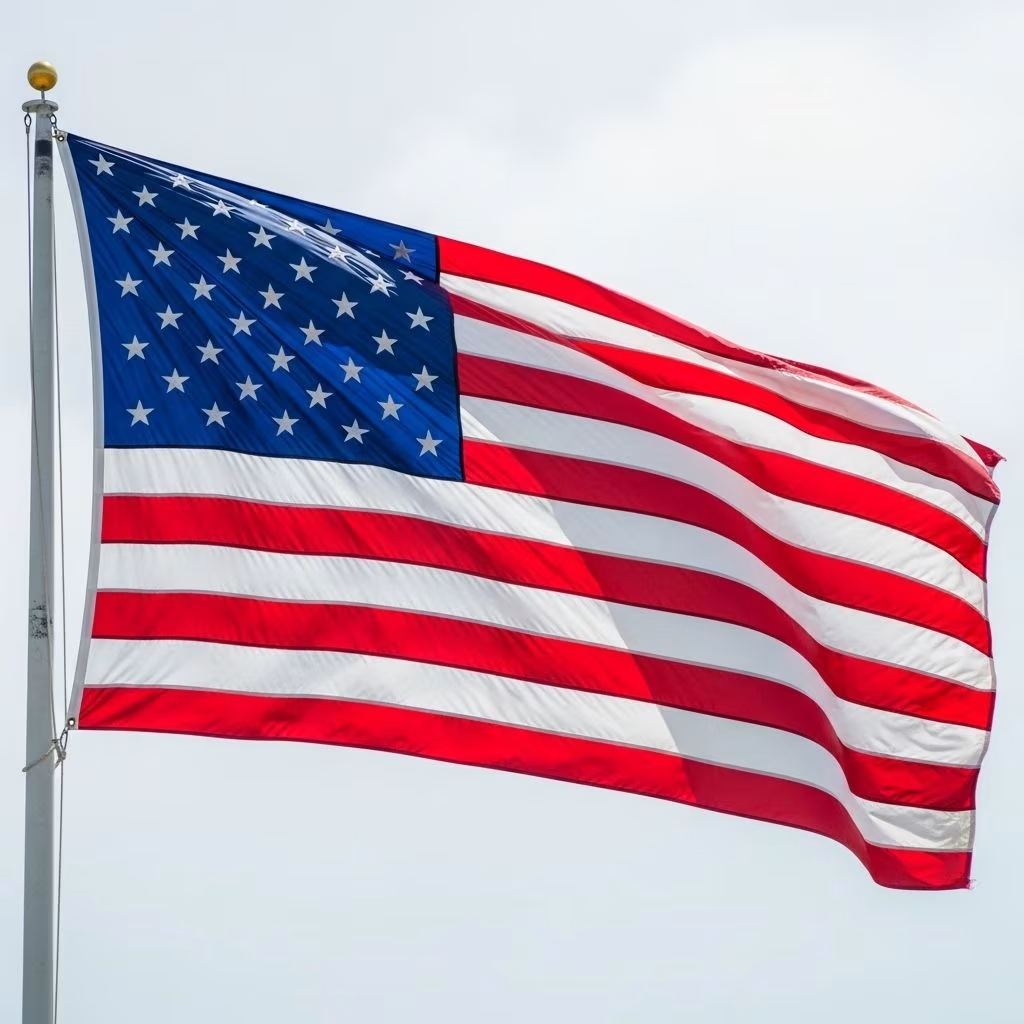
- The Union (the blue field of stars) is always the point of honor.
- If hung horizontally or vertically on a wall, the union should be at the flag’s right (the observer’s left).
- Displayed in a window, the union should face left of the observer on the street.
- Never use the flag as drapery, covering, or decoration – use bunting in red, white, and blue instead.
- The flag should never touch the ground, floor, or water.
- When carried with other flags, the American flag should be in front and center, or on the marching right.
- On a staff with another flag (such as a state or pennant), the U.S. flag is raised first, lowered last, and always above or at the center of the group.
Displaying the Flag Outdoors
Outdoor display calls for attention to mounting, location, and orientation. Common scenarios include flagpoles, buildings, porches, and vehicles.
Flagpole or Staff
- Position the flag on its own right (left to the observer). If displayed with another flag against a wall with crossed staffs, the U.S. flag’s staff is in front and at the observer’s left.
- On community or institutional flagpoles with other flags present, the U.S. flag is always centered and highest. No other flag may be placed above or, in peacetime, to its right.
- When flown with flags of other nations (in peacetime), flags should be the same size and at the same height, each on a separate staff.
Building-Mounted Flags
- When mounted from a window sill, balcony, or angled staff: The union should be at the peak unless the flag is at half-staff.
- Flat display on a wall (indoors or outdoors): The union is at the observer’s upper left (flag’s own right).
- From a window: Display so that the union is to the left of an observer outside looking in.
- Suspended across a street (vertical):
- In an east-west street: Union to the north.
- In a north-south street: Union to the east.
Weather and Illumination
- Never fly the flag in inclement weather unless it is an all-weather flag.
- At night, flag must be properly illuminated to be displayed overnight.
Displaying the Flag Indoors
Indoor use of the flag is common in schools, meeting halls, homes, and places of worship. Each setting calls for observance of position and prominence:
- Display flat on a wall: Union should be uppermost and to the flag’s own right (observer’s left).
- In auditoriums or houses of worship: Place on a staff to the speaker’s right as they face the audience.
- Any other flag present goes to the speaker’s left/audience’s right.
- When displayed on a platform, the flag may be flat, above, and behind the speaker.
- For window displays: The union should always be to the left of the observer from the street.
In Public Facilities
- The flag should be flown on or near the administration building of every public institution daily.
- Displayed in or near every polling place on election days.
- In or near every schoolhouse during school days.
Special Cases: Vehicles, Uniforms, Coffins, and Parades
Vehicles
- Attach the staff firmly to the chassis or clamp it to the right fender when displayed on vehicles, including cars and floats.
- Display is reserved for official vehicles transporting high-ranking officials, such as the president or government representatives.
Coffins
- The flag used in military funerals or to honor public service drapes the casket so the union is at the head and over the left shoulder.
- The flag must not touch the ground and should never be lowered into the grave or allowed to be used as a covering for anything other than the casket.
Uniforms and Patches
- Only members of the armed services, police, firefighters, and patriotic organizations may wear flag patches on their uniforms.
- The patch is typically worn on the right sleeve so that the union is towards the front, symbolizing forward movement.
Parades and Processions
- The flag bearer marches to the right of other flags or in front when alone or with a line of flags.
- No other flag should be carried higher than the American flag.
Showing Respect: Handling and Maintenance
- Hoist briskly and lower ceremoniously: Showing due reverence and precision.
- Never allow the flag to touch the ground or any items beneath it.
- Keep the flag clean and in good repair. Replace it if it becomes faded, frayed, or soiled.
- Disposal: When a flag is no longer fit for display, it must be disposed of in a dignified manner, typically by burning in a ceremony conducted by organizations such as the American Legion or Veterans of Foreign Wars.
What Not To Do: Prohibited Uses and Mistakes
- Never use the flag for advertising purposes.
- The flag must not be used as clothing, bedding, or drapery.
- Do not draw, mark, or place symbols or signs on the flag.
- Do not fasten, display, use, or store the flag in a manner that allows it to be easily torn or damaged.
- Never use the flag to carry, hold, or deliver anything.
- The flag is not to be used as part of a costume or athletic uniform, except for a flag patch for military personnel, first responders, or members of patriotic organizations.
Flag Display Quick Reference Table
| Scenario | Union Position | Notes |
|---|---|---|
| Hanging vertically on a wall | Upper left (observer’s view) | Blue field uppermost, observer’s left |
| In a window | Left of outside observer | Union faces left to street viewers |
| Suspended over street (east-west) | Union to north | Respect orientation based on direction |
| Staff on a building | At staff’s peak | Except at half-staff |
| With other nation’s flag | Separate staffs, same height | No one flag above another |
Frequently Asked Questions (FAQs)
Q: Can I fly the American flag year-round?
A: Yes, you can display the flag every day, weather permitting. For night display, ensure it is properly illuminated.
Q: What is the “union” of the flag and why is its position important?
A: The union is the blue field with white stars representing the 50 states. Flag code requires it to be in the position of honor (upper left from observer’s point of view) whenever displayed.
Q: What do I do with an old, worn flag?
A: Flags unfit for display should be retired in a dignified manner, usually by ceremonial burning conducted by patriotic organizations.
Q: Can the flag ever touch the ground?
A: The flag should never touch anything beneath it, including the ground, floor, or water, as an act of respect.
Q: Is it disrespectful to display the flag in inclement weather?
A: Only all-weather flags may be flown in bad weather; otherwise, bring the flag inside during storms.
Q: Can I hang the American flag on my car?
A: Yes, as long as the flag is mounted firmly on the right fender or chassis. Only used for official representations and not for daily decor.
Q: Are there rules about flag decoration on clothing or items?
A: The actual flag should never be used for wearing or decoration. Flag patterns or motifs are permitted, but not the flag itself as attire.
References
- https://www.youtube.com/watch?v=dX2e4cdM_Eg
- https://www.legion.org/advocacy/flag-advocacy/flag-code
- https://emilypost.com/advice/american-flag-etiquette-es-copy
- https://www.vfw.org/community/flag-etiquette
- https://amigraphics.com/blog/how-to-properly-display-the-american-flag
- https://www.uslawshield.com/fourth-july-properly-display-american-flag/
- https://www.flagstoreusa.com/resources/patriotic-etiquette/us-flag-display-guidelines/
- https://www.courier-journal.com/story/news/2024/07/02/july-4th-decorations-likely-violate-us-flag-code-rules/74277297007/