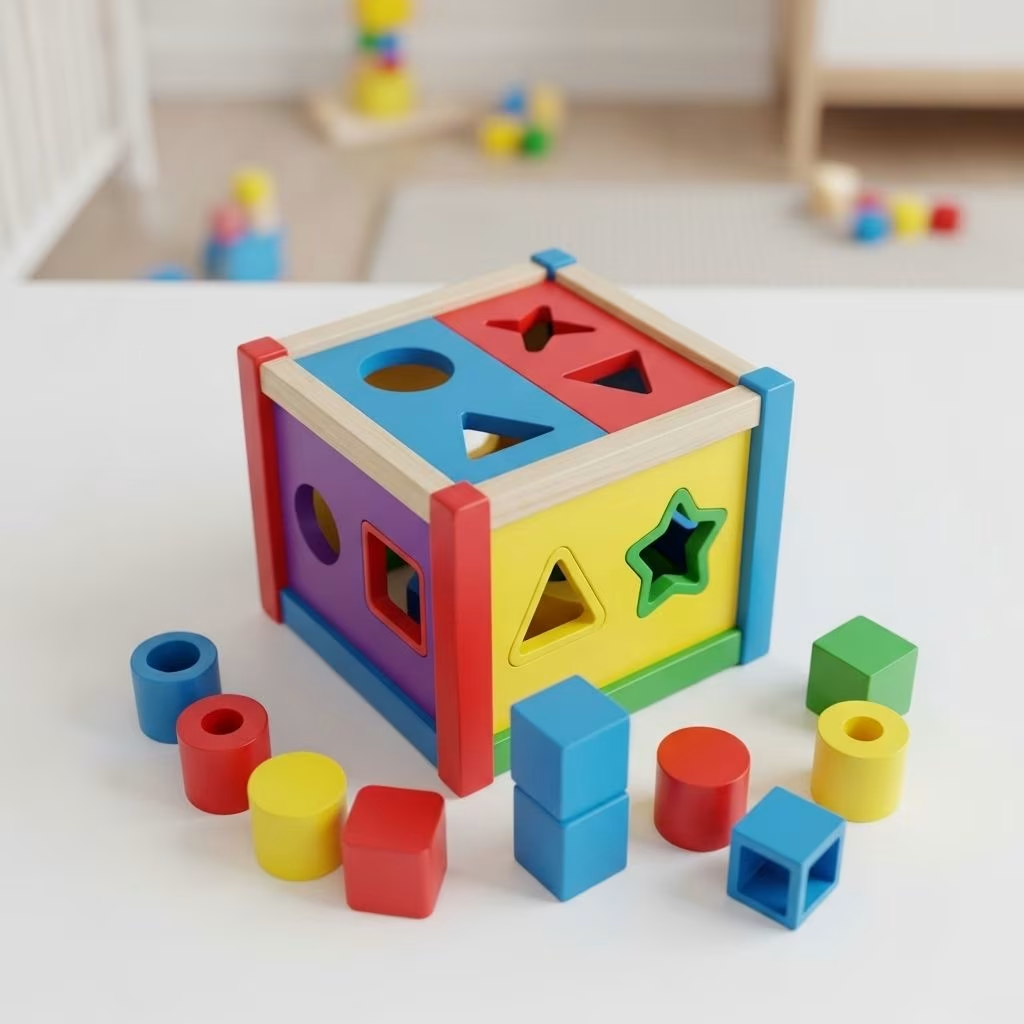
Shape sorter toys are a signature of childhood—simple, colorful, and often the first real puzzle a child encounters. But these classic playthings have a remarkable secret: they’re as much a test for adults as for toddlers, and they can teach us about the foundations of learning, problem-solving, and even humility.
Why Is the Shape Sorter So Tricky?
At first glance, a shape sorter looks straightforward: match the shape to the corresponding hole, drop it in, and repeat. But when a shape-matching puzzle recently went viral with adults debating the correct answer, it exposed how even simple tasks can get surprisingly complex as we grow up.
- Adults overthink it: We process more information, factor in symmetry, and sometimes forget that shape sorters are made for direct, basic matching—not abstract reasoning that comes with age and experience.
- Kids follow visual cues: For toddlers, it’s about trial and error, direct matching, and immediate feedback. Their brains are wired for pattern recognition and hands-on experimentation.
- Variation in answers: Adults may see multiple possibilities (rotation, fitting, color), but the actual mechanism accepts only the “correct” simple match set by the toy’s design.
So, what’s the correct answer on a shape sorter? The only block that will fit through the triangular hole is the triangle—no matter how one turns or rethinks it!
Learning, Not Just Matching
Shape sorters deliver much more than entertainment. They’re fundamental tools for cognitive development, teaching kids how to recognize, compare, and analyze shapes. Here’s what happens when a child plays:
- Visual Discrimination: Kids learn to spot differences in shapes and sizes, a skill foundational for later reading and math.
- Motor Skills: Picking up and manipulating shapes to fit builds fine motor coordination and hand-eye development.
- Problem Solving: Each attempt—successful or not—teaches persistence, prediction, and a form of scientific reasoning.
It’s not about memorizing shapes, but understanding their attributes: What makes a triangle a triangle? How does it differ from a square or circle? This encourages children to express why a shape fits, which is the basis of deeper learning.
The Psychology Behind the Puzzle
What separates adult and child approaches to the same puzzle?
| Children | Adults |
|---|---|
| Act through trial & error | Analyze, hypothesize multiple answers |
| Rely on immediate feedback | Consider rotation or over-engineer solutions |
| Focus on what fits, not why | Focus on logic, pattern, or tricks |
| Succeed through tactile learning | May be hindered by overthinking |
This split explains why adults, faced with a simple shape sorter, may second-guess the correct answer even as a toddler plows ahead confidently.
The Real Benefits of Playing with Shape Sorters
Experts highlight a range of cognitive and motor skill benefits that shape sorter toys provide:
- Visual Discrimination: Distinguishing between circles, triangles, squares, and other shapes lays the groundwork for reading letters and numbers as children get older.
- Visual-Motor Integration: Coordinating vision with hand movements—vital for writing, sports, and daily activities.
- Fine Motor Skills: Precise manipulation of small objects strengthens the hand muscles and control needed for future pencil grip and other tasks.
- Spatial Awareness: Understanding how shapes relate to each other in space paves the way for geometry and map skills.
- Logical Reasoning: Kids learn that not every attempt works, fostering patience, experimentation, and logical deduction.
Beyond Memorization: Deep Learning with Shapes
True mastery of shapes comes not from simply memorizing names but from learning to describe and understand their properties.
- Recognizing shapes in the wider environment: Noticing that a clock is a circle or a bookshelf ends in a rectangle links abstract learning to real-world context.
- Describing attributes: Knowing a square has four equal sides and four right angles, while a triangle has three sides and three vertices.
- Explaining reasoning: Being able to answer questions like, “Why does this shape fit here?” leads to greater critical thinking.
When children grasp not just what a triangle is but why it has its form, their understanding deepens considerably.
Setting Up a Shape Sorting Activity at Home
You don’t need high-tech toys to spark a child’s curiosity and learning. A simple shape sorting activity can be set up with everyday objects:
- Painters tape: Create outlines of different shapes on the floor or a table.
- Random household items: Find objects of various shapes—blocks, lids, books, kitchen tools.
- Active exploration: Ask children to describe each shape and predict where it fits. Discuss attributes such as number of sides and corners.
Encourage conversation with questions:
- How did you know the yo-yo was a circle?
- What makes this block a square?
- Why doesn’t this book go in the triangle?
This approach helps kids move beyond recognition to defense and explanation, which is critical for developing higher-order thinking skills.
Shape Sorting: Not Just for Toddlers
While shape sorters are most commonly associated with ages 1–3, their benefits persist across ages. Older children can tackle more advanced puzzles, sort 3D solids with matching 2D bases, or even sort objects by different attributes (color, size, function).
- Early school readiness: Sorting and classifying lay the groundwork for mathematics, science, and literacy.
- Special needs learning: These toys provide tactile, visual, and kinesthetic learning opportunities particularly effective for kids with developmental delays.
- Adult brain teasers: More complex or abstract shape puzzles can challenge adults, too—and reveal how easily we can be outmatched by a toy designed for toddlers!
Common Myths and Misconceptions
Because of their ubiquity, shape sorters are often underestimated. Here are some common myths:
- “They’re just basic toys.” In reality, they’re sophisticated learning tools foundational for geometry, problem-solving, and even reading readiness.
- “Kids only need to learn the names of shapes.” Real understanding comes from describing and manipulating, not merely labeling.
- “Older kids and adults can skip them.” Advanced variations on shape sorters can continue to challenge logic, dexterity, and visual reasoning at any age.
Shape Sorters and Real-Life Skill Building
What’s learned at the shape sorter doesn’t stay with the toy. These skills transfer to life beyond play:
- Handwriting: Fine motor skills gained through manipulating small pieces translate directly to pencil grip and letter formation.
- Reading: Visual discrimination between similar shapes supports recognizing letters (“b” vs. “d” or “p” vs. “q”).
- Problems Solving: Approach to puzzles builds patience, persistence, and the confidence to tackle new situations.
Shape Sorters in Today’s World
Even in the digital age, classic shape sorters remain profoundly relevant. Educational technology often borrows from the same principles: pattern recognition, matching, classification, and problem-solving. Whether in physical or digital form, these are timeless skills.
Frequently Asked Questions (FAQs)
Are shape sorters appropriate for all ages?
While best suited for toddlers aged 1-3, older children can use more complex variations—such as 3D-to-2D matching or sorting by mixed attributes. Adults may enjoy brainteaser-style puzzles inspired by the same concept.
How do shape sorters support early learning milestones?
They build visual discrimination, hand-eye coordination, fine motor skills, and problem-solving skills, all essential for school readiness and daily life.
What should I look for in a shape sorter toy?
Choose toys with varied shapes (including triangles, squares, circles, rectangles, stars, etc.), pieces that are easy to grasp, and materials appropriate for the child’s age. For extra challenge, find sorters that include colors and textures.
Why do adults struggle with a basic shape sorter puzzle?
Adults often overthink, considering angles, rotations, and complicated solutions, instead of direct visual matching—the way toddlers do. This tendency to intellectualize can make adults miss the simple answer.
Can homemade activities be as helpful as commercial toys?
Absolutely. Drawing shapes on paper or taping outlines on the floor, then sorting household objects, mimics the developmental benefits of a store-bought shape sorter.
Key Takeaways
- Shape sorters foster deep and lasting cognitive, visual, and motor development in children.
- Adults can learn a lot by returning to the basics—and often find themselves stumped by the simplicity.
- The true power of a shape sorter is not in getting the “right” answer but in exploring how we think, learn, and interact with the world.
Resources for Play and Learning
- Try your own DIY shape sorting activity with painter’s tape and household objects, encouraging kids to explain their reasoning and test their ideas.
- Explore advanced puzzles that invite 3D-to-2D matching, attribute sorting, or team play for older kids and adults.
- Remember: Play is practice for the mind—whether you’re two, twenty, or seventy-two.
References
- https://busytoddler.com/shape-sorting/
- https://www.whatdowedoallday.com/friday-do-over-free-shape-sorting-activity/
- https://www.prevention.com
- https://covdblog.wordpress.com/2017/06/30/visionary-toys-shape-sorter/
- https://pmc.ncbi.nlm.nih.gov/articles/PMC7780956/
- https://www.prevention.com/life/a61242145/shapesorter-answer/
- https://www.pakeys.org/wp-content/uploads/2017/11/2014-Pennsylvania-Learning-Standards-for-Early-Childhood-Infants-Toddlers.pdf