


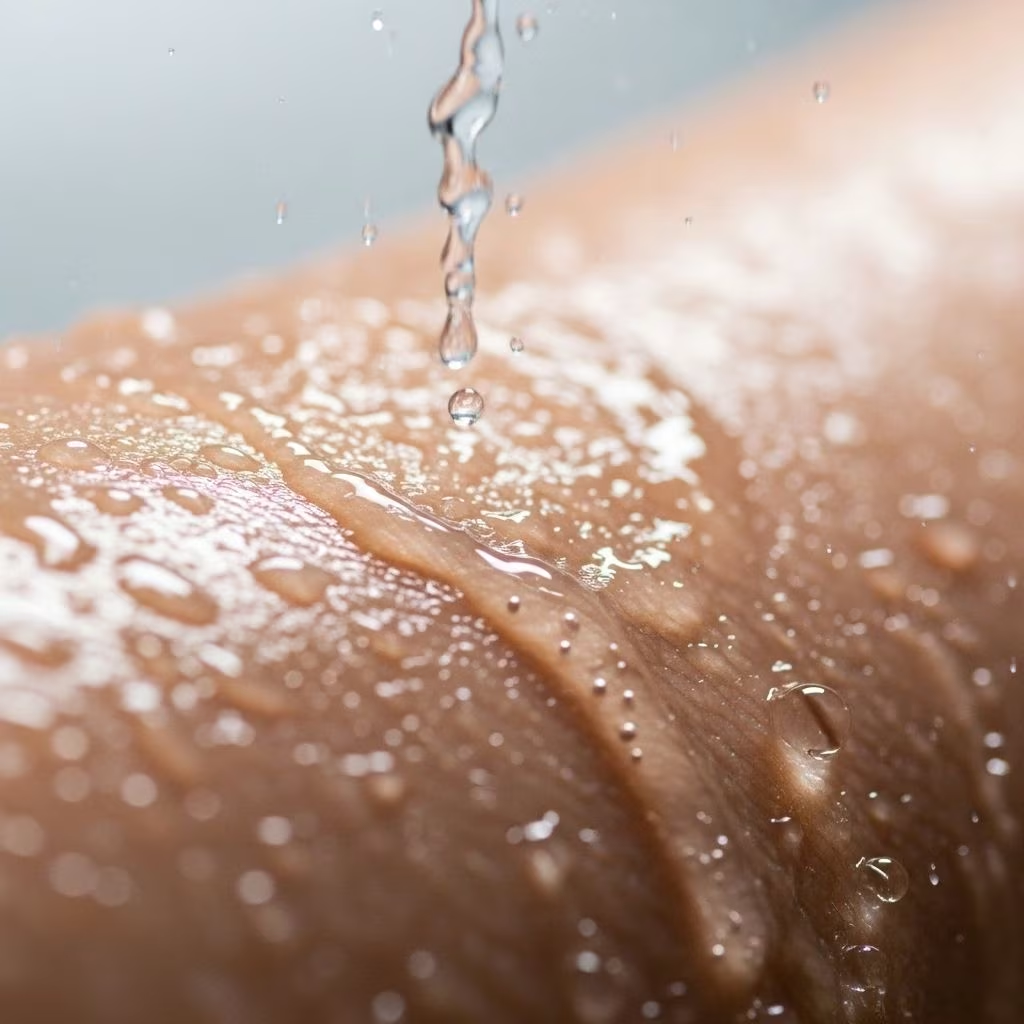
Can Skin Absorb Water for Hydration? Mechanisms, Myths, and Realities Explained
Skin hydration is fundamental for the optimal functioning and healthy appearance of human skin. The popular belief that the skin can absorb water simply by direct contact with liquids is widely debated in both scientific and lay communities. This article explores the molecular mechanisms of skin hydration, the role of the stratum corneum (SC), natural moisturizing factors (NMF), the limits of water absorption through the skin, and the effect of topical applications and environmental conditions. Extensive research and contemporary understanding will clarify the misconceptions and reveal what really governs skin moisture.
Introduction
Water is vital for healthy skin functioning, serving critical roles in elasticity, appearance, and biological processes. Although it is tempting to assume that simply immersing skin in water or applying water-based products would lead to increased hydration, the reality is far more complex due to the skin’s structure and intrinsic protective functions.
How Does Skin Hydrate?
Skin hydration depends upon controlling water loss, retaining water in the upper layers, and allowing cells to maintain appropriate permeability. The outermost layer—the stratum corneum (SC)—plays a central role. The SC is composed of corneocytes embedded in a matrix of intercellular lipids, and these structures regulate the movement of water between the deeper layers of skin and the external environment.
- Water is supplied to the SC passively from deeper skin layers, especially the viable epidermis.
- Water evaporates from the SC into the environment—a process known as transepidermal water loss (TEWL).
Only a very limited amount of water is absorbed from external sources, and this is tightly regulated. True inner skin hydration is primarily determined by the water supplied from the dermis and how effectively it is retained by the SC.
The Stratum Corneum: Skin’s Protective Barrier
The SC is not just a passive outer covering; it is a dynamic, highly organized barrier that determines skin permeability:
- Corneocytes: Dead, flattened skin cells packed with NMF and keratin proteins.
- Intercellular lipids: Lipid molecules arranged in vertical and horizontal layers, forming a water-tight matrix.
- Barrier to both evaporation and absorption: The SC prevents excessive water loss, but also restricts entry of water and exogenous substances.
| Function | Description |
|---|---|
| Prevent dehydration | Limits water evaporation (TEWL) |
| Protect from chemicals/infections | Barrier against pathogens and irritants |
| Limit water entry | Prevents excessive swelling and dilution of cell contents |
The SC’s effectiveness in retaining water is due to its dual structure: hygroscopic agents inside corneocytes, and tightly packed lipids between cells.
Natural Moisturizing Factor (NMF)
The natural moisturizing factor consists of water-loving compounds that attract and retain water in the SC. These components make up about 10% of the corneocyte mass, and up to 30% of SC’s dry weight:
- Amino acids and their derivatives (e.g., pyrrolidone carboxylic acid, urocanic acid)
- Lactic acid
- Urea
- Inorganic salts (chlorides, phosphates, citrates of sodium, potassium, calcium, magnesium)
- Sugars
NMF components are highly efficient humectants. They can attract water from the atmosphere and draw it into the corneocytes—even at relative humidity as low as 50%. Hydrated NMF interacts with keratin, increasing the elasticity and suppleness of the SC, giving skin a healthy look and feel.
Can Skin Absorb Water from the Environment?
The ability of skin to absorb water from external sources is limited by its structure and physiological regulation.
- Minimal absorption of liquid water: Healthy, intact skin is nearly impermeable to liquid water. Most water contacting the skin remains on the surface and evaporates quickly.
- Atmospheric humidity: The SC can absorb a small, regulated amount of water from air, determined by humidity and NMF content.
- Role of relative humidity (RH): Water flux through the skin increases sharply only when RH is above 90%.
- Water gradient: Water moves primarily from the dermis outward, with only the very surface layer occasionally equilibrating with ambient conditions.
Conclusion: You cannot hydrate deeper skin or the body by soaking in water, swimming, or merely wetting the skin. True hydration comes from internal water supply and retention, not surface absorption.
How Does Humidity Affect Water Uptake?
- At low RH (below 50%), NMF and the SC ensure basic hydration but visible dryness may occur.
- At typical ambient RH (50–80%), SC holds steady water content.
- At RH above 90%, water content and SC swelling increase substantially, but this mostly affects the most superficial layer and may even compromise barrier function if prolonged.
Effects of Topical Water and Creams
Although direct water application cannot penetrate deeply and hydrate the skin, creams and occlusive formulations play a significant role:
- Occlusive creams: These form a protective film that reduces water evaporation (TEWL) by trapping moisture at the skin surface.
- Humectants in formulations: Ingredients like glycerol, hyaluronan, and others attract water and help retain it inside the SC.
- Barrier change: By creating a new boundary condition at the skin surface, creams increase hydration of the outer SC without changing its intrinsic properties.
Topically applied water rarely penetrates beyond the very outer layer unless combined with penetrative enhancers or occlusion. In practical terms, true hydration requires not just adding water, but also maintaining barrier integrity and boosting NMF and lipid content.
Environmental Effects on Skin Hydration
External humidity is a critical factor for skin hydration:
- High humidity increases water retention on the skin’s surface and in the upper SC.
- Low humidity accelerates TEWL, leading to visible dryness and flaky skin.
- Extremely humid environments can cause swelling and reduced mechanical strength of the skin.
Short-term exposure to water (for example, showering or swimming) temporarily increases superficial hydration and skin pliability but does not translate to true hydration of deeper layers.
Molecular Dynamics of Hydrated Skin
Recent molecular studies show that hydration triggers reorganization of keratin filaments and alters peptide dynamics within the corneocytes at RH above about 85%. These molecular changes coincide with macroscopic swelling and modifications in mechanical properties.
| Relative Humidity | Skin Effects |
|---|---|
| Below 50% | Dryness, visible flaking, increased TEWL |
| 50%–85% | Normal elasticity, healthy appearance |
| Above 85%–90% | Molecular rearrangement, swelling, decreased barrier strength |
Hydration vs. Moisturization
It is important to distinguish between hydration (water content in skin) and moisturization (the process of retaining moisture and maintaining skin barrier integrity):
- Hydration: Addition of water to skin cells primarily from internal supply.
- Moisturization: Use of topical agents—emollients, humectants, and occlusives—to support water retention and barrier function.
Effective skincare involves boosting both hydration (from within) and moisturization (from outside).
Common Myths and Misconceptions
- Myth: Soaking skin hydrates the body.
- Reality: Skin is nearly impermeable to external liquid water; hydration comes mainly from the underlying tissue.
- Myth: Drinking water instantly plumps the skin.
- Reality: While drinking water supports inner skin hydration, effects are gradual and mediated by systemic physiology.
- Myth: Applying water alone acts as a moisturizer.
- Reality: Water evaporates rapidly; only formulations containing humectants and/or occlusives truly support lasting moisture retention.
Frequently Asked Questions (FAQs)
Q: Can skin absorb water for overall body hydration?
A: No. The skin’s outer layer prevents significant liquid water penetration. Body hydration relies on oral water intake and systemic distribution.
Q: How does humidity affect skin moisture?
A: Higher humidity allows the SC and NMF to draw more water from the air, increasing surface hydration. Low humidity accelerates water loss and dryness.
Q: Can you hydrate your skin by submerging it in water?
A: Superficial hydration can occur briefly, but it evaporates rapidly once removed from water. Lasting hydration requires retaining water within the SC using moisturizers.
Q: What are the best ways to maintain skin hydration?
A: Protect from excessive washing, use moisturizers rich in humectants and occlusives, maintain adequate systemic hydration through diet, and protect barrier integrity.
Q: How do creams enhance skin hydration?
A: Creams with humectants and occlusives form boundary conditions that reduce TEWL and promote retention of water within the SC, supporting skin health.
Final Thoughts
Skin hydration involves a complex interplay between biological structure, molecular chemistry, environmental influences, and topical treatments. The skin is not a passive sponge; instead, it maintains tight regulation of water loss and uptake through the stratum corneum, natural moisturizing factor, and lipid matrix. While some superficial moisture can be absorbed under rare circumstances (high humidity, occlusion, specific creams), effective hydration is best achieved by supporting the skin’s innate systems with internal water supply and well-designed topical products.
Understanding these mechanisms not only dispels common myths but also empowers individuals to choose better skincare practices, enhancing the health and resilience of their skin in all environments.
References
- https://pubmed.ncbi.nlm.nih.gov/17524122/
- https://pmc.ncbi.nlm.nih.gov/articles/PMC3565729/
- https://www.nature.com/articles/s41598-017-15921-5
- https://onlinelibrary.wiley.com/doi/10.1111/j.1473-2165.2007.00300.x
- https://practicaldermatology.com/topics/general-topics/understanding-the-role-of-natural-moisturizing-factor-in-skin-hydration/21612/
- https://www.lodaites.com/en/blogs/news/understanding-skin-hydration-mechanisms
- https://www.nature.com/articles/s41598-020-73684-y


