


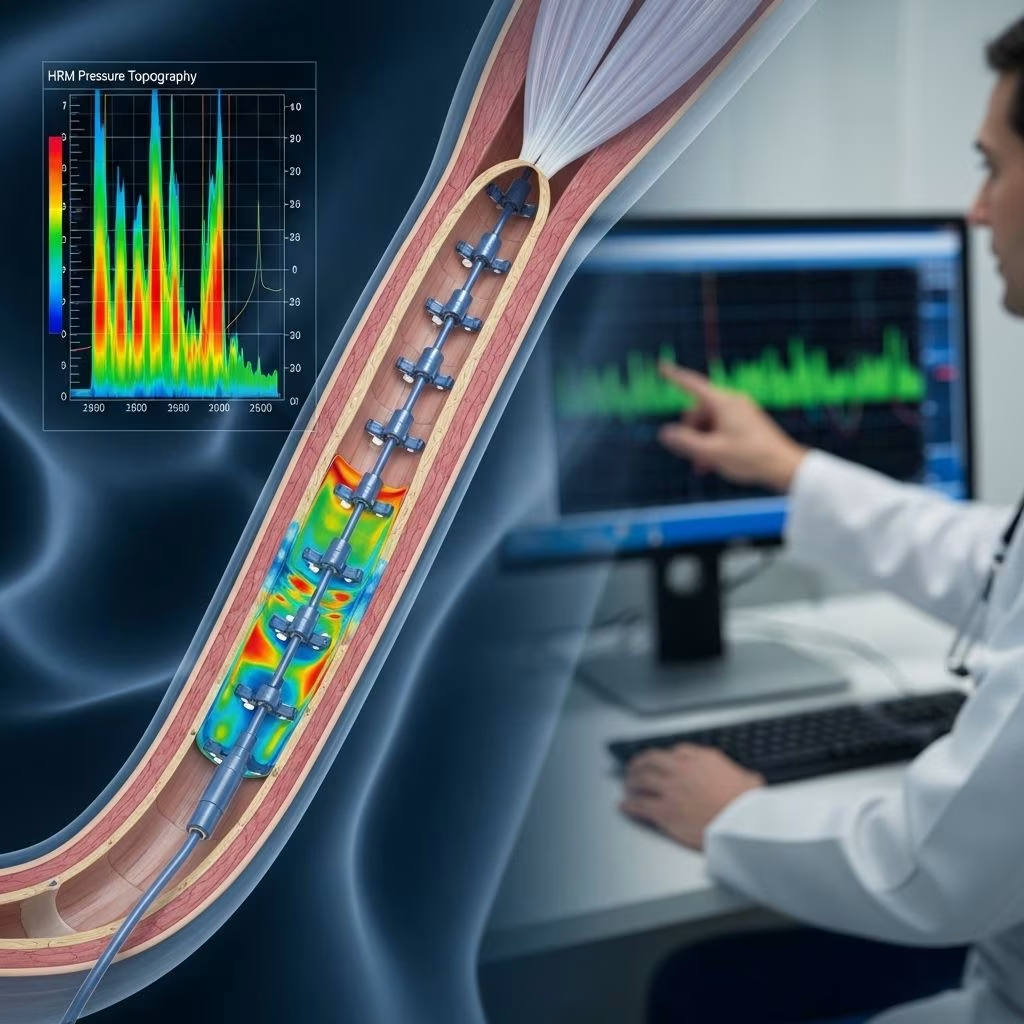
Esophageal pain is a complex clinical symptom often mistaken for cardiac or gastrointestinal disease. Accurate recognition and diagnosis are fundamental for effective treatment. The emergence of high-resolution manometry (HRM) has transformed our understanding and management of esophageal motor function, providing unparalleled insight into the pathophysiology of esophageal pain and motility disorders.
Introduction
Esophageal pain, commonly manifesting as chest discomfort or dysphagia, is a frequent but diagnostically challenging symptom in gastroenterology. It often mimics cardiac pain, leading to extensive and sometimes unnecessary cardiac workups. The breadth of potential esophageal pathologies—including motility disorders and functional esophageal syndromes—requires sophisticated diagnostic tools. High-resolution manometry (HRM) now forms the cornerstone for evaluating esophageal motor function, offering detailed pressure mapping and diagnostic clarity far beyond traditional techniques.
Overview of Esophageal Pain
Esophageal pain may be caused by multiple underlying conditions, including:
- Abnormal esophageal motility (e.g., diffuse esophageal spasm, achalasia)
- Gastroesophageal reflux disease (GERD)
- Non-cardiac chest pain
- Scleroderma and connective tissue disorders
- Other functional disorders
Symptoms often include:
- Retrosternal or chest pain unrelated to heart pathology
- Difficulty swallowing (dysphagia)
- Regurgitation
- Sensation of food sticking in the chest
Accurate diagnosis requires exclusion of cardiac disease and careful assessment with advanced motility testing.
What is High-Resolution Manometry?
High-resolution manometry is an advanced diagnostic technique for assessing esophageal motor function. HRM employs specialized catheters embedded with dozens of closely spaced pressure sensors (usually 1–2 cm apart) along their length. These sensors record real-time pressure events throughout the esophagus and at both sphincters (upper and lower). Reflecting these data in color-coded esophageal pressure topography (EPT) plots, HRM enables precise identification of motility abnormalities.
- Key distinctions from conventional manometry:
- Densely packed sensors provide spatially continuous pressure readings.
- Pressure topography gives a visual (heatmap-style) contour of esophageal muscle activity.
- Rapid data acquisition and ease of interpretation.
- Integration with impedance testing: Some HRM catheters also measure impedance to assess bolus transit.
Development and Evolution
The development of HRM traces back to the need for a more comprehensive, standardized, and reproducible assessment of esophageal motility. The Chicago Classification was developed to systematically interpret HRM findings, and it continues to evolve with new research and clinical experience.
Indications for HRM in Esophageal Pain
HRM is particularly valuable in the following clinical scenarios:
- Unexplained, persistent non-cardiac chest pain
- Evaluation of dysphagia with no evident mechanical obstruction
- Assessment of motility prior to anti-reflux or foregut surgery
- Characterization of specific motility disorders, such as achalasia or spastic motor syndromes
- Assessment of refractory gastroesophageal reflux symptoms
- Investigation of regurgitation, food impaction, or rumination syndrome
Esophageal manometry may also be required for pre-operative planning, to inform surgical approaches and reduce the risk of post-operative dysmotility.
Procedure: How HRM is Performed
The HRM procedure is minimally invasive and can generally be completed in less than 30 minutes:
- A thin, flexible catheter with embedded pressure sensors is inserted through the nose and advanced into the stomach.
- Topical anesthesia (nasal or throat spray/gel) is used to minimize discomfort; sedation is rarely required.
- The patient is typically positioned semi-reclining or reclining.
- The patient is asked to swallow small amounts of water or saline at intervals; each swallow generates a pressure profile.
- The test measures both resting and swallow-induced esophageal pressures.
- Pressure data are instantly acquired and displayed on a computer as a real-time esophageal pressure topography plot.
Preparation for the Procedure
- Fasting: No food or drink for at least 6 hours prior to the procedure.
- Certain medications (e.g., calcium channel blockers, nitrates) may need to be paused, as instructed by the provider.
- Continue essential medications with small sips of water; discuss specifics with your physician.
- Patients can usually resume normal activity immediately after the test.
Interpretation and Findings in HRM
HRM data are elucidated through esophageal pressure topography (EPT), providing a ‘map’ of muscle contraction, sphincter function, and bolus flow. Interpretation is standardized through the Chicago Classification, which organizes motility disorders based on objective, quantifiable criteria.
| Parameter | Description |
|---|---|
| Integrated Relaxation Pressure (IRP) | Assesses adequacy of lower esophageal sphincter (LES) relaxation. |
| Distal Contractile Integral (DCI) | Quantifies contraction strength in the distal esophagus. |
| Peristaltic Integrity | Evaluates continuity and propagation of esophageal contractions. |
| LES Basal Pressure | Basal resting pressure of the lower esophageal sphincter. |
| Upper Esophageal Sphincter (UES) Pressure | Assesses the function of the UES in initiating swallowing. |
Objective measurements allow for consistent classification and guide treatment recommendations.
HRM and Esophageal Motility Disorders
The increased resolution and clarity of HRM have expanded the spectrum of diagnosable motility disorders, including:
- Achalasia: HRM differentiates subtypes based on patterns of LES relaxation, peristalsis, and contractile vigor.
- Esophagogastric Junction Outflow Obstruction
- Distal Esophageal Spasm: Detected by simultaneous, premature, or spastic contractions.
- Jackhammer Esophagus: Hypercontractile disorder defined by extraordinarily high DCI values.
- Ineffective Esophageal Motility: Low-amplitude or failed peristalsis accounts for weak bolus transit.
- Scleroderma Esophagus: Absent or severely decreased esophageal contractions and hypotensive LES.
Many patients with unexplained esophageal pain have been reclassified thanks to HRM, allowing for tailored treatments and improved outcomes.
Benefits and Limitations of HRM
Benefits
- Provides precise, reproducible, and detailed mapping of esophageal pressures.
- Facilitates accurate, standardized diagnoses using the Chicago Classification.
- Optimizes surgical planning and post-operative evaluation (e.g., anti-reflux procedures).
- Reduces unnecessary testing by clarifying the source of esophageal pain.
- Improves detection of subtle or previously undefined motility disorders.
Limitations
- May cause temporary discomfort due to the insertion of the nasal catheter.
- Limited utility in patients with oropharyngeal swallowing disorders.
- Interpretation requires specific training and experience.
- Transient motility changes may elude a single HRM examination.
Clinical Impact of HRM in Esophageal Pain
The advent of HRM has revolutionized the diagnostic pathway for patients with unexplained chest pain and non-obstructive dysphagia. Its clinical impact includes:
- Enabling earlier and more accurate diagnosis of achalasia and its variants, leading to timely intervention.
- Re-characterizing previously ‘idiopathic’ esophageal pain into treatable motility disorders.
- Guiding precision medicine approaches—choosing between pneumatic dilation, surgical myotomy, or other interventions based on HRM-defined subtypes.
- Identifying functional, non-obstructive causes of symptoms to avoid unnecessary procedures.
HRM has also become essential in evaluating treatment responses and monitoring disease progression or recurrence after therapy.
Future Directions and Innovations
- Integration with Impedance: Combining HRM with impedance monitoring allows clinicians to evaluate both the motor function and bolus passage, enhancing understanding of symptom origin.
- Expanded Use of AI and Machine Learning: Automated analysis and interpretation may soon optimize diagnostic accuracy and efficiency.
- Portable and Wireless Devices: Next-generation HRM catheters may offer greater comfort and ambulatory testing.
- Longitudinal Monitoring: Repeated HRM frames may help characterize fluctuating symptoms and tailor care for chronic patients.
Ongoing research will likely yield even more nuanced subclassifications and therapeutic strategies based on individual esophageal pathophysiology.
Frequently Asked Questions (FAQs)
Q: Does high-resolution manometry hurt?
A: HRM is generally not painful but may cause mild discomfort or a gagging sensation when the catheter is inserted through the nose. Topical anesthetics minimize discomfort, and the test is brief.
Q: How is HRM different from traditional esophageal manometry?
A: HRM uses closely spaced sensors and advanced computer mapping, providing a more detailed and visually intuitive analysis of esophageal motility compared to traditional, widely spaced sensors.
Q: Who should have an HRM test?
A: Individuals with unexplained swallowing difficulties, non-cardiac chest pain, regurgitation, or those being evaluated before anti-reflux surgery often benefit most from HRM.
Q: Are there any risks to the procedure?
A: Risks are minimal; some patients experience a sore throat, nosebleed, or nasal irritation soon after the procedure. Serious complications are exceedingly rare.
Q: What conditions can HRM diagnose?
A: HRM is used to diagnose achalasia, distal esophageal spasm, ineffective esophageal motility, hypercontractile (jackhammer) esophagus, and sphincter dysfunction, among others.
References
- High-Resolution Manometry in Clinical Practice – PMC
- High Resolution Esophageal Manometry with Impedance – Covenant Health
- Esophageal Manometry Test – Cleveland Clinic
- High-Resolution Esophageal Manometry – University of Florida
- Esophageal Manometry – Mayo Clinic
References
- https://pmc.ncbi.nlm.nih.gov/articles/PMC4843031/
- https://www.covenanthealth.com/thompson-cancer-survival-center/high-resolution-esophageal-manometry/
- https://my.clevelandclinic.org/health/diagnostics/4952-esophageal-manometry-test
- https://gastroliver.medicine.ufl.edu/gi-motility/gi-motility-center/esophageal-manometry/
- https://www.mayoclinic.org/tests-procedures/esophageal-manometry/about/pac-20394000
- https://pmc.ncbi.nlm.nih.gov/articles/PMC9380033/
- https://www.jnmjournal.org/journal/view.html?uid=1059&vmd=Full


