


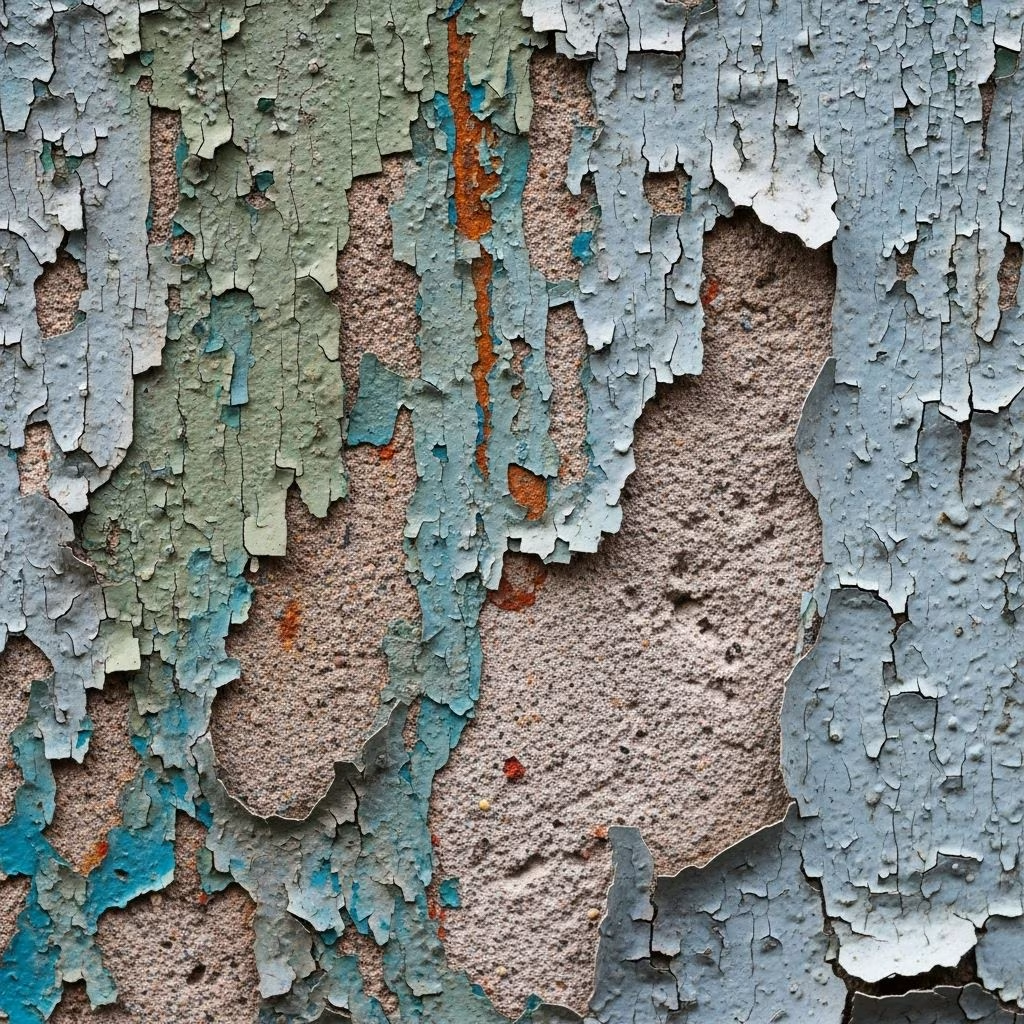
Urban environments are canvases of visual complexity. From crumbling brick facades to sleek glass panels, the city’s surfaces teem with untold stories and rich patterns. Mindful photography of abstract urban textures urges us to slow down and see these everyday elements not simply as backgrounds but as vital artistic material. This article explores the philosophical and technical approaches behind capturing abstract urban textures, blending mindfulness with creative composition for compelling photographic outcomes.
Introduction: Embracing the Urban Surface
Modern cities may appear as little more than a realm of concrete, glass, steel, and brick. Yet, for the mindful observer, these materials—shaped by time, weather, and human activity—create a dense mosaic of lines, patterns, textures, and colors. Mindful photography invites practitioners to observe these surfaces with heightened awareness, focusing on the present moment without judgment or the search for conventionally ‘beautiful’ scenes. The result: striking and often abstract images that preserve the city’s ephemeral details and evoke a sense of artistic wonder.
The Philosophy of Mindful Photography
Mindfulness, rooted in meditative traditions, emphasizes presence, stillness, and acceptance. In photography, this philosophy translates into a conscious, unhurried engagement with your environment, letting you:
- Eliminate distractions and truly see the subject matter before you.
- Appreciate the ordinary—such as a weathered wall or a rain-soaked sidewalk—by observing without expectation.
- Create space for inspiration to arise spontaneously, rather than imposing preconceived notions onto your compositions.
- Release the pressure to always capture ‘spectacular’ images, instead documenting what is simply present.
By applying these principles, photographers begin to view the city as a dynamic field of possibilities, where every scratch, crack, and reflection can become art.
Defining Abstract Urban Textures
Abstract photography moves beyond literal documentation. It focuses on form, color, pattern, and especially texture, to create images that may not be immediately recognizable but evoke curiosity or emotion. Urban textures include:
- Flaking paint on factory doors
- Repeating grates, tiles, or fences
- Reflections in puddles or windows
- Graffiti layers and peeling posters
- Brickwork, stucco, concrete, and metal
Capturing these elements abstracts them from their context, allowing the photograph to stand alone as a work of art. The resulting images might be geometric and ordered, or chaotic and full of movement—both approaches offer rich visual rewards.
Why Mindfulness Matters in Photography
- Slowed perception: Moving slowly through your environment reveals overlooked details.
- Sharpened attention: Deep focus lets you see subtle variations in shadow, color, and surface.
- Creative openness: Mindfulness helps you let go of strict expectations or strict rules about subject matter.
- Reduced stress: A meditative approach transforms city walks into restorative creative exercises rather than pressure-driven photo hunts.
Noticing Patterns, Forms, and Surfaces
Patterns and textures are key elements in abstract urban photography, providing a visual structure while imparting emotional resonance. For example:
| Element | Effect/Emotional Impact | Typical Urban Example |
|---|---|---|
| Repetition/Pattern | Order, calm, strength | Rows of windows, tiles, paving stones |
| Irregularity | Tension, movement, chaos | Cracked asphalt, poster layers, broken glass |
| Contrast/high-contrast light | Energy, drama, focus | Shadows on steps, sun on metal railings |
| Smoothness/Roughness | Tranquility/unease | Polished granite vs. rough concrete |
Mindful urban photographers consciously explore these properties, often isolating a small segment of a larger scene to highlight its abstract quality.
Checklist: Mindful Elements to Observe
- Single, isolated forms (a lone lamppost, solitary steps)
- Clean backgrounds with limited distractions
- Strong geometric shapes (lines, circles, repeating grids)
- Textures: rough, smooth, peeling, reflective surfaces
- High-contrast scenes (light/shadow, color/gray)
- Negative space emphasizing isolation or emptiness
- Muted or restricted color palettes for atmospheric effect
- Symmetry and asymmetry found in reflections or juxtapositions
Practical Approaches & Techniques
Mindful photography emphasizes simplicity and intention. Here are practical ways to capture abstract urban textures:
1. Slow Down and Observe
Before taking a photo, spend several minutes walking and observing. Notice changes in light, subtle shifts in surface detail, and how patterns transform as you move. Need inspiration? Focus on a single wall or ground area and see how many unique images you can make from it.
2. Break Scenes Into Elements
A powerful method is to break the complex city into compositional elements: lines, shapes, textures, and colors. View your environment as a collection of these parts, not as an overwhelming whole. This mental exercise fosters intentional framing and the creation of abstract imagery.
3. Get Closer
Abstract images often benefit from tightly cropped compositions. Move in close to isolate a patch of rust on a metal sheet, or the intersecting cracks of a painted curb. Macro lenses can reveal microcosms of detail invisible from afar.
4. Experiment with Camera Angles and Movement
- Shoot from unconventional perspectives: directly overhead, from ground level, or at sharp angles.
- Try intentional camera movement (ICM) during exposure to create painterly or surreal effects.
- Use reflections in puddles or glass for layered, semi-abstract images.
5. Pay Attention to Light
Urban textures change dramatically in different lighting. Early morning, late afternoon, and rainy days all bring unique qualities. Observe how natural and artificial light creates contrast, shadow, and color variation.
6. Leverage Post-Processing
- Convert images to black and white to emphasize form and texture.
- Increase contrast and clarity to bring out subtle details.
- Superimpose additional texture layers for creative effect in digital editing tools (such as Photoshop), enhancing the tactile quality of your photos.
Emotional and Artistic Impact
Abstract urban texture photography is about more than simple documentation—it evokes emotions:
- Order and Calm: Repetitive patterns and minimalist frames generate tranquility and meditative calm.
- Tension and Intrigue: Chaotic surfaces or unexpected juxtapositions challenge the viewer and stimulate curiosity.
- Ambiguity: By obscuring context and focusing on form, abstract images invite interpretation and personal meaning.
- Presence: Both photographer and viewer are encouraged to slow down, fostering a deep connection with the moment and the material world.
Color vs. Monochrome in Urban Abstraction
- Color: Can make patterns pop and draw attention to unexpected details.
- Monochrome: Strips scenes down to light and form, emphasizing the play of textures without the distraction of color.
Experimentation is key: some textures sing in black and white, while others rely on urban hues for impact.
Case Studies: From Streets to Abstractions
Superimposing Textures in Urban Compositions
Fine art photographer Philippe Monthoux describes using digital post-processing to superimpose additional textures onto urban images for an intensified, ‘urban feel.’ For example, a photograph of a roof and pavement in Edinburgh was transformed by overlaying a custom texture, enhancing depth and complexity.
Abstract Street Details
By isolating an element—such as the lines formed by shadows on a stairwell or the repetition found in iron railings—photographers bring minimalistic focus and abstract qualities to street photography. Intentional observation and slow shooting are instrumental in discovering and recording such scenes.
Textures in Modern Architecture
Modern urban buildings offer a wealth of repetitive patterns and geometric textures, from glass facades to tiled subway stations. By shooting close-ups of these features or capturing unusual reflections, photographers create semi-abstract images that challenge viewers to reinterpret familiar spaces.
Frequently Asked Questions
What camera or lens is best for capturing abstract urban textures?
Most modern cameras can capture excellent texture details. Macro and prime lenses are useful for close-up work, while wide-angles can highlight large patterns in architecture. The key is observation, not gear.
How can I become more mindful while photographing?
Try leaving your phone and distractions behind. Walk slowly. Take deliberate breaths and focus all attention on your visual field. Avoid rushing—wait until you feel drawn to a surface or pattern before shooting.
Is post-processing necessary?
Not required, but post-processing can enhance contrast, sharpen textures, or add creative overlays to deepen the abstract or tactile effect. Both in-camera and digital methods are valid approaches.
How do I make sure my images don’t look cluttered?
Use minimalist composition techniques: isolate a single element, make use of negative space, and fill the frame with texture rather than context. When in doubt, simplify.
Can abstract photographs convey meaning, or are they just decorative?
Abstract photography can be deeply meaningful, evoking emotions and prompting viewers to reflect on their environment. Texture and pattern can represent time, decay, growth, or the human imprint on urban space.
Conclusion: Practicing Mindful Urban Photography
Mindful photography of abstract urban textures is less about technical perfection and more about cultivating attentive seeing. By pausing, observing, and honoring the city’s mundane surfaces, photographers transform the ordinary into works of art. They also foster a state of presence that turns the busy city into a meditative, creative playground. Whether you bring home a portfolio of minimalist abstractions or simply enjoy your next city stroll more deeply, the practice offers immense rewards to both eye and soul.
References
- https://philippemonthoux.com/blog/urban-textures/
- https://www.thelandscapephotoguy.com/slow-and-mindful-photography-find-peace-with-your-camera/
- https://blog.freeimages.com/post/pattern-and-texture-in-modern-photography
- https://expertphotography.com/complete-guide-abstract-photography-112-tips/
- https://www.creativeislandphoto.com/blog/natural-abstracts-in-photography
- https://digital-photography-school.com/abstract-street-photography/
- https://fineartpics.co.uk/mindful-photography
- https://www.iphotography.com/blog/mindful-photography-how-to-use-your-camera-to-slow-down-and-see-the-world-differently/
- https://www.youtube.com/watch?v=syaBFkTOEEE
- https://www.youtube.com/watch?v=T56ktONNJH4


