


What Is an Action Potential?
An action potential, often called a nerve impulse or “spike,” is a rapid, transient electrical event that forms the fundamental mechanism of communication in the nervous system. When a neuron or muscle cell receives a strong enough stimulus, its resting membrane potential shifts, resulting in a fast change in voltage across the cell membrane. This propagating electrical wave helps transmit information throughout the body, underlining every sensation, movement, thought, and emotional response.
Key Points:
- Only excitable cells, such as neurons and muscle cells, generate action potentials.
- An action potential occurs when the stimulus reaches a specific threshold value, triggering a sequence of electrical changes along the cell membrane.
- These events allow for the rapid communication required for sensation, reflexes, and conscious activity in living organisms.
The generation and conduction of action potentials are central to brain function, muscle contraction, and many aspects of endocrine signaling.
How Action Potentials Work
At the heart of every action potential is a sensitive balance of charged ions inside and outside the cell. Normally, the resting membrane potential of a neuron is about -70 millivolts (mV), with the inside more negatively charged than the outside. This separation of charge is maintained by ion pumps and leak channels in the cell membrane.
The Sequence of Events
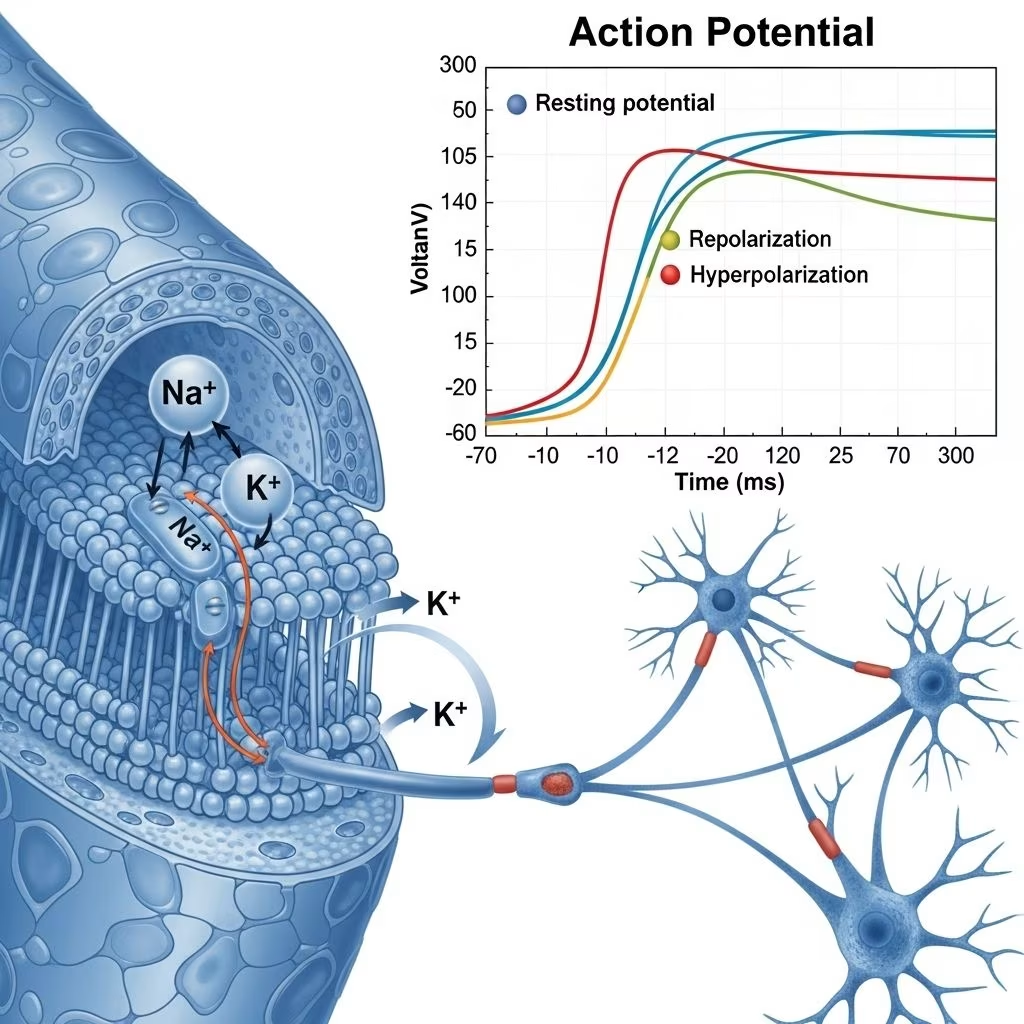
- Resting State: The neuron sits at its resting potential (around -70 mV). Sodium (Na+) is more concentrated outside, while potassium (K+) is higher inside the cell.
- Stimulation: A stimulus shifts the membrane potential toward zero, a process called depolarization.
- Threshold: If the depolarization reaches a critical threshold (usually about -55 mV), an action potential is triggered.
- Rising Phase (Depolarization): Voltage-gated sodium channels open, causing a sodium influx. This further raises the membrane potential, sometimes as high as +40 mV.
- Peak/Overshoot: Maximum sodium entry occurs. Then, sodium channels close and potassium channels open.
- Falling Phase (Repolarization): Potassium exits the cell, restoring the negative internal environment.
- Undershoot (Hyperpolarization): Potassium channels stay open a little longer, making the inside even more negative than at rest before returning to baseline.
This process takes only a few milliseconds, demonstrating the remarkable efficiency of neural signaling.
Phases of the Action Potential
| Phase | Description & Ion Movement |
|---|---|
| Resting | Stable -70 mV, maintained by Na+/K+ ATPase and leak channels |
| Depolarization | Na+ influx causes membrane potential to rise sharply |
| Overshoot | Brief period when membrane potential is positive |
| Repolarization | K+ efflux restores negative internal environment |
| Hyperpolarization | K+ channels remain open too long, causing membrane to dip below resting level |
Key Features of Action Potentials
- All-or-None Law: An action potential either occurs fully or not at all if the threshold is not reached. Stimuli above threshold produce identical action potentials in that neuron.
- Unidirectional Propagation: Action potentials move in one direction along the neuron due to the refractory periods.
- Self-Propagating: Once triggered, the impulse is passed efficiently along the axon to the next cell.
- Signal Coding: Information is encoded in the frequency and pattern of action potentials, not their amplitude, which remains constant.
The Refractory Periods
After firing, the ion channels experience two periods crucial for regular neural signaling:
- Absolute Refractory Period: No stimulus can generate another action potential. This ensures impulses travel in only one direction and sets a maximum firing frequency.
- Relative Refractory Period: A new action potential is possible, but requires a stronger-than-usual stimulus. Potassium channels are still resetting during this time.
How Action Potentials Travel (Propagation)
Action potentials travel along the length of the axon—sometimes great distances. The speed depends on:
- Axon diameter: Larger diameter allows faster conduction.
- Myelination: Nerve fibers insulated with myelin (by glial cells) conduct impulses faster, allowing “saltatory conduction”—the signal jumps between gaps in the myelin (nodes of Ranvier).
This rapid conduction is crucial for complex behaviors, fast reflexes, and brain processing speed.
Neurotransmission: The Role in Communication Between Neurons
The arrival of an action potential at the end of an axon (the synaptic terminal) triggers the release of neurotransmitters into the synaptic cleft. These chemicals cross the gap, bind to receptors on the next cell, and can cause excitation or inhibition, modulating the next neuron’s likelihood of firing.
The delicate balance between excitatory and inhibitory signals across vast neural networks forms the basis for every movement, sensation, and thought.
The Importance of Action Potentials in the Human Body
- Brain Function: Underlies cognition, emotion, perception, and learning.
- Sensory Processing: Transmits sensory information (touch, pain, sight, sound, etc.) to and from the brain.
- Muscle Movement: Initiates and coordinates voluntary and involuntary muscle contractions.
- Endocrine Control: Triggers hormone release in excitable endocrine tissues.
Clinical Relevance: Disorders Involving Action Potentials
- Epilepsy: Abnormal action potential firing leads to seizures.
- Multiple Sclerosis: Myelin loss impairs fast action potential transmission, affecting movement and sensation.
- Paralysis: Damage to neurons disrupts action potentials, leading to loss of function.
- Arrhythmias: In the heart, abnormal action potentials can cause irregular heartbeats.
Key Takeaways
- Action potentials are rapid, transient electrical events vital for fast cell-to-cell communication in nerves and muscles.
- The process involves the coordinated action of voltage-gated ion channels and precise changes in ionic gradients.
- Signal strength is conveyed through firing frequency rather than amplitude.
- Proper action potential function underpins everything from thought and sensation to movement and hormonal control.
Frequently Asked Questions (FAQs)
Q: What is an action potential?
A: An action potential is a rapid, temporary change in the electrical membrane potential of an excitable cell, such as a neuron. It allows neurons to send signals over long distances in the body.
Q: What triggers an action potential?
A: A stimulus causes depolarization of the cell membrane. If the membrane potential reaches a critical threshold, voltage-gated ion channels open, generating an action potential.
Q: Why are action potentials called ‘all-or-none’ responses?
A: Because once the threshold is reached, the action potential always occurs with the same amplitude and speed; stronger stimuli don’t produce bigger impulses, just more frequent ones.
Q: How does myelin affect action potentials?
A: Myelin sheath increases the speed of conduction by allowing the action potential to jump between gaps (nodes of Ranvier) in a process known as saltatory conduction.
Q: What happens if action potentials are abnormal?
A: Problems with action potentials can lead to neurological diseases like epilepsy, multiple sclerosis, and certain types of paralysis or arrhythmias.
Quick Glossary
- Neuron: A nerve cell specialized for communication.
- Depolarization: Reduction in membrane potential, making the inside less negative.
- Repolarization: Restoration of the negative membrane potential after depolarization.
- Hyperpolarization: Temporary period when the membrane potential is more negative than the resting potential.
- Threshold: The critical membrane potential needed to trigger an action potential.
- Synapse: Junction where neurons communicate with target cells.
- Excitability: The ability of a cell to respond to stimuli and generate an action potential.
- Myelin: Lipid-based insulating layer that speeds up nerve impulse transmission.
References & Further Reading
- Queensland Brain Institute, Action Potentials and Synapses.
- Kenhub, Action Potential: Definition, Steps, Phases.
- NCBI StatPearls, Physiology, Action Potential.
- Khan Academy, Neuron Action Potentials: The Creation of a Brain Signal.
References
- https://qbi.uq.edu.au/brain-basics/brain/brain-physiology/action-potentials-and-synapses
- https://www.kenhub.com/en/library/physiology/action-potential
- https://en.wikipedia.org/wiki/Action_potential
- http://faculty.washington.edu/chudler/ap.html
- https://www.ncbi.nlm.nih.gov/books/NBK538143/
- https://www.youtube.com/watch?v=W2hHt_PXe5o
- https://www.khanacademy.org/test-prep/mcat/organ-systems/neuron-membrane-potentials/a/neuron-action-potentials-the-creation-of-a-brain-signal
- https://www.ncbi.nlm.nih.gov/books/NBK546639/
- https://www.youtube.com/watch?v=TUOSCEVt6HI
- https://www.moleculardevices.com/applications/patch-clamp-electrophysiology/what-action-potential


