


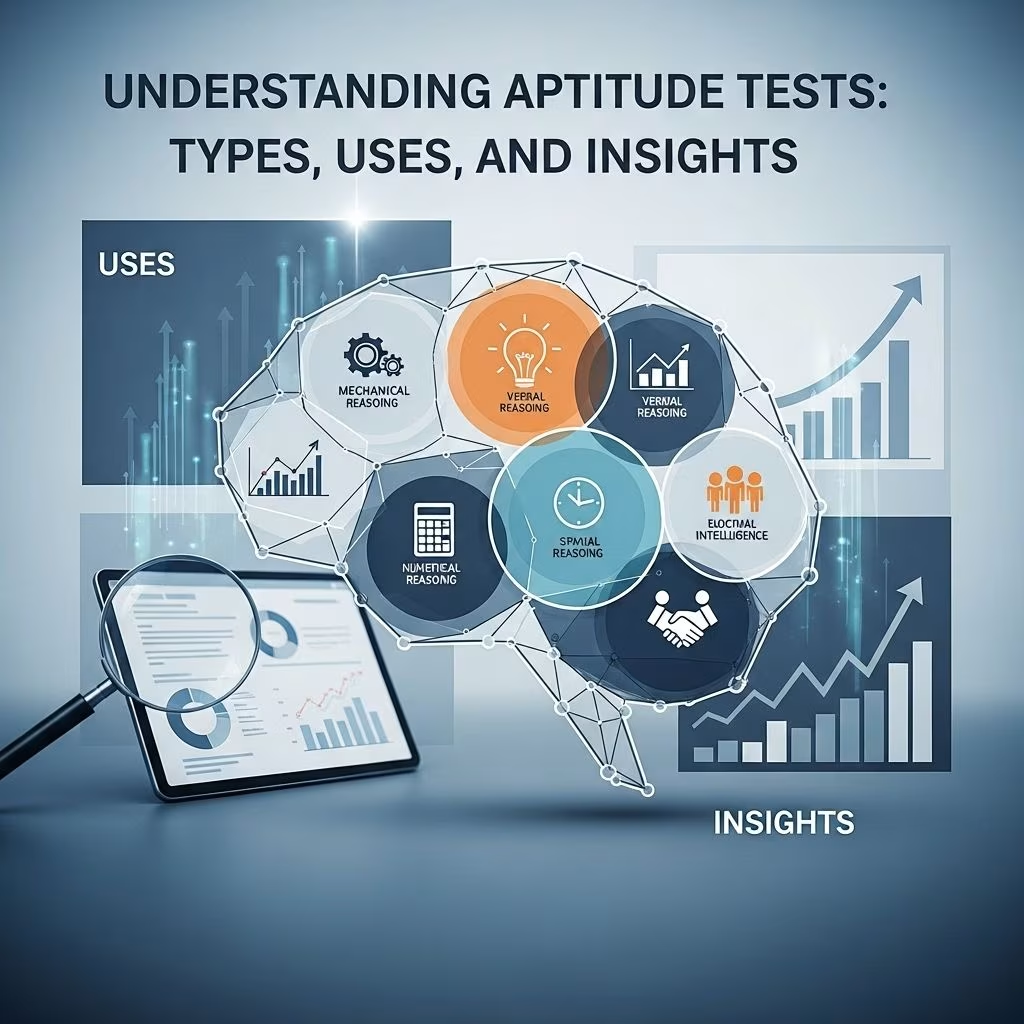
Aptitude tests are powerful tools designed to assess an individual’s ability to perform specific tasks, solve problems, and adapt to new information. Used in education, recruitment, employee development, and career planning, these tests help organizations and individuals make informed decisions about learning paths, job suitability, and personal growth.
What is an Aptitude Test?
Aptitude tests are standardized assessments that evaluate a person’s natural abilities or potential to learn particular skills. Unlike achievement tests, which measure what you already know, aptitude tests focus on your capacity to acquire new skills and adapt to unfamiliar situations. They offer insights into your strengths and areas where you may excel with further training or education.
Why Are Aptitude Tests Used?
- Recruitment and Hiring: Employers use these tests to objectively assess candidates’ capabilities, helping ensure the right fit for specific roles and reducing bias in the selection process.
- Employee Development: Organizations utilize aptitude assessments to guide professional growth, identify areas for improvement, and plan for succession.
- Educational Guidance: Schools and colleges administer aptitude tests to advise students on suitable courses, academic tracks, or career paths.
- Personal Growth: Individuals can gain clarity on their innate talents, inform career changes, and set meaningful development goals using test results.
Types of Aptitude Tests
A variety of aptitude tests exist, each designed to measure specific types of ability. Below are the most common categories:
1. Verbal Reasoning Tests
These measure your ability to understand, interpret, and reason using written information. They often include reading comprehension, logic-based scenarios, and identifying key points from text.
- Evaluates reading skills, vocabulary, and verbal logic
- Important for communication-intensive roles
2. Numerical Reasoning Tests
These assess your capacity to work with numbers, interpret data, and handle mathematical concepts such as percentages, ratios, basic arithmetic, and data analysis from tables or graphs.
- Essential for finance, engineering, technology, and scientific fields
- Tests might include interpreting data sets or solving word problems involving numbers
3. Abstract and Logical Reasoning Tests
These tests measure your ability to identify patterns, logical relationships, and sequences outside of language or mathematics. They challenge you to solve problems using shapes, patterns, or diagrams, rather than words or numbers.
- Tests pattern recognition and logical deduction
- Used for roles requiring analytical and innovative thinking
4. Spatial Reasoning Tests
Spatial reasoning aptitude is the ability to visualize and manipulate objects mentally. These are commonly used in design, architecture, and engineering fields.
- Includes understanding of shapes, spatial manipulation, and orientation in space
- Tests the ability to visualize two- or three-dimensional shapes and predict outcomes
5. Mechanical Reasoning Tests
These are designed to assess understanding of mechanical and physical concepts, such as forces, energy, levers, gears, and pulleys. They are frequently used for technical, engineering, or hands-on operational roles.
- Measures problem-solving using mechanical principles
- Questions may feature diagrams about levers, pulleys, or machinery
6. Attention and Detail-Oriented Tests
Attention tests evaluate your ability to spot errors, match or distinguish details, and maintain focus under time pressure. Roles like quality assurance, accounting, or technical verification frequently use these tests.
- Common tasks: error checking, data matching, pattern discrepancies
- Useful for positions requiring accuracy and vigilance
7. Situational Judgment Tests (SJTs)
SJTs present hypothetical work scenarios and ask you to choose the most appropriate response. These tests examine your decision-making skills, interpersonal judgments, and alignment with company culture.
- Assesses behavioral tendencies in realistic job situations
- Helps determine leadership, teamwork, and problem-solving aptitude
8. Skill-Specific and Technical Aptitude Tests
These measure hands-on abilities directly related to job tasks, such as programming, writing, or tool operation. Technical tests are crucial for specialized roles like IT, coding, or skilled trades.
- Validates proficiency in precise vocational or technical areas
- Reduces on-the-job training needs by confirming expertise
How Aptitude Tests Are Used
Aptitude tests occur at different stages and for diverse purposes. Here’s where and how they are typically applied:
Recruitment and Hiring
- Shortlist candidates objectively
- Compare applicants on standardized criteria
- Eliminate selection bias and predict on-the-job performance
Employee Development and Succession Planning
- Identify areas of strength and growth
- Guide targeted training and development efforts
- Support internal mobility and succession plans
Educational Guidance and Career Counseling
- Assist students in choosing courses or academic tracks
- Inform decisions about potential career paths based on aptitudes
- Highlight hidden strengths and skill gaps
Personal Development
- Help individuals set personal and professional development goals
- Guide preparation for competitive exams or new professional challenges
Sample Aptitude Test Questions by Type
Understanding what’s involved in different types of aptitude tests can help candidates prepare. Below are examples of what to expect in common test categories:
| Test Category | Sample Question | What It Assesses |
|---|---|---|
| Numerical Reasoning | If a train travels 120 miles in 3 hours, what is its average speed? | Basic calculations and understanding of rates |
| Verbal Reasoning | Choose the word that is most similar to ‘Happy’: A) Sad B) Elated C) Angry | Vocabulary, comprehension, verbal logic |
| Abstract Reasoning | Which shape completes the pattern? (Pattern-based, using images) | Pattern recognition and logical deduction |
| Mechanical Reasoning | Which gear will turn the fastest if Gear A turns at 60 rpm? | Understanding of basic mechanical concepts |
| Attention to Detail | Spot the difference: Compare two product codes for an error. | Accuracy, focus, error detection |
| Situational Judgment | How would you respond if a client requests an urgent change? | Professional judgment and interpersonal skills |
Strengths and Limitations of Aptitude Tests
Advantages
- Objective and standardized
- Efficient for screening large groups
- Reveal hidden talents and potential fit
- Reduce biases in hiring and education placement
Limitations
- Do not account for motivation or experience
- Potential for test anxiety to affect scores
- Results may not capture creativity or soft skills fully
- Some cultural or educational backgrounds may influence outcomes
How to Prepare for an Aptitude Test
Preparation can boost both confidence and performance. Here are strategies for success:
- Familiarize yourself with test formats and question styles
- Practice with sample questions and timed mock tests
- Focus on areas of weakness and review essential concepts
- Take care of logistics: get enough rest, read instructions carefully, and manage your time during the test
Interpreting Aptitude Test Results
Results from aptitude tests are generally presented as raw scores, percentiles, or banded levels. Proper interpretation is crucial:
- Compare your scores to established norms for your age or target group
- Review performance in each section for strengths and gaps
- Consult guidance counselors or HR professionals for context on results as they relate to your personal or career goals
Common Uses and Real-World Applications
- Hiring for entry-level or graduate roles: Aptitude tests help identify candidates with raw potential over specific experience.
- Promotion or leadership tracks: Companies may use cognitive or situational tests to assess readiness for advancement.
- School guidance: High schools and universities use aptitude assessments to recommend academic majors or vocational programs.
- Professional licensure: Some fields require passing aptitude-based or skills tests for certification.
Frequently Asked Questions (FAQs)
What is the difference between aptitude and intelligence tests?
Intelligence tests measure general intellectual ability (IQ), while aptitude tests assess specific abilities or potential to develop skills in targeted areas.
Are aptitude tests reliable predictors of job success?
Studies show that certain aptitude tests, especially cognitive ones, can be strong predictors of job performance, but they are most effective when combined with interviews and other assessment methods.
Can you prepare or study for aptitude tests?
While aptitude tests aim to measure innate abilities, familiarity with formats and practicing similar questions can improve outcomes by reducing anxiety and increasing speed.
Are results from aptitude tests permanent?
No—aptitude scores may shift over time with education, training, or real-world experience. They are best viewed as a ‘snapshot’ rather than a permanent measure.
Who creates and administers aptitude tests?
Professional assessment companies and psychometricians design commercial aptitude tests. Schools, employers, and career counselors often facilitate testing or recommend platforms.
Key Takeaways on Aptitude Tests
- Aptitude tests provide a structured, objective way to evaluate potential, guide job placement, and shape education and career choices.
- There are multiple types of aptitude tests—each designed to measure particular cognitive, technical, or behavioral abilities.
- While extremely useful, these assessments should be one of several decision-making tools, accounting for skills, motivation, and experience for a holistic view.
References
- https://www.pmapstest.com/blog/types-of-aptitude-tests
- https://mconsultingprep.com/aptitude-tests-guide
- https://www.hipeople.io/blog/types-of-aptitude-tests
- https://ca.indeed.com/career-advice/career-development/what-is-aptitude
- https://www.bryq.com/blog/what-is-aptitude
- https://www.ebsco.com/research-starters/social-sciences-and-humanities/aptitude-testing


