


Cannon-Bard Theory of Emotion: Overview
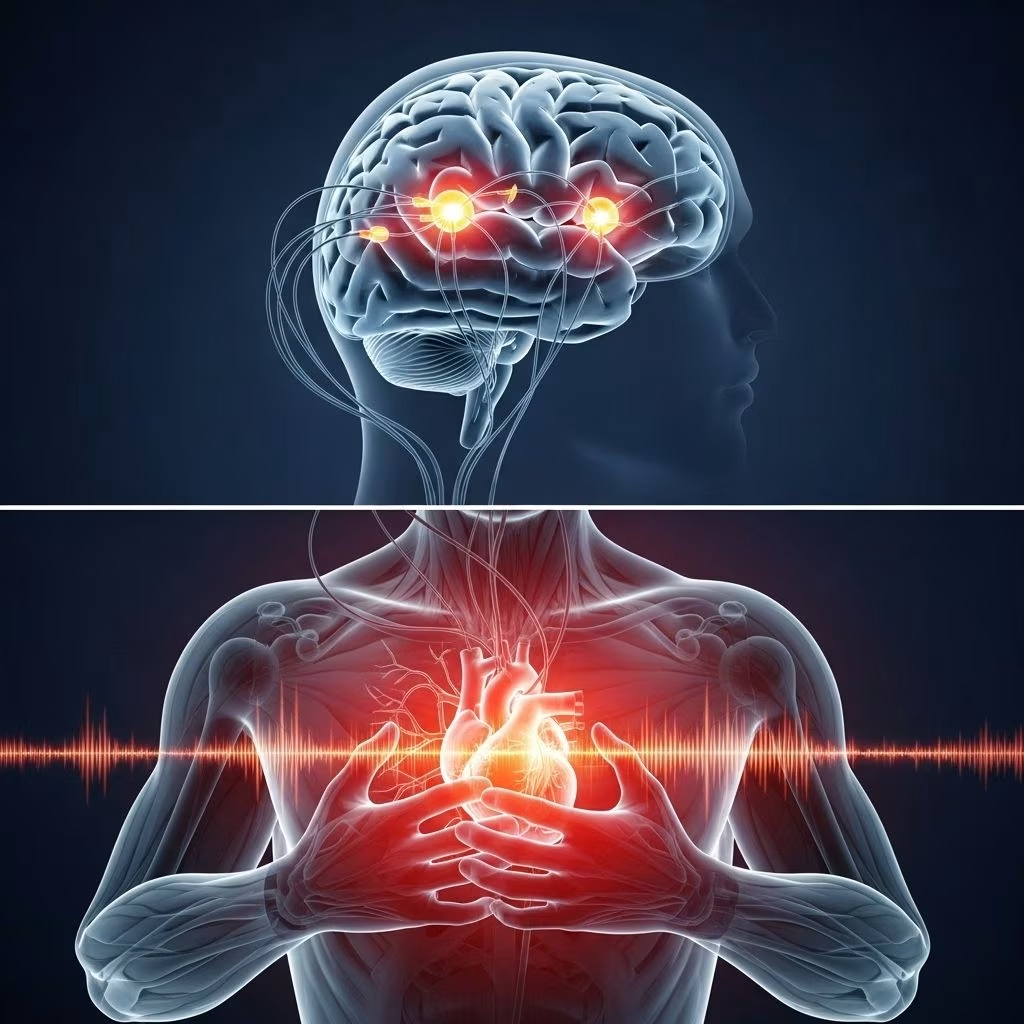
The Cannon-Bard theory of emotion is a foundational concept in psychology that fundamentally shifted how scientists understand the interplay between emotions and physiological responses. Developed in the late 1920s by Walter B. Cannon and Philip Bard, this theory posits that emotional experiences and physical reactions to stimuli occur simultaneously and independently, challenging earlier beliefs that emotions always follow bodily changes.
Defining the Cannon-Bard Theory
The Cannon-Bard theory asserts that when an individual encounters an emotionally charged stimulus, two outcomes happen at the same time:
- Emotional experience: The conscious feeling of an emotion
- Physiological response: Physical changes in the body, such as an elevated heart rate or trembling
Both occur independently, meaning neither causes the other, but both are direct responses to the external stimulus. According to Cannon-Bard, these reactions originate in the thalamus, a brain structure that receives sensory information. The thalamus, in turn, sends signals to activate emotional feelings in the cortex and physical reactions in the body’s nervous system, ensuring both the feeling and bodily expression of emotion occur in parallel.
Historical Development and Context
The theory was formally introduced in 1927 by Walter B. Cannon, a Harvard physiologist, and his graduate student Philip Bard. They formulated this model as a direct response to the prevailing James-Lange theory of emotion. The James-Lange theory hypothesized that emotions are the result of physical responses: a person feels afraid because they feel their body trembling or their heart racing.
Cannon and Bard challenged this, arguing that:
- Physiological changes can occur without subsequent emotion (e.g., increased heart rate when exercising)
- Different emotions can produce similar physiological responses, making a “one-way” process implausible
- Some bodily changes are too slow to account for the rapid onset of emotions
This challenge led to the revolutionary Cannon-Bard theory, demonstrating that the brain is the critical mediator of both emotional and physical reactions.
The Role of the Thalamus and the Brain
The Cannon-Bard theory spotlighted the thalamus as the central relay in emotional processing. When a stimulus is detected:
- The thalamus receives sensory signals
- It sends one signal to activate the emotional centers in the cortex, creating a conscious feeling
- Another signal goes to the autonomic nervous system and skeletal muscles, triggering a physiological response
Importantly, these processes are independent—the emotional and physical reactions are parallel rather than sequential.
| Theory | Sequence of Events | Brain Structures Involved |
|---|---|---|
| James-Lange | Stimulus → Physiological response → Emotion | Peripheral nervous system |
| Cannon-Bard | Stimulus → Thalamus activation → Emotion & Physiological response (simultaneously) | Thalamus, cortex, autonomic nervous system |
This table illustrates how Cannon-Bard theory’s view of brain involvement differs from the James-Lange hypothesis.
Key Principles and Mechanisms
- Simultaneous Occurrence: Emotional and bodily responses happen at the same time
- Independence: Each process is direct from stimulus, not dependent upon the other
- Central Brain Role: Thalamus relays information for both emotional feeling and physical expression
- Implications: Body reactions to stimuli (sweating, shaking) and conscious emotions (fear, joy) do not rely on one another
Real-World Examples of the Cannon-Bard Theory
- Fear Response: When you see a snake while hiking, you might feel fear and notice your heart racing. According to Cannon-Bard, the two reactions—fear and racing heart—arise simultaneously and independently, triggered by the thalamus processing the stimulus.
- Exam Nerves: A student about to take a difficult test feels stress and experiences trembling hands at the same time. The anxiety is not caused by the physical sensation, nor the trembling by the emotional state—both are triggered in parallel.
- Petting a Cat: As you stroke a relaxed cat, the feline might begin purring and appear tranquil. The Cannon-Bard theory explains that the feeling of calmness and the act of purring are two independent responses initiated simultaneously by the thalamus.
How the Cannon-Bard Theory Differs from Other Emotion Theories
The Cannon-Bard theory is most often compared to the James-Lange model, but other theories of emotion also take different perspectives, including:
- Schachter-Singer (Two-Factor) Theory: This view proposes that emotion is based on physiological arousal plus cognitive interpretation (labeling), so feeling comes only after appraisal of bodily changes.
- Lazarus Theory: It emphasizes cognitive appraisal as the primary driver of both physiological and emotional responses.
In contrast, Cannon-Bard maintains that the cognitive feeling and bodily reactions occur together, not in a hierarchical order.
Scientific Basis and Research Evidence
Cannon’s studies involved research on animals and people with brain injuries. He discovered:
- Animals with removed nerve connections to the body still demonstrated emotional expressions, indicating that emotion does not depend on bodily feedback alone
- The thalamus was highly involved in emotional arousal, relaying sensory information to both the cortex and physiological systems
Modern neuroscience corroborates that the thalamus is a critical hub, but recognizes additional brain regions, such as the amygdala (processing strong emotions like fear and pleasure), play essential roles.
Criticisms and Limitations of the Cannon-Bard Theory
- Overemphasis on the Thalamus: Subsequent research has shown that other brain regions (e.g., amygdala, hypothalamus) also contribute directly to emotional processing.
- Complex Feedback Loops: The theory does not account for interactions where emotion and bodily response do influence one another in feedback cycles.
- Individual Differences: People sometimes report feeling emotions after noticing bodily changes, which the Cannon-Bard theory cannot explain.
- Lack of Empirical Detail: Though influential, Cannon-Bard’s description of simultaneous independence is broad and lacks mechanistic neurobiological specifics compared to modern research.
Practical Applications and Impact
The Cannon-Bard theory has reshaped psychological thinking about emotions. Its impact includes:
- Informing therapy modalities focused on both emotional states and physical reactions (e.g., mindfulness, biofeedback)
- Guiding research into neural mechanisms of emotional processing
- Helping differentiate between emotional disorders stemming from brain vs. bodily dysfunction
Understanding the distinction between simultaneous occurrence and causal chain aids clinicians, researchers, and educators navigate psychological and physical aspects of emotion.
Frequently Asked Questions (FAQs)
What makes the Cannon-Bard theory unique compared to older emotion theories?
The Cannon-Bard theory asserts that emotional feeling and bodily reactions to stimuli are generated at the same time, independently. This stands in sharp contrast to earlier models such as the James-Lange theory, which proposed a sequential process where body reactions precede and cause emotions.
Which part of the brain is central in the Cannon-Bard theory?
The thalamus is considered the main relay for processing emotional and physiological responses, according to Cannon-Bard. It distributes sensory information to regions involved in feeling and reacting physically.
Can emotional experiences occur without bodily changes?
Yes. The Cannon-Bard theory suggests that emotional experiences and bodily changes are triggered together, but each is independent. Research shows that individuals can experience emotion even when bodily feedback is absent or altered.
What are some criticisms of the Cannon-Bard theory?
Major critiques include its overemphasis on the thalamus, lack of explanation for feedback between body and emotion, and insufficient accounting for the complexities of the brain’s role in emotional processes.
How has the Cannon-Bard theory influenced modern psychology?
It has led to greater focus on brain regions involved in emotional responses, influenced neural research, and promoted holistic approaches to therapy that consider both emotional and physiological factors.
Cannon-Bard vs. James-Lange Theory: Comparison Table
| Aspect | Cannon-Bard Theory | James-Lange Theory |
|---|---|---|
| Response Sequence | Simultaneous, independent (emotion and physiology together) | Sequential (physiology leads to emotion) |
| Brain Involvement | Thalamus as central relay; cortex for feeling | Peripheral nervous system |
| Examples | Fear and trembling occur together when seeing a snake | Trembling leads to feeling fear when seeing a snake |
| Criticisms | Too focused on the thalamus; lacks detail about feedback | Cannot explain emotion without bodily changes; similar physiological states create different emotions |
Summary and Key Takeaways
- Cannon-Bard theory revolutionized emotion science, stating that emotional and physical responses are triggered together and independently by the brain
- Introduced in 1927 by Walter Cannon and Philip Bard, it challenged, and provided crucial alternatives to, older models like James-Lange
- The thalamus is the central relay for emotional response in this model
- While foundational, modern neuroscience recognizes more complexity in how emotions and body reactions are processed
The Cannon-Bard theory remains a vital stepping stone in the evolution of psychological theories about emotion, helping to clarify the nuances of emotional experiences and their physiological counterparts.
References
- https://www.simplypsychology.org/what-is-the-cannon-bard-theory.html
- https://www.healthline.com/health/cannon-bard
- https://clearmindtreatment.com/blog/cannon-bard-theory-bridging-gap-between-emotion-physiology/
- https://psychcentral.com/health/cannon-bard-theory-of-emotions
- https://www.webmd.com/mental-health/what-is-cannon-bard-theory
- https://en.wikipedia.org/wiki/Cannon%E2%80%93Bard_theory
- https://fiveable.me/key-terms/ap-psych/cannon-bard-theories
- https://positivepsychology.com/cannon-bard-theory/
- https://psu.pb.unizin.org/psych425/chapter/cannon-bard-theory/


